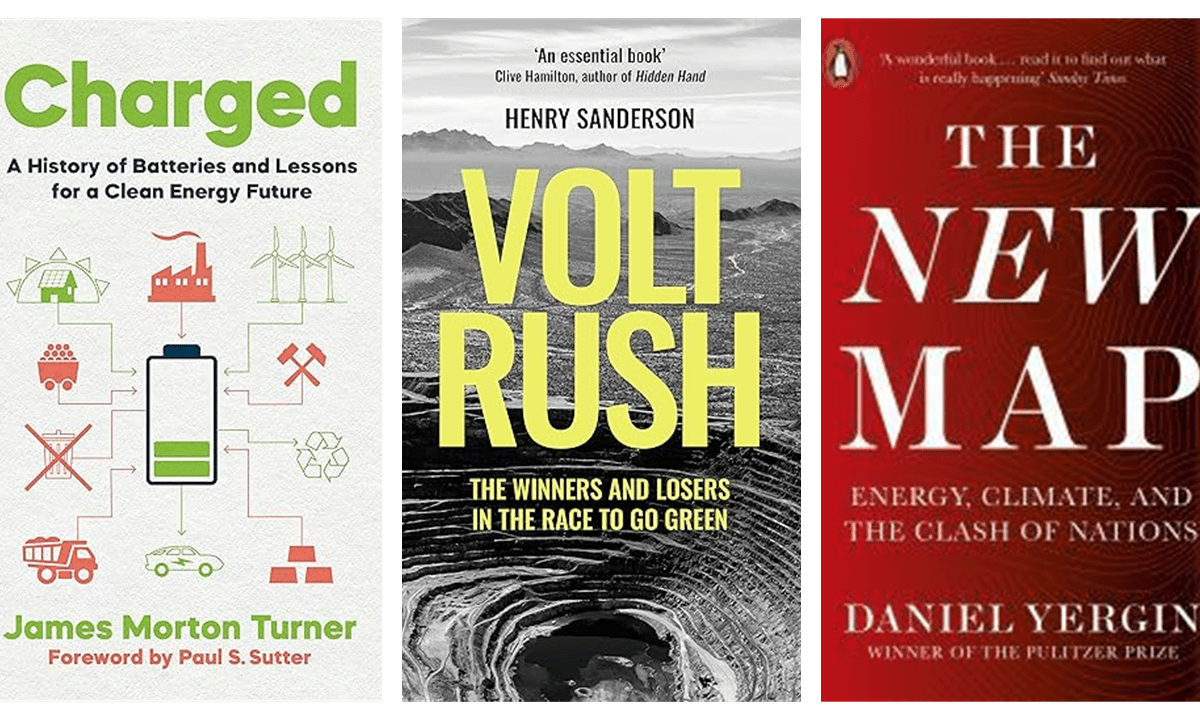
1. Charged – A History of Batteries and Lessons for a Clean Energy Future by James Morton Turner (2022)
Summary
Charged by James Morton Turner explores the history of batteries and their importance in modern society. Turner explains that batteries are not only scientific inventions but also political and environmental tools that shape economies and daily life.
The book follows the development of batteries from early experiments in electricity to today’s lithium-ion technology. It describes how scientists and engineers worked to improve energy storage so that devices could become smaller, lighter, and more powerful. Turner also explains the growing demand for rechargeable batteries in mobile phones, laptops, and especially electric vehicles.
A major theme of the book is the environmental cost of battery production. Mining for battery materials can damage ecosystems and create social problems in poorer countries. He also discusses recycling and the need for better systems to reuse battery materials in the future.
Overall, Charged helps readers understand that batteries are essential for the transition to renewable energy, but they also bring difficult challenges. The book encourages a balanced view: batteries can support a greener future, but only if they are developed and managed responsibly.
Why I liked it
Charged is highly readable and does more than simply focus on lithium-ion batteries. Instead, it guides the reader through a range of battery technologies, from lead-acid batteries to smaller portable types such as nickel-cadmium and nickel–metal hydride, before arriving at lithium-ion batteries and the rise of electric vehicles.
Particular attention is given to the recycling of each battery technology. The recycling of lead-acid batteries is presented as a success story, while the challenges associated with recycling and disposing of other battery types are clearly highlighted. It is evident that establishing an effective system for recycling lithium-ion batteries will be crucial going forward.
The book explores the technology, industrialisation, and impact of various battery types, making it an excellent introduction for those new to the field who wish to learn more. At the same time, it offers valuable insights even for those with more experience. This is largely because the author, Turner, is a historian who places batteries in a broader context, illustrating their significant influence over time. For instance, he explains how the first commercially produced batteries enabled early telephone and telegraph systems. In addition, the book examines the human and environmental costs associated with the production and recycling of lead-acid batteries.
Generally, this book is an excellent choice for battery beginners as well as old foxes in the field.
E-Books (Sweden): https://www.adlibris.com/sv/bok/charged-9780295750262
Amazon: https://www.amazon.com/Charged-History-Batteries-Weyerhaeuser-Environmental/dp/0295750243
2. Volt Rush – The Winners and Losers in the Race to Go Green by Henry Sanderson (2022)
Summary
Volt Rush by Henry Sanderson discusses the global race to secure the materials needed for batteries and electric vehicles. The book focuses on lithium, cobalt, nickel, and other critical minerals that are essential for the transition to clean energy. Sanderson explains how the rapid growth of electric cars and renewable energy systems has created intense competition between companies and countries.
A major theme of the book is China’s dominant position in the battery supply chain. Sanderson describes how Chinese companies invested early in mining, battery production, and electric vehicle technology, giving China a strong advantage over Western countries by securing the entire supply chain. He also explores the role of major car manufacturers and technology companies that are competing for access to raw materials.
The book highlights the environmental and ethical challenges connected to mining, especially in countries such as the Democratic Republic of Congo, where cobalt production has raised concerns about pollution and labour conditions. Sanderson argues that the clean energy transition depends not only on technology but also on stable and responsible supply chains.
Generally, Volt Rush provides a clear overview of the political, economic, and environmental issues behind the battery industry. It shows that the future of clean energy will depend heavily on access to critical minerals and global cooperation in managing these resources responsiblyTop of Form.Bottom of Form
Why I liked it
Volt Rush can make for a brutally honest read. Like Charged, it is very well written, with each chapter opening by recounting a key moment in the battery industry and its value chain—particularly the mining and procurement of the raw materials required for battery production.
One episode that stands out is Volkswagen’s 2017 invitation to cobalt traders to its headquarters in Wolfsburg. The company appeared to assume that suppliers would be eager—if not desperate—to sell cobalt simply because the buyer was Volkswagen. The episode starkly exposes the arrogance the company displayed at the time (an attitude that was likely shared by other legacy car manufacturers). Unsurprisingly, none of the traders agreed to supply Volkswagen.
This kind of unflinching account recurs throughout the book. While often shocking, it helps to explain how we arrived at the current situation, in which Western OEMs are largely dependent on Chinese companies for much—if not all—of their battery supply chain.
The book focuses primarily on the procurement of raw materials, examining in particular the challenges of securing nickel and cobalt. However, it also explores other parts of the supply chain.
Published in 2022, the book can at times feel somewhat dated. For instance, one might argue that the emphasis on nickel and cobalt is no longer quite as dominant an issue due to the rise of LFP (lithium iron phosphate) cathode chemistry. It also includes a chapter on Northvolt as the great hope of Europe’s battery industry—an assessment that, needless to say, has not aged especially well.
Nevertheless, the book remains highly readable and comes warmly recommended for anyone interested in understanding the global battery supply chain.
Ad libris (Sweden): https://www.adlibris.com/sv-FI/bok/volt-rush-9780861543755
Amazon: https://www.amazon.se/-/en/Henry-Sanderson/dp/0861543750
3. The New Map – Energy, Climate and the Clash of Nations by Daniel Yergin (2020)
Summary
The New Map by Daniel Yergin investigates how energy, politics, and technology are reshaping the modern world. The book explains how oil and natural gas continue to influence global power, while renewable energy and climate policies are creating major changes in international relations and economies as the world is slowly shifting towards an electrified future. Yergin shows that energy is not only about fuel, but also about security, trade, and political influence.
A large part of the book focuses on the changing balance of power between countries such as the United States, China, Russia, and nations in the Middle East. Yergin describes how the American shale revolution reduced US dependence on imported oil and changed global energy markets. He also examines China’s growing demand for energy and its investment in renewable technologies and electric vehicles.
The book also discusses the global transition towards cleaner energy. Yergin explains both the opportunities and the challenges of moving away from fossil fuels. He argues that the transition will take time because modern economies still depend heavily on oil and gas for transport, industry, and electricity production for some time to come.
In summary, The New Map provides a clear and balanced explanation of how energy shapes the modern world. It combines history, economics, and geopolitics to help readers understand the complex relationship between energy and global power in the twenty-first century.
Why I liked it
Unlike the first two books, The New Map is a somewhat slower read, but it is nonetheless highly informative.
Rather than focusing solely on battery technology and its impact, the book takes a broader view of energy, encompassing oil and gas as well. For instance, it examines the effects of the oil crises of the 1970s alongside the shale gas revolution in the United States. One of the book’s key strengths lies in the way it draws on such historical events to illuminate the present, skilfully weaving together the interdependencies between nations shaped by energy.
Yergin acknowledges that we are in the midst of a major transition away from fossil-based energy sources towards electrification. He also emphasises that the pace of this shift will depend on a range of factors, including government support and policy decisions. Written in 2020, the book predates both Russia’s invasion of Ukraine—which led to Western sanctions on Russian oil and gas—and the conflict between the United States, Israel, and Iran, along with its repercussions for the global oil market. It would have been fascinating to see how the author might have interpreted these developments.
What stands out most is the way the book sheds light on the broader economic and political context of energy, as well as the global connections and interdependencies that underpin the transition to an electrified future.
Ad libris (Sweden): https://www.adlibris.com/sv/bok/new-map-9780141994635

