Three Battery Books You Should Read

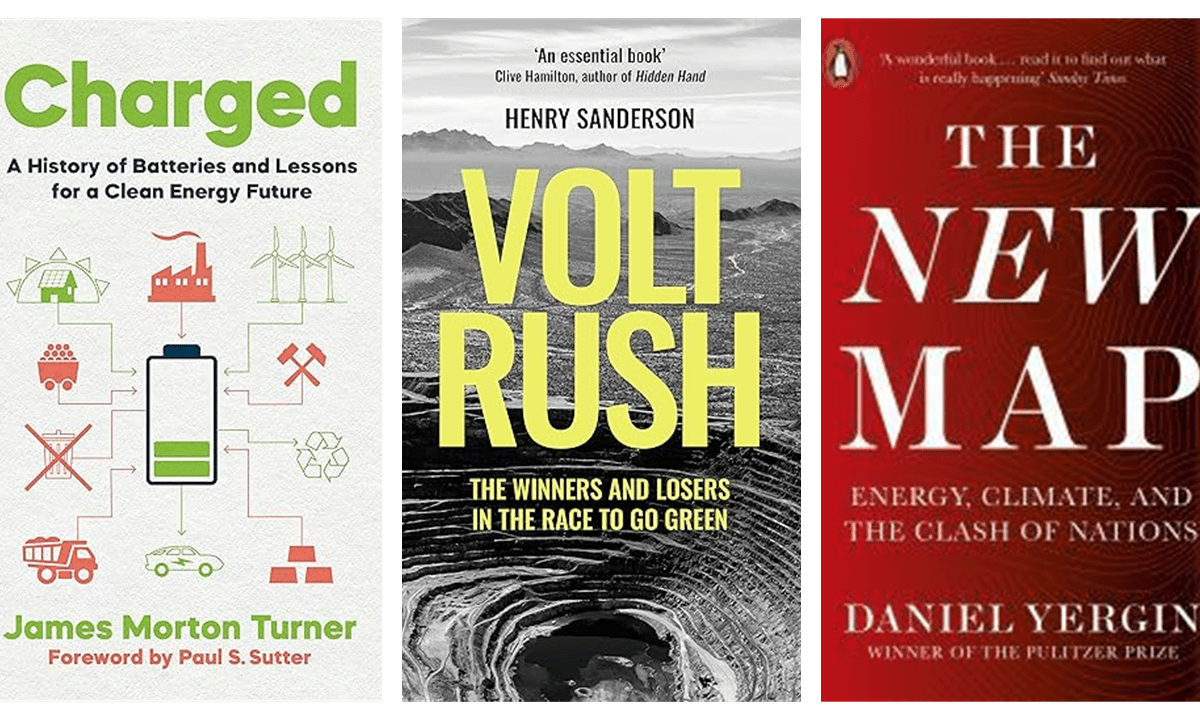
1.  Charged – A History of Batteries and Lessons for a Clean Energy Future by James Morton Turner (2022)

Summary

Charged by James Morton Turner explores the history of batteries and their importance in modern society. Turner explains that batteries are not only scientific inventions but also political and environmental tools that shape economies and daily life.

The book follows the development of batteries from early experiments in electricity to today’s lithium-ion technology. It describes how scientists and engineers worked to improve energy storage so that devices could become smaller, lighter, and more powerful. Turner also explains the growing demand for rechargeable batteries in mobile phones, laptops, and especially electric vehicles.

A major theme of the book is the environmental cost of battery production. Mining for battery materials can damage ecosystems and create social problems in poorer countries. He also discusses recycling and the need for better systems to reuse battery materials in the future.

Overall, Charged helps readers understand that batteries are essential for the transition to renewable energy, but they also bring difficult challenges. The book encourages a balanced view: batteries can support a greener future, but only if they are developed and managed responsibly.

Why I liked it

Charged is highly readable and does more than simply focus on lithium-ion batteries. Instead, it guides the reader through a range of battery technologies, from lead-acid batteries to smaller portable types such as nickel-cadmium and nickel–metal hydride, before arriving at lithium-ion batteries and the rise of electric vehicles.

Particular attention is given to the recycling of each battery technology. The recycling of lead-acid batteries is presented as a success story, while the challenges associated with recycling and disposing of other battery types are clearly highlighted. It is evident that establishing an effective system for recycling lithium-ion batteries will be crucial going forward.

The book explores the technology, industrialisation, and impact of various battery types, making it an excellent introduction for those new to the field who wish to learn more. At the same time, it offers valuable insights even for those with more experience. This is largely because the author, Turner, is a historian who places batteries in a broader context, illustrating their significant influence over time. For instance, he explains how the first commercially produced batteries enabled early telephone and telegraph systems. In addition, the book examines the human and environmental costs associated with the production and recycling of lead-acid batteries.

Generally, this book is an excellent choice for battery beginners as well as old foxes in the field.

E-Books (Sweden): https://www.adlibris.com/sv/bok/charged-9780295750262

Amazon: https://www.amazon.com/Charged-History-Batteries-Weyerhaeuser-Environmental/dp/0295750243

2.  Volt Rush – The Winners and Losers in the Race to Go Green by Henry Sanderson (2022)

Summary

Volt Rush by Henry Sanderson discusses the global race to secure the materials needed for batteries and electric vehicles. The book focuses on lithium, cobalt, nickel, and other critical minerals that are essential for the transition to clean energy. Sanderson explains how the rapid growth of electric cars and renewable energy systems has created intense competition between companies and countries.

A major theme of the book is China’s dominant position in the battery supply chain. Sanderson describes how Chinese companies invested early in mining, battery production, and electric vehicle technology, giving China a strong advantage over Western countries by securing the entire supply chain. He also explores the role of major car manufacturers and technology companies that are competing for access to raw materials.

The book highlights the environmental and ethical challenges connected to mining, especially in countries such as the Democratic Republic of Congo, where cobalt production has raised concerns about pollution and labour conditions. Sanderson argues that the clean energy transition depends not only on technology but also on stable and responsible supply chains.

Generally, Volt Rush provides a clear overview of the political, economic, and environmental issues behind the battery industry. It shows that the future of clean energy will depend heavily on access to critical minerals and global cooperation in managing these resources responsiblyTop of Form.Bottom of Form

Why I liked it

Volt Rush can make for a brutally honest read. Like Charged, it is very well written, with each chapter opening by recounting a key moment in the battery industry and its value chain—particularly the mining and procurement of the raw materials required for battery production.

One episode that stands out is Volkswagen’s 2017 invitation to cobalt traders to its headquarters in Wolfsburg. The company appeared to assume that suppliers would be eager—if not desperate—to sell cobalt simply because the buyer was Volkswagen. The episode starkly exposes the arrogance the company displayed at the time (an attitude that was likely shared by other legacy car manufacturers). Unsurprisingly, none of the traders agreed to supply Volkswagen.

This kind of unflinching account recurs throughout the book. While often shocking, it helps to explain how we arrived at the current situation, in which Western OEMs are largely dependent on Chinese companies for much—if not all—of their battery supply chain.

The book focuses primarily on the procurement of raw materials, examining in particular the challenges of securing nickel and cobalt. However, it also explores other parts of the supply chain.

Published in 2022, the book can at times feel somewhat dated. For instance, one might argue that the emphasis on nickel and cobalt is no longer quite as dominant an issue due to the rise of LFP (lithium iron phosphate) cathode chemistry. It also includes a chapter on Northvolt as the great hope of Europe’s battery industry—an assessment that, needless to say, has not aged especially well.

Nevertheless, the book remains highly readable and comes warmly recommended for anyone interested in understanding the global battery supply chain.

Ad libris (Sweden): https://www.adlibris.com/sv-FI/bok/volt-rush-9780861543755

Amazon: https://www.amazon.se/-/en/Henry-Sanderson/dp/0861543750

3.  The New Map – Energy, Climate and the Clash of Nations by Daniel Yergin (2020)

Summary

The New Map by Daniel Yergin investigates how energy, politics, and technology are reshaping the modern world. The book explains how oil and natural gas continue to influence global power, while renewable energy and climate policies are creating major changes in international relations and economies as the world is slowly shifting towards an electrified future. Yergin shows that energy is not only about fuel, but also about security, trade, and political influence.

A large part of the book focuses on the changing balance of power between countries such as the United States, China, Russia, and nations in the Middle East. Yergin describes how the American shale revolution reduced US dependence on imported oil and changed global energy markets. He also examines China’s growing demand for energy and its investment in renewable technologies and electric vehicles.

The book also discusses the global transition towards cleaner energy. Yergin explains both the opportunities and the challenges of moving away from fossil fuels. He argues that the transition will take time because modern economies still depend heavily on oil and gas for transport, industry, and electricity production for some time to come.

In summary, The New Map provides a clear and balanced explanation of how energy shapes the modern world. It combines history, economics, and geopolitics to help readers understand the complex relationship between energy and global power in the twenty-first century.

Why I liked it

Unlike the first two books, The New Map is a somewhat slower read, but it is nonetheless highly informative.

Rather than focusing solely on battery technology and its impact, the book takes a broader view of energy, encompassing oil and gas as well. For instance, it examines the effects of the oil crises of the 1970s alongside the shale gas revolution in the United States. One of the book’s key strengths lies in the way it draws on such historical events to illuminate the present, skilfully weaving together the interdependencies between nations shaped by energy.

Yergin acknowledges that we are in the midst of a major transition away from fossil-based energy sources towards electrification. He also emphasises that the pace of this shift will depend on a range of factors, including government support and policy decisions. Written in 2020, the book predates both Russia’s invasion of Ukraine—which led to Western sanctions on Russian oil and gas—and the conflict between the United States, Israel, and Iran, along with its repercussions for the global oil market. It would have been fascinating to see how the author might have interpreted these developments.

What stands out most is the way the book sheds light on the broader economic and political context of energy, as well as the global connections and interdependencies that underpin the transition to an electrified future.

Ad libris (Sweden): https://www.adlibris.com/sv/bok/new-map-9780141994635

Amazon: https://www.amazon.com/The-New-Map/dp/0241472342

How to Make an Air Pressure Bottle Rocket

You will need:

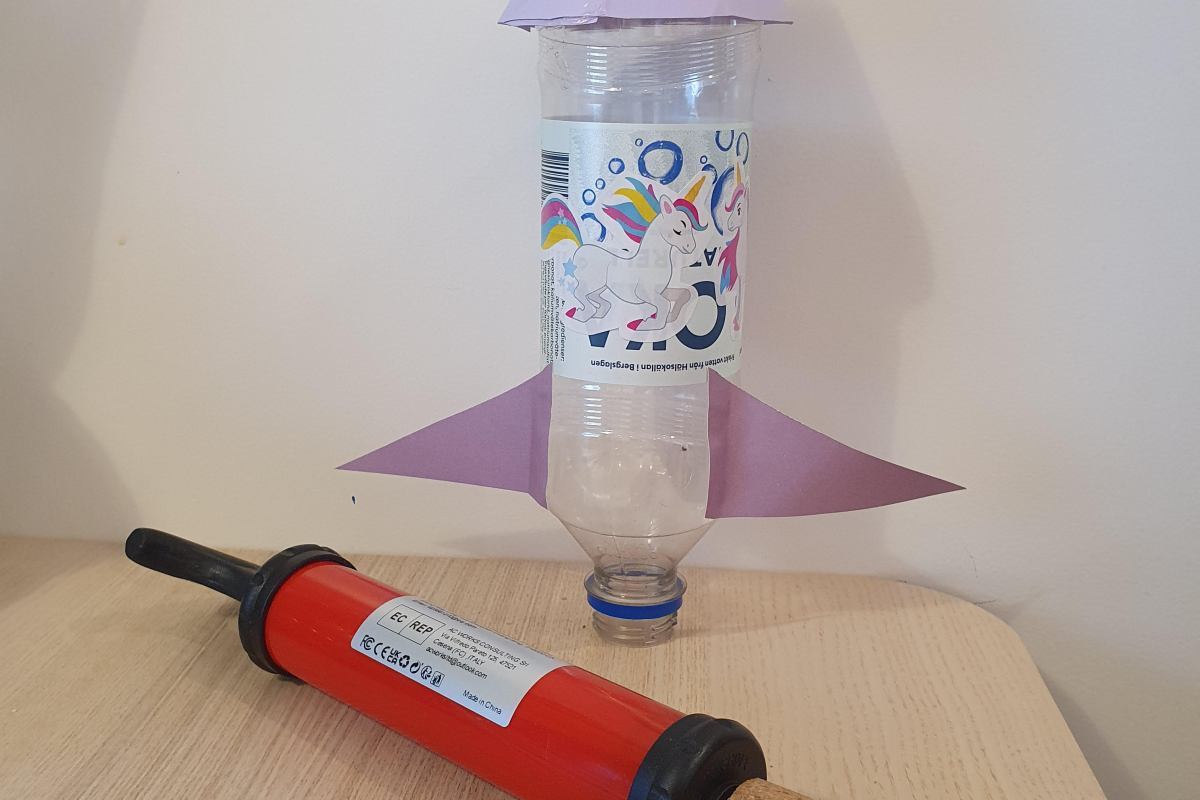
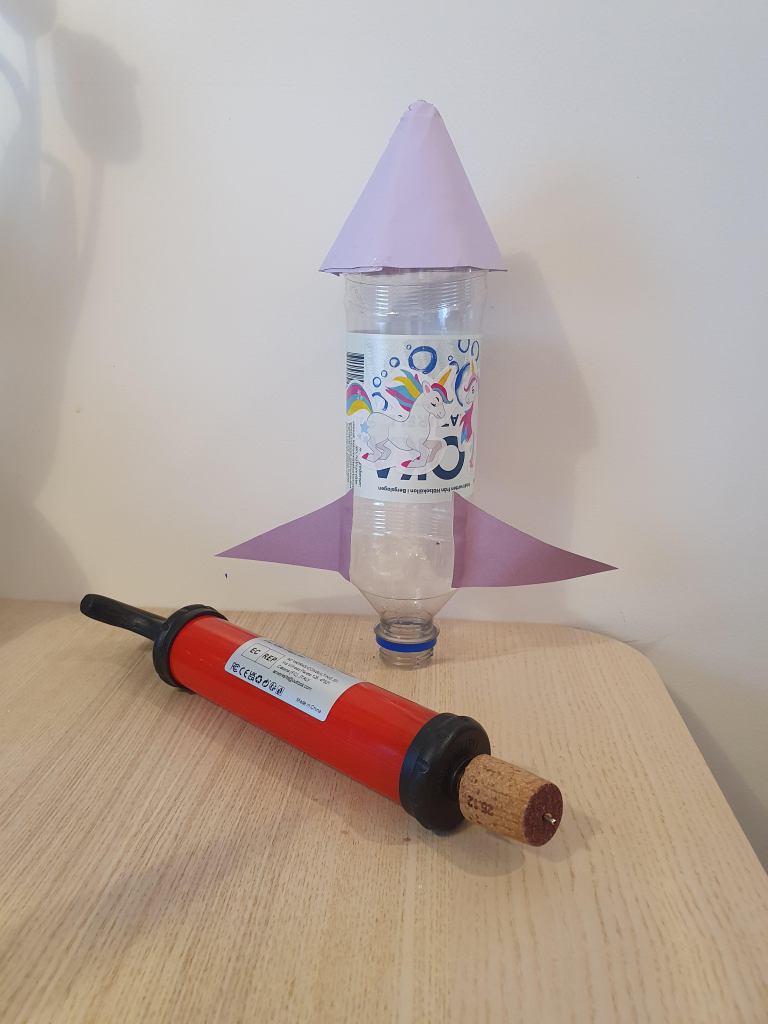
  • 1 Empty plastic bottle (We found that smaller bottles like 500 ml work better than bigger ones.)
  • 1 Cork that fits tightly in the bottle
  • 1 Ball pump with a needle
  • Paper or cardboard for nose cone and fins
  • Scissors
  • Universal glue or tape for the fins and nose cone
  • Tiny screwdriver or similar tool to make a hole in the cork for the ball pump
  • Stickers or acrylic paint and paint brushes for decorating

Step 1: Build the Rocket

Turn the bottle upside down.
The bottle neck will be the bottom of the rocket.

Decorate the bottle with stickers or paint it with acrylic paint. If you use paint, wait for it to dry.

Cut the nose cone and fins from paper or cardboard. (We found that cardboard gives a more stable cone and fins.)

Glue or tape paper fins and a paper nose cone onto the bottle. Ask an adult for help if using universal glue.

Step 2: Put in the Cork

Select a cork that will fit tightly into the hole of the bottle.

Ask an adult to drill a small hole through the middle of the cork with a tiny screwdriver or a similar tool to fit the needle of the ball pump.

Push the cork tightly into the bottle opening. You can wrap it in tape to fit better if it is too small.

Step 3: Pump Air Into the Bottle

Take the rocket outside.

Place the needle of the ball pump through the hole prepared for it. It should fit quite tightly.

Point the bottle away from you and hold ONLY onto the ball pump or the cork outside the bottle. (Do NOT hold onto the bottle itself!)

Start pumping with the ball pump. You may need an adult to help with this (because it can require a lot of strength to pump the bottle completely full of air).

Step 4: Blast Off!

As more air goes inside, the pressure gets stronger.

Finally, the cork pops out and the rocket shoots away!

Why Does It Fly?

The pump pushes air into the bottle.
The air pressure builds up inside.
When the cork pops out, the fast-moving air pushes the rocket away.

The fast-moving air is an action which causes a reaction which is the rocket moving away.

This concept of action and reaction is also called Newton’s 3rd Law of Motion. This effect is also used by real rockets when they push of the ground. The main difference is that real space rockets use very strong fuels (hydrogen and oxygen) to create even more pressure and fast-moving gasses for the action part.

Safety Tips

  • Always launch outside.
  • Never point the rocket at yourself, other people or animals.
  • Always bring an adult to assist in your launch.
  • Ask an adult to help with universal glue and to make the tiny hole into the cork.

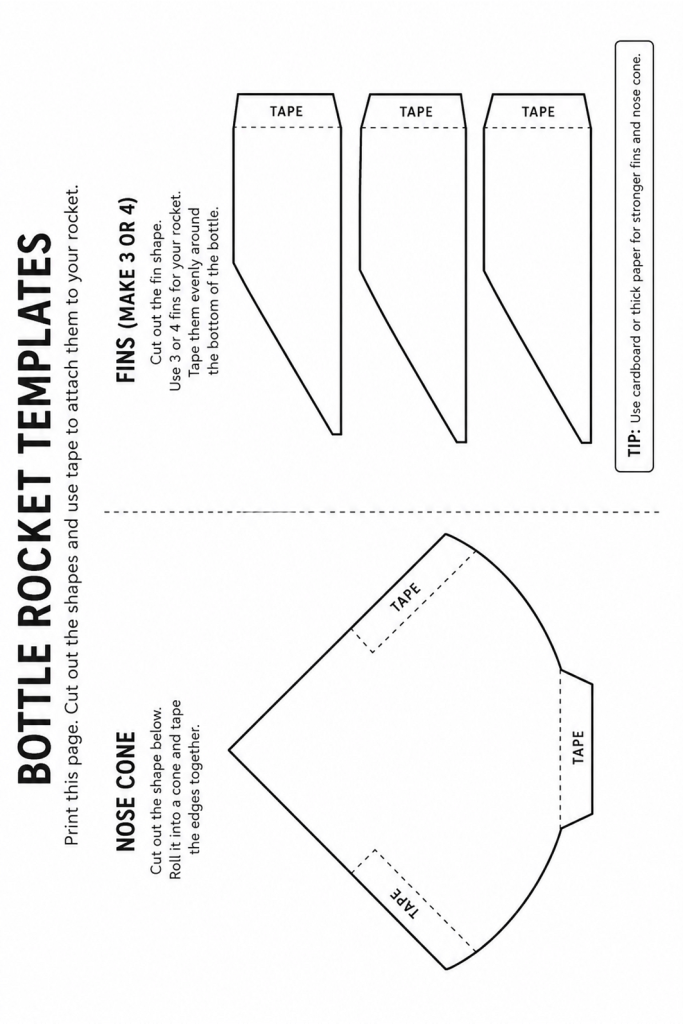
Template for fins and nose cone

Wildlife Feeding Traces: What to Look For

When taking a walk in the forest in early spring you can find many feeding traces of different animals. Join us in exploring some of them.

1 Traces left on trees

Deer, rabbits and hares all feast on the bark of trees during the winter months when grass and other plants do not grow well. But they leave different clues on trees that help us tell them apart.

Deer are quite tall, so they can reach higher parts of a tree. When deer eat, they often tear the bark with their mouths. This can leave rough, jagged edges on the tree. You might also see damage higher up, about as tall as your chest or even above your head. In addition, roe deer and red deer normally pull of strips of bark, while fallow deer are more content to nibble.

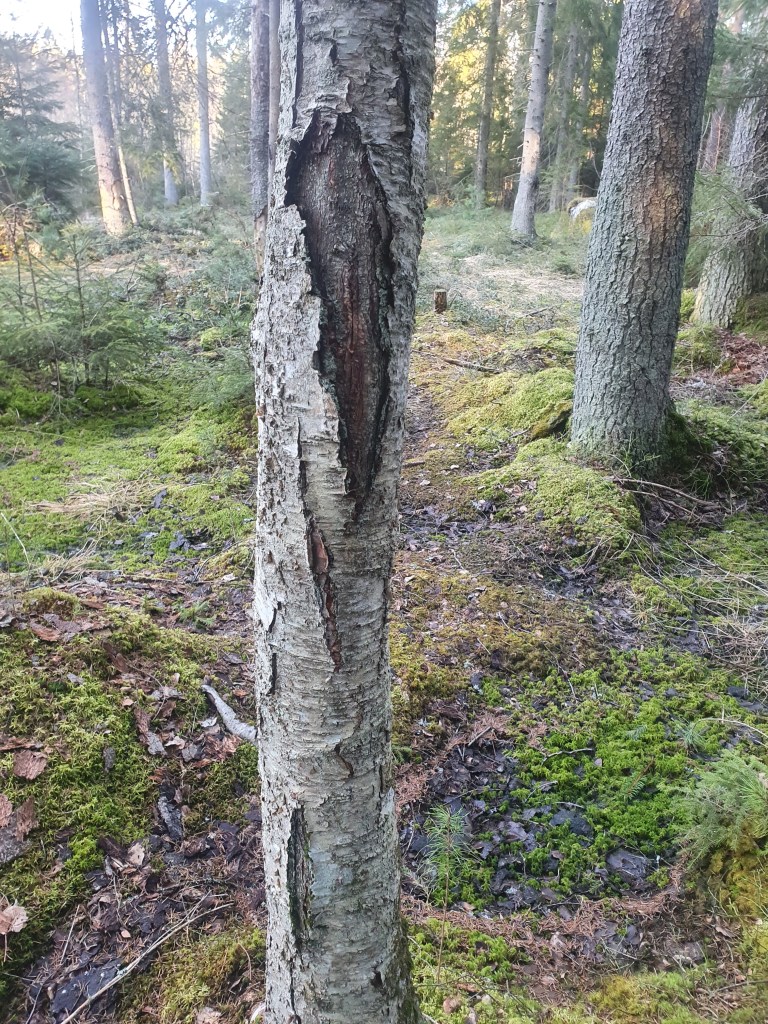
The image below shows a tree which had some of its bark most likely stripped of by a roe deer during winter. The dark colour shows that the tree has begun to heal in this part.

Rabbits and hares are much smaller than deer, so they can only reach low parts of a tree. They have very sharp front teeth, and they nibble neatly. This means the bark or twigs they eat often look cleanly cut, almost like they were snipped with tiny scissors. The damage is usually close to the ground.

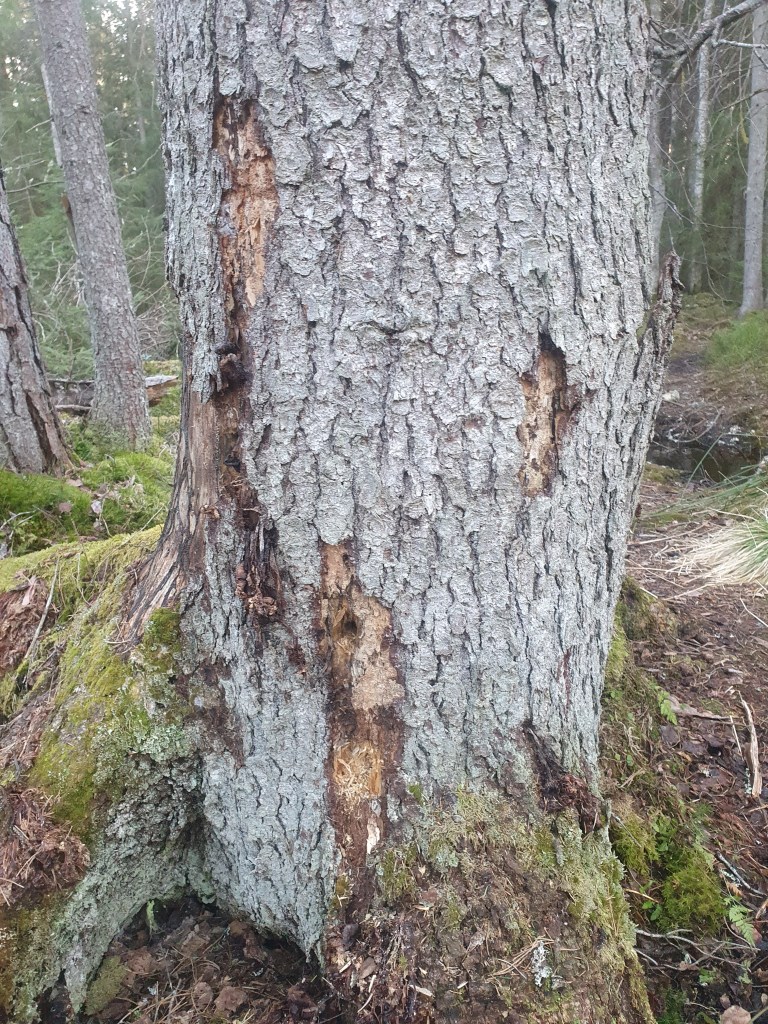
This image shows the damage in the bark close to the ground which means that it may have been eaten by a rabbit or hare.

In summary, if the tree is damaged high up with rough edges, it was likely a deer. If the damage is low down with neat, tidy bites, it was probably a rabbit or a hare.

2 Traces left by wild boar

Wild boar leave very noticeable signs when they search for food in the forest.

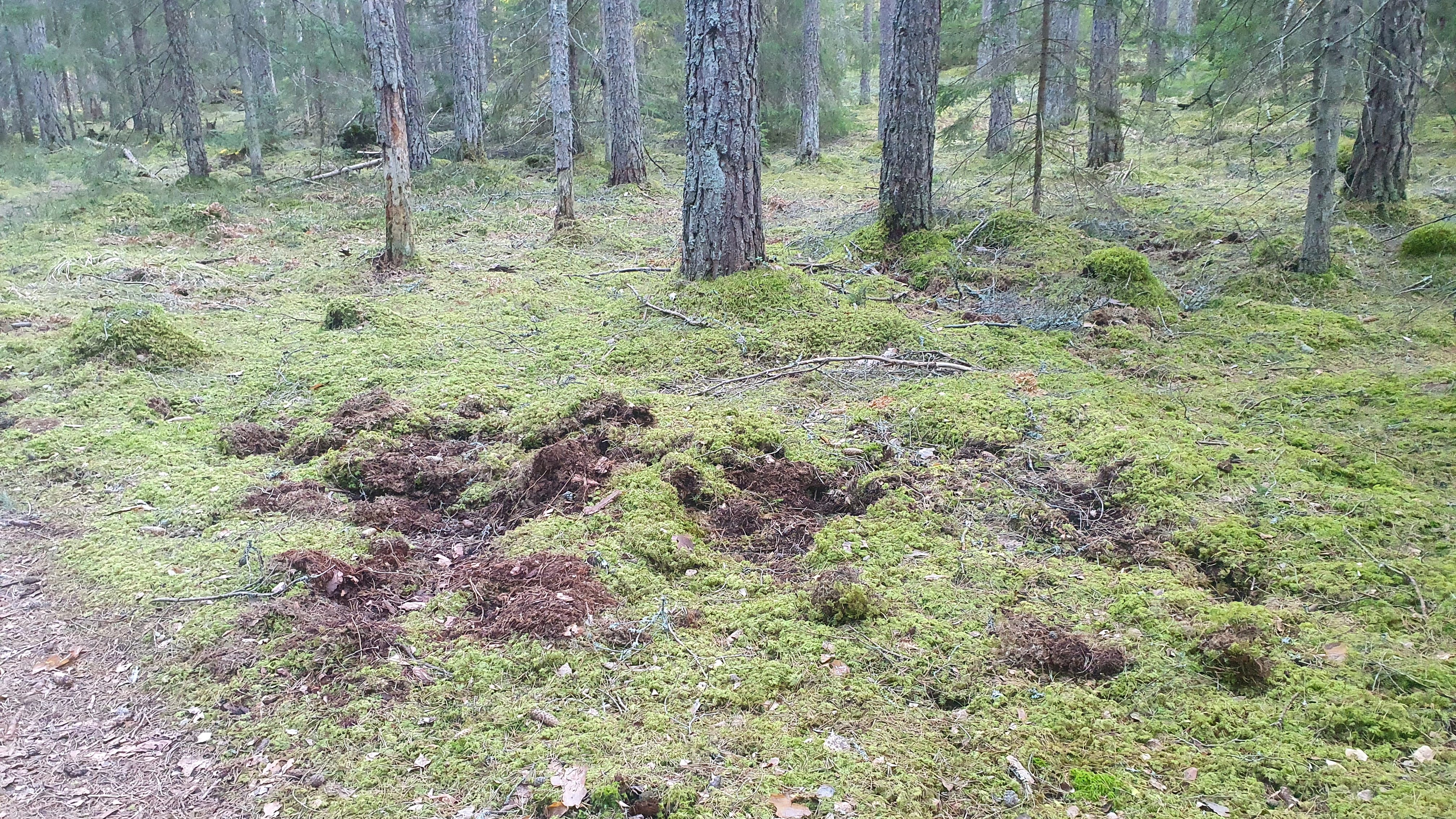
They use their strong snouts to dig in the ground. This is called “rooting.” When they do this, they turn over the soil looking for roots, insects, worms, and bulbs. The ground can look messy, with patches of earth all churned up, almost like it has been ploughed.

You might also see small holes and uneven ground where they have been digging. Sometimes large areas are disturbed, not just one spot.

Wild boar can also leave footprints. Their tracks look a bit like a deer’s, but they are rounder and wider. If the ground is soft, you may see many of these prints together.

So, if you see torn-up soil, lots of digging marks, and hoof prints in the forest, a wild boar has probably been there looking for food.

The image below shows a small area in a forest where wild boar have rooted for food.

3 Traces left on gnawed cones

In the forest, you can often find eaten spruce cones on the ground. By looking closely, you can tell which animal has been feeding on them.

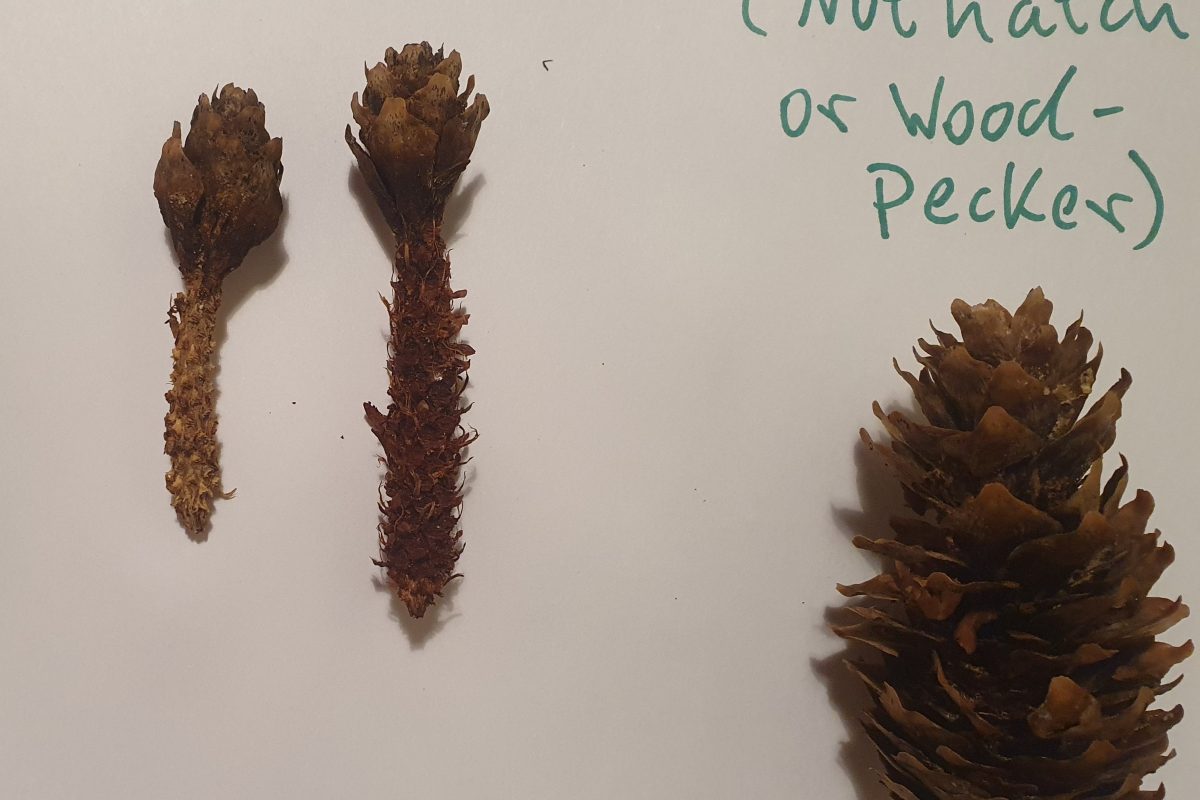
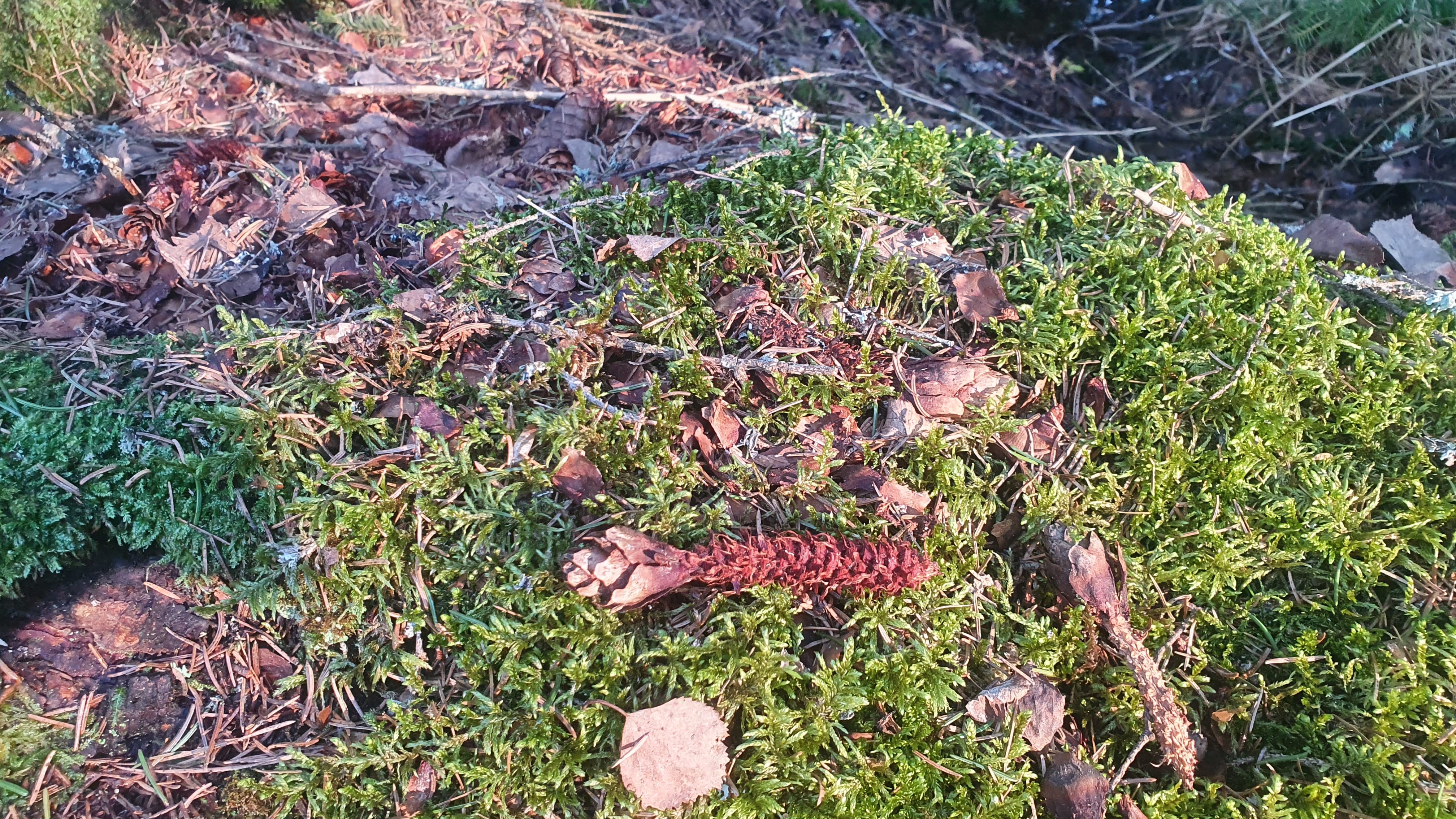
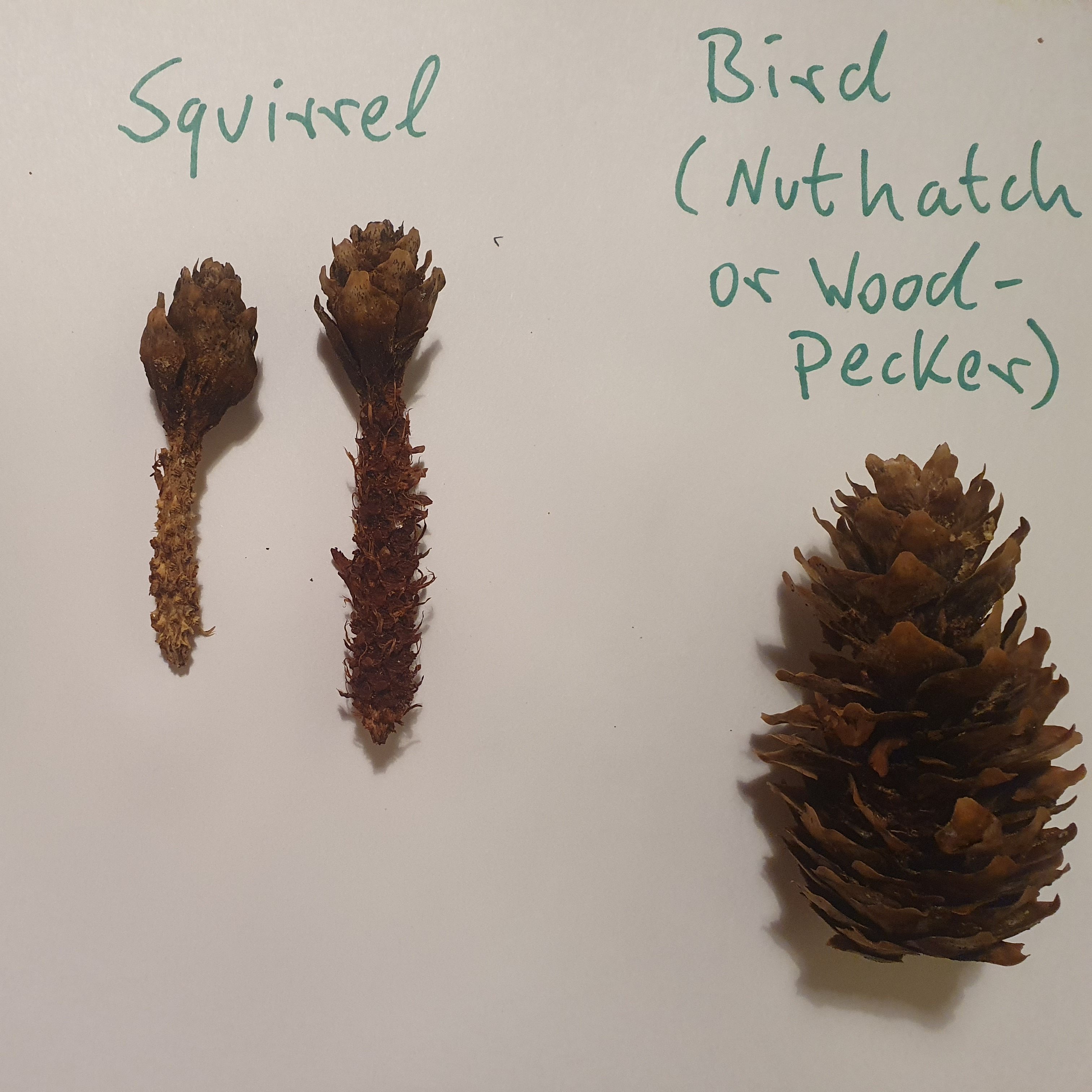
A squirrel leaves quite a tidy cone behind. It holds the cone and nibbles off the scales one by one. When it is finished, mostly the middle part, called the core, is left. Squirrels normally leave some scales at the tip of the cone where they have been holding it. The image below shows a cone left by a squirrel under a tree. You can even see some scales around it on the ground.

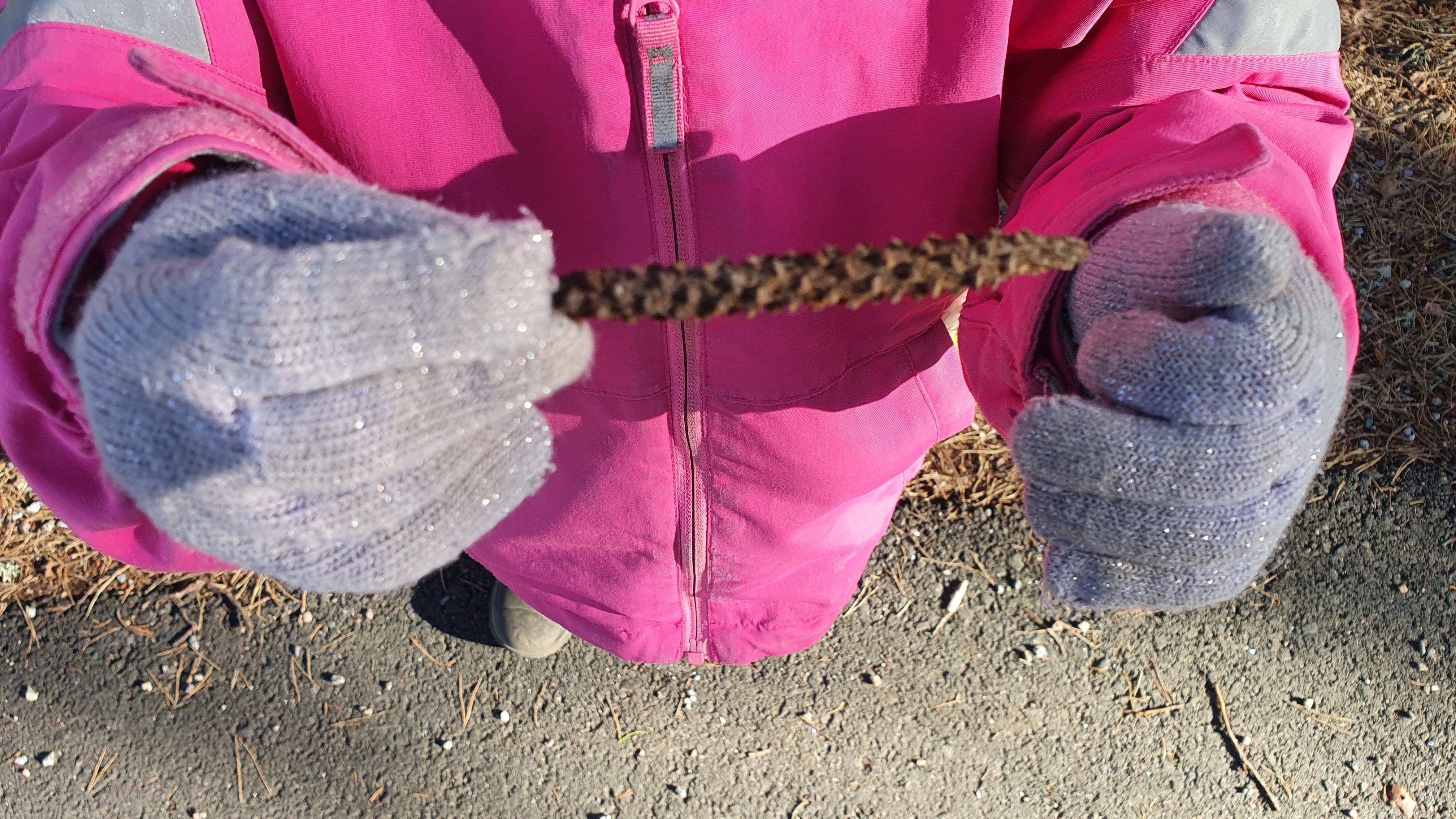
A wood mouse eats in a different way. It strips the cone of every last scale and only the clean core is left, which may almost just look like a stick which can be seen in the image below.

Birds like woodpeckers and nuthatches have a special way of eating cones. They often wedge the cone into a crack in the bark of a tree to hold it still. Then they peck at it to get the seeds out. The cone may look pecked and broken, with rough marks. Sometimes you can even find the place in the tree where the cone was held, called a “cone anvil.”

So, a clean, stripped core is likely from a wood mouse, a cone with scales left at the top from a squirrel and a pecked cone, often near a tree crack, from a bird like a woodpecker or nuthatch.

Make your own rain gauge

Have you ever wondered how much rain falls from the sky? Scientists use a tool called a rain gauge to measure rain. You can make your own at home or at school. It is simple and fun.

What you need

  • An empty, clear plastic bottle
  • A pair of scissors
  • A ruler
  • Sticky tape
  • A waterproof marker pen

What to do

  1. Cut the bottle.
    Ask an adult to help you cut the top part off the plastic bottle.
  2. Mark the ruler lines.
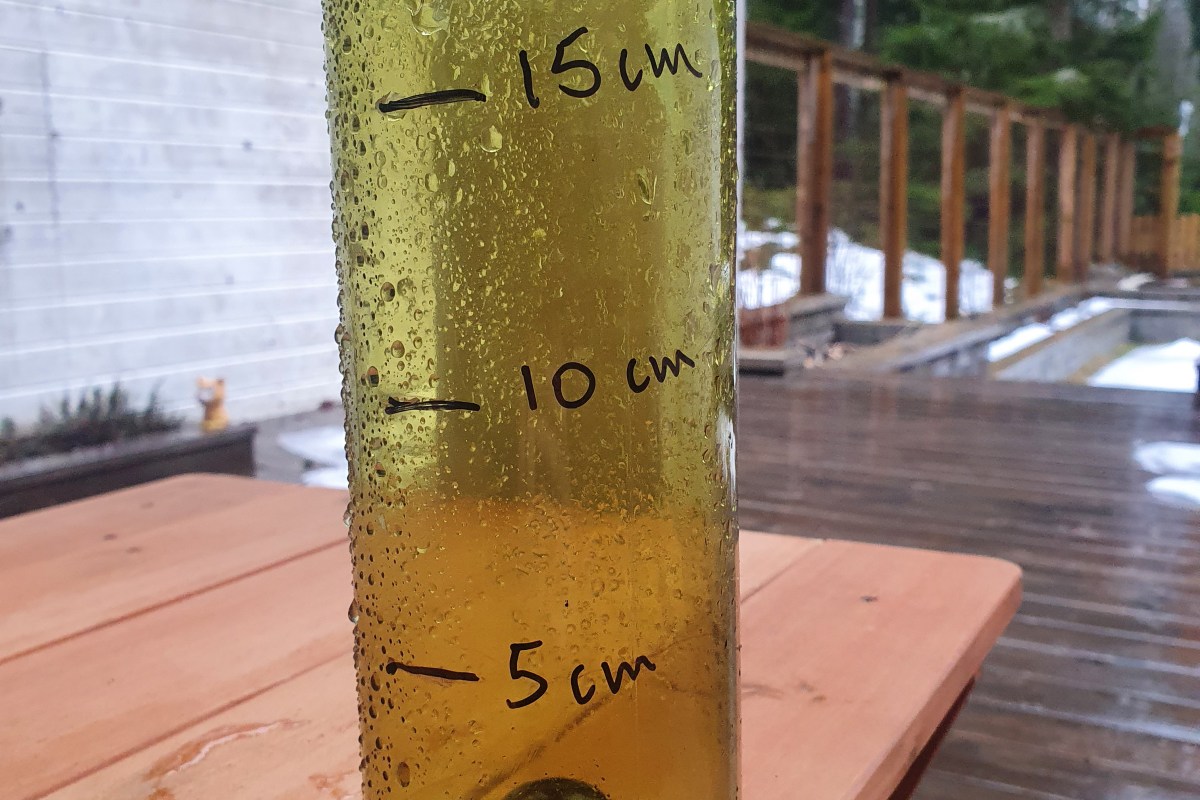
    Use the ruler and marker pen to draw lines up the side of the bottle. These lines will help you measure the rain.
  3. Optional: Turn the top upside down.
    Place the cut top of the bottle upside down like a funnel. Use sticky tape to hold it in place.
  4. Tape the edges of the bottle. Place sticky tape around the edge at the top of the bottle. This is done because the edge is quite sharp to avoid cutting yourself.

How to use your rain gauge

  • Put your rain gauge outside in an open space.
  • Make sure it is not under a tree or roof.
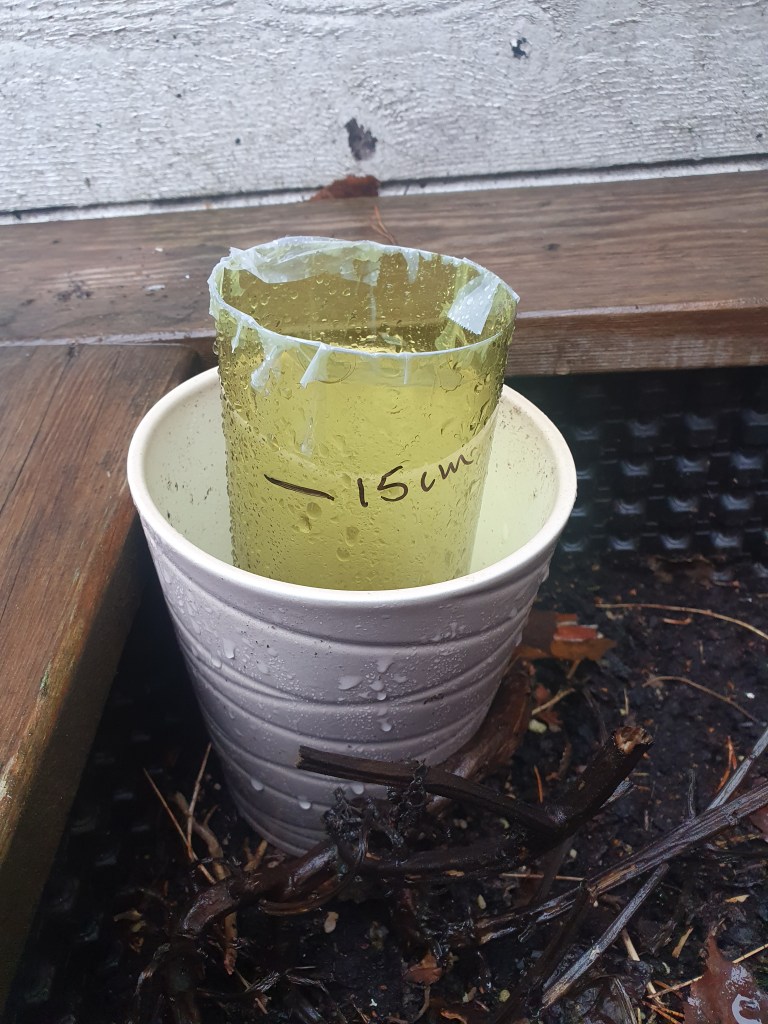
  • Make sure that the rain gauge cannot easily be blown away by the wind, e.g. place it inside a flowerpot or dig a small whole where you can place the rain gauge. See image below for an example.
  • After it rains, look at the water level.
  • Use the ruler marks to see how much rain has fallen.

Why this is interesting

Measuring rain helps us learn about the weather and how it changes. Farmers, gardeners, and scientists all use rain gauges to understand weather and climate change better.

You can check your rain gauge every day and keep a weather diary. This turns you into a real scientist!

Example table for a weatehr diary

Day of the WeekType of WeatherAmount of Rainfall
Monday
Tuesday
Wednesday
Thursday
Friday
Saturday
Sunday