
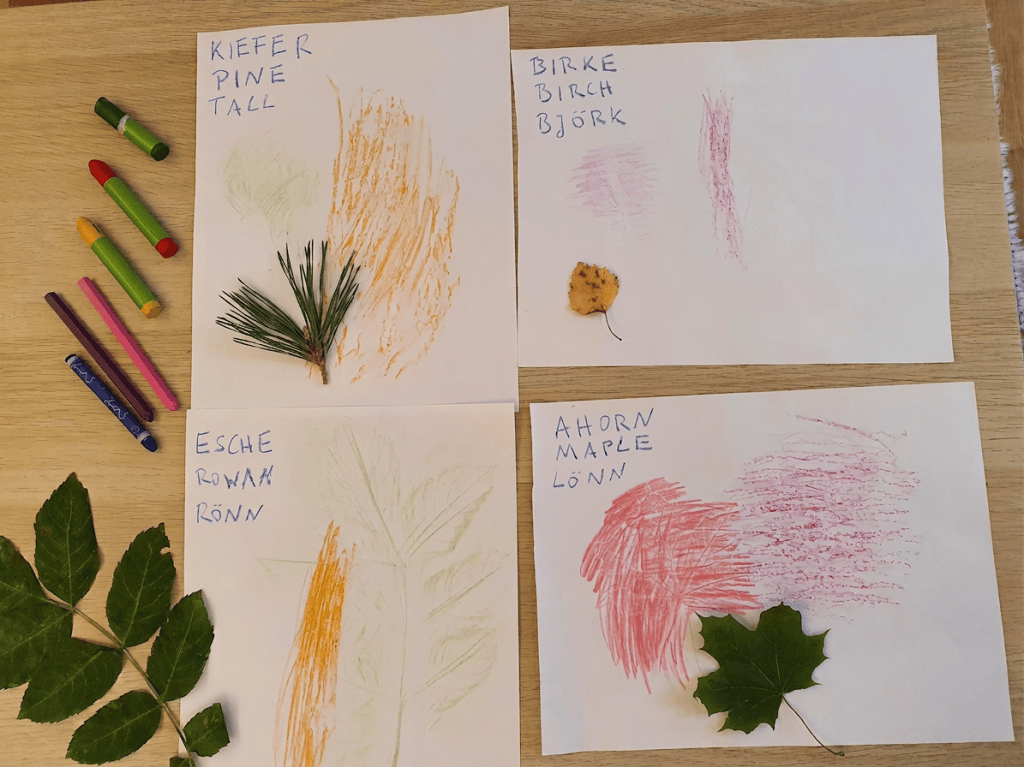
Collecting and pressing leaves from different trees is a popular autumn activity. It is a great way to help children learn about different types of trees. This activity takes the idea one step further by encouraging children to explore and compare the bark of different trees too.
Here is what you need:
- Wax crayons
- White paper
- Tape
- A few different types of trees to investigate in a nearby forest or park
What to do:
- Find an area with between three and six different types of trees to explore.
- Choose one tree to investigate first.
- Look closely at the tree’s bark. Is it smooth or rough? Does it have lots of cracks? Older children can write down what they notice.
- Hold a piece of paper firmly against the tree trunk with one hand. Use a wax crayon to colour over the paper and make a rubbing of the bark. Leave enough empty space on the paper to make a rubbing of a leaf later. It may be easier to work in pairs. One child can hold the paper against the tree while the other makes the rubbing.
- Write the name of the tree on your bark rubbing.
- Find a leaf from the same tree. Look carefully at it. What shape is it? What colour is it? Older children can write down what they notice.
- Keep the leaf safely with its bark rubbing so that you do not mix it up with leaves from other trees.
- Move on to the next tree. Make sure it is a different type of tree from the one you have just investigated. (My preschooler and I explored four different types of trees before they lost interest, but older children may enjoy investigating more.)
- Take your bark rubbings and collected leaves home with you.
- Once you are back inside, take out your bark rubbings and leaves.
- For each tree, place the leaf underneath the empty space you left on the paper.
- Use a wax crayon to make a rubbing of the leaf next to the bark rubbing.
- If you still have some empty space on the paper, you can use tape to attach the real leaf as well.
- Older children can compare the different types of trees they have investigated. They could share their notes and use them to complete a comparison table.
What can children learn?
I also used this activity to talk to my preschooler about the job that tree bark does. Bark protects a tree, a little like our skin protects our bodies.
We also talked about how different the bark of each type of tree can look. For example, the rowan tree had very smooth bark that almost looked like our skin. The pine tree, on the other hand, had much rougher bark with deep cracks.
My preschooler had already learned a lot about the different shapes of leaves, so I used this activity as a chance to focus more on bark. However, you can easily use the activity to explore both leaves and bark. It is a wonderful way to encourage children to look closely at the trees around them and discover how different each one can be.
Table to fill in for older children
| Tree name | Bark observations | Leaf observations |
|---|---|---|

