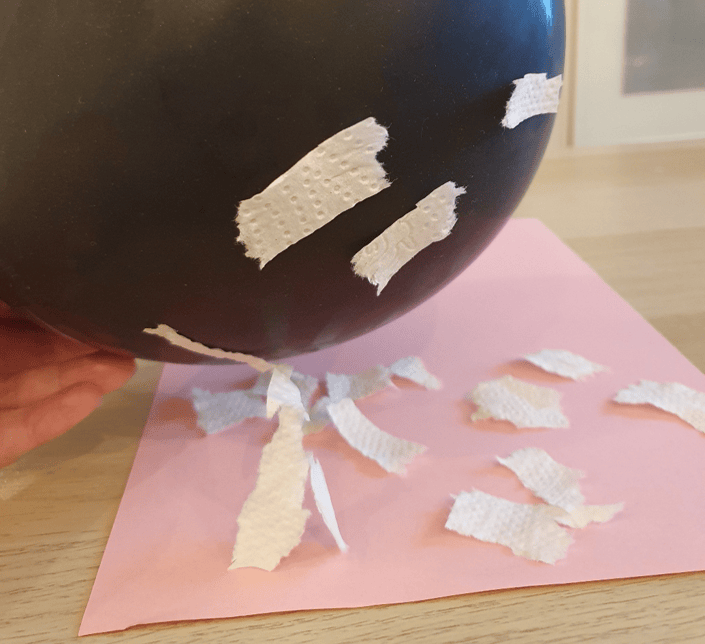
Most people know the simple static electricity experiment where you rub a balloon against your clothes and then hold it near small pieces of paper or tissue. The pieces of paper are attracted to the balloon and may even jump up and stick to it, almost as if by magic!
This happens because of static electricity. Rubbing the balloon against your clothes causes electric charges to build up on the surface of the balloon. When the charged balloon is brought close to the pieces of paper, it attracts them.
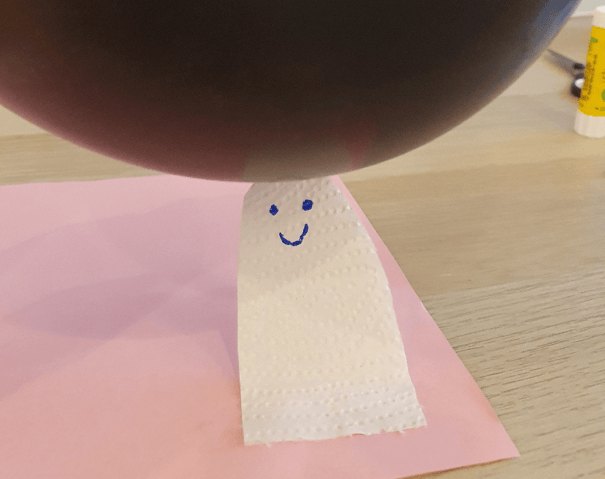
But there is a much cooler way to demonstrate static electricity – with a spooky Halloween twist! In this experiment, you can make little paper ghosts float towards a balloon. 👻
What you need
A balloon
Scissors
Glue
Kitchen roll or tissue paper
Drawing paper, either coloured or plain white
Felt-tip pens
What to do
Cut two or three ghost shapes out of kitchen roll or tissue paper.
Use felt-tip pens to draw spooky faces on your ghosts.
Put two or three thin lines of glue on the drawing paper. (You need as many lines of glue as you have ghosts.)
Glue only the bottom part of each ghost to the paper. The main body of the ghost should not be glued down, so that it can move freely.
Blow up the balloon and tie it.
Rub the balloon against your clothes for about 10–20 seconds.
Hold the balloon a short distance above the head of one of the ghosts.
Watch carefully. The ghost should rise towards the balloon, as if it is floating!
Try moving the balloon slowly from side to side. Can you make the ghost follow it?
Important: Keep the balloon a short distance away from the ghost. The experiment will not work as well if you touch the ghost directly on the drawing paper with the balloon.
What is happening?
When you rub the balloon against your clothes, electrons move from one material to another. This gives the balloon a static electric charge.
When you bring the charged balloon close to the paper ghost, the electric charge in the ghost is rearranged slightly. The part of the ghost closest to the balloon becomes more strongly attracted to it. This attractive electric force can be strong enough to lift the lightweight tissue paper off the drawing paper.
The ghost is not really flying – it is being pulled upwards by an electrostatic force.
Try rubbing the balloon for different lengths of time and holding it at different distances from the ghost. What conditions make your ghost rise the highest?
Note: You can use other food items instead of pasta and sausages. Choose foods with a light colour so that you can easily see how well they take up the food colouring.
What to do
Cook the pasta. Younger children should ask an adult for help with this step.
Fill three bowls with warm water from the tap. Leave enough space in each bowl for the food item.
Choose one colour of food colouring. Add 5–7 drops to each bowl. Using the same colour in all three bowls makes it easier to compare the results.
Place one food item in each bowl.
Leave the food in the coloured water for 10 minutes. Stir the water gently with a spoon from time to time.
Carefully pour away the coloured water.
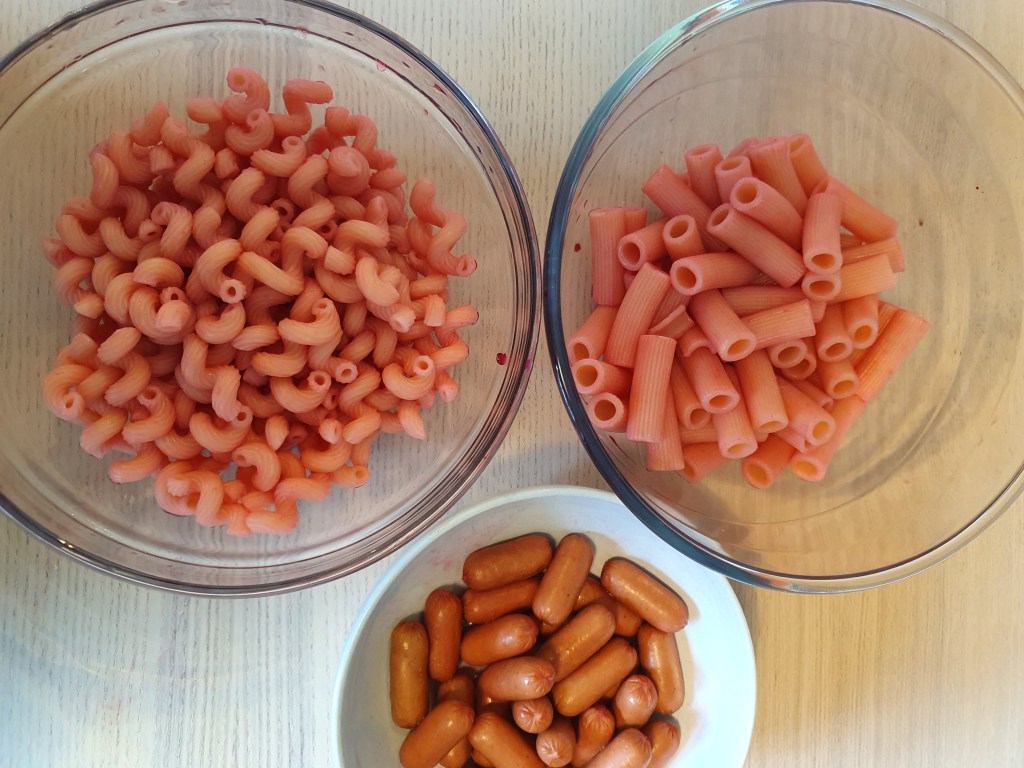
Observe the results. Which food has taken up the colour best? Did the pasta or the sausages become more strongly coloured? If you used different pasta shapes, did they take up the colour in the same way? Older children can write down what they observe and compare the different foods.
Background science
Food colouring can stick to the surface of food. Different foods have different types of surfaces, so some foods take up or hold on to the colour better than others.
When the food colouring comes into contact with the food, its dye particles can interact with molecules on the food surface. Some of these interactions are physical, such as the dye becoming trapped in tiny spaces or pores on the surface. In some cases, dye molecules can also form strong chemical interactions with molecules in the food.
A chemical change happens when substances form new substances with different chemical properties. A chemical reaction is a process in which this happens. However, simply seeing food become coloured does not prove that a chemical reaction has taken place. In this experiment, the main process is the dye moving from the water and sticking to or becoming trapped in the surface of the food.
In this experiment, the pasta may take up the food colouring more evenly than the sausages. The sausage skin can prevent the colour from reaching the food underneath. The colour may be stronger in small holes or damaged areas of the skin, where the coloured water can reach the inside more easily.
The different pasta shapes may take up the colour in a similar way. This is because, even though the shapes are different, they are made from the same type of pasta and have identical surface properties.
This experiment shows that the material and surface of an object can affect how well a dye sticks to it.
Collecting and pressing leaves from different trees is a popular autumn activity. It is a great way to help children learn about different types of trees. This activity takes the idea one step further by encouraging children to explore and compare the bark of different trees too.
Here is what you need:
Wax crayons
White paper
Tape
A few different types of trees to investigate in a nearby forest or park
What to do:
Find an area with between three and six different types of trees to explore.
Choose one tree to investigate first.
Look closely at the tree’s bark. Is it smooth or rough? Does it have lots of cracks? Older children can write down what they notice.
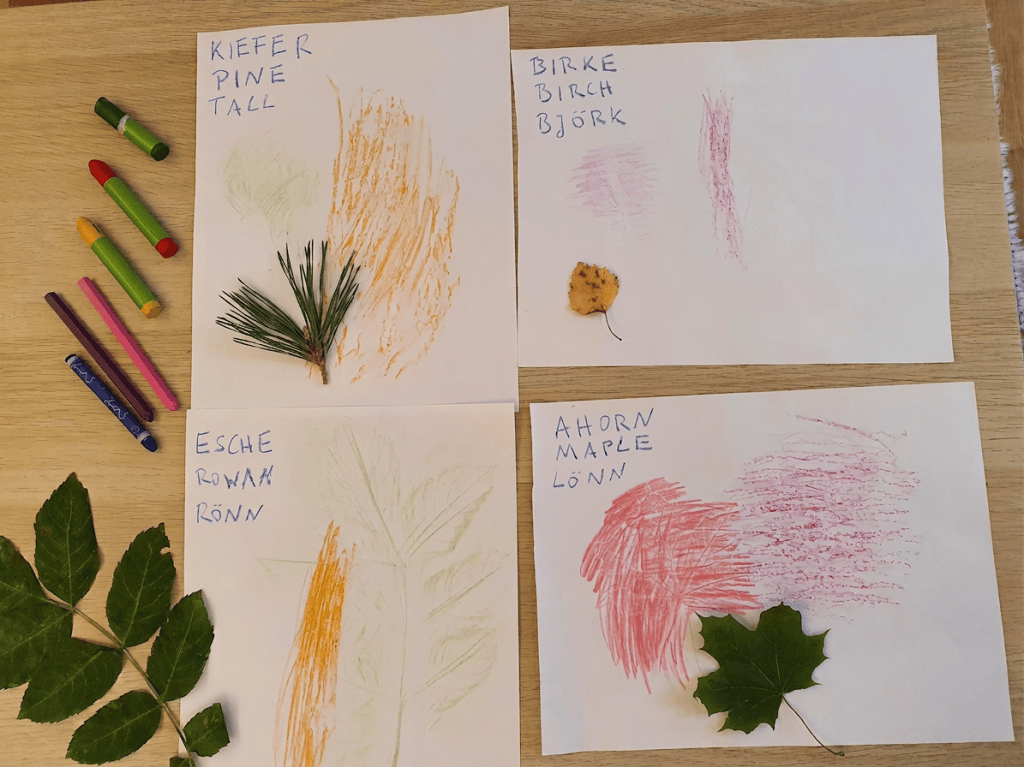
Hold a piece of paper firmly against the tree trunk with one hand. Use a wax crayon to colour over the paper and make a rubbing of the bark. Leave enough empty space on the paper to make a rubbing of a leaf later. It may be easier to work in pairs. One child can hold the paper against the tree while the other makes the rubbing.
Write the name of the tree on your bark rubbing.
Find a leaf from the same tree. Look carefully at it. What shape is it? What colour is it? Older children can write down what they notice.
Keep the leaf safely with its bark rubbing so that you do not mix it up with leaves from other trees.
Move on to the next tree. Make sure it is a different type of tree from the one you have just investigated. (My preschooler and I explored four different types of trees before they lost interest, but older children may enjoy investigating more.)
Take your bark rubbings and collected leaves home with you.
Once you are back inside, take out your bark rubbings and leaves.
For each tree, place the leaf underneath the empty space you left on the paper.
Use a wax crayon to make a rubbing of the leaf next to the bark rubbing.
If you still have some empty space on the paper, you can use tape to attach the real leaf as well.
Older children can compare the different types of trees they have investigated. They could share their notes and use them to complete a comparison table.
What can children learn?
I also used this activity to talk to my preschooler about the job that tree bark does. Bark protects a tree, a little like our skin protects our bodies.
We also talked about how different the bark of each type of tree can look. For example, the rowan tree had very smooth bark that almost looked like our skin. The pine tree, on the other hand, had much rougher bark with deep cracks.
My preschooler had already learned a lot about the different shapes of leaves, so I used this activity as a chance to focus more on bark. However, you can easily use the activity to explore both leaves and bark. It is a wonderful way to encourage children to look closely at the trees around them and discover how different each one can be.
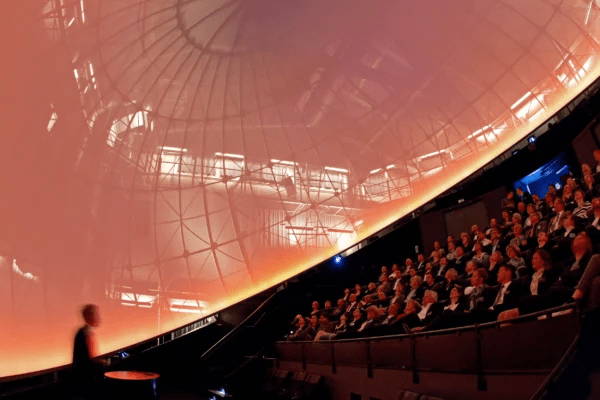
If you ever happen to be in the Swedish city of Norrköping (about two hours South-West of Stockholm), I can really recommend that you visit Visualiseringscenter C (Visualisation center).
Situated in the heart of Norrköping, Visualiseringscenter offers a fascinating mix of science, technology and hands-on discovery. Visitors can explore interactive exhibitions and learning environments covering subjects such as space, the human body, criminology and the city itself.
The highlight is WISDOME, a spectacular immersive dome theatre where science is presented in 360-degree 3D. Instead of simply watching a film, you feel as though you are travelling through space, exploring the microscopic world of life or witnessing the history of the Moon landings. Shows such as Once Upon the Moon and Chemistry of Life turn complex scientific ideas into memorable visual experiences. Most viewings are in Swedish language, but headphones are available to have the shows translated into English while viewing them.
We watched the shows Once Upon the Moon and VAST Junior – A space journey for kids. Both were nothing short of amazing. The latter was a show specifically for children aged 5 to 12 and our preschooler loved flying past the moon and over the surface of Mars which is exactly what watching a screening about space feels like in the WISDOME. I went back later to also watch a show about AI, AI – An Immersive Journey into the Future, which was very exciting too. The movie explained clearly how AI works as well as its limitations, making clear that while AI can be perform well at many tasks, it does not understand these tasks and their purpose like humans do. Flying through the model of a neural network used to train an AI was also an unforgettable experience.
For anyone interested in science, the centre is especially exciting because it connects cutting-edge research with curiosity and imagination. Visualisation makes things that are normally impossible to see—whether incredibly small or unimaginably distant—accessible and understandable.
My favourite exhibition piece – apart from the WISDOME – were a 3D – model showing all planets of our solar system as well as the larger moons of the gas giants. The details on the surface of the models was amazing. Another highlight were the models of some vital human organs obtained through computer tomography which showed lots of details and explanations about the functions of the different organ parts.
All in all, I can really recommend a visit, especially with children at preschool and school age. Almost forgot to mention that there is a space-themed playroom where kids can dress up as astronauts. So, really worth a visit!
1. EV growth continues—but becomes regionally fragmented
Electric mobility remains the backbone of battery demand, yet 2025 and the first half of 2026 highlighted pronounced regional divergence:
China surpassed a watershed moment, with more than half of new car sales electrified.
Europe saw modest recovery after a weak prior year.
The United States lagged behind, constrained by cost, infrastructure gaps, and policy uncertainty.
These differences have real technical implications. Battery developers must now design region-specific solutions, balancing cost, energy density, and lifecycle requirements depending on local market maturity.
Notably, plug-in hybrid vehicles (PHEVs) have declined in key markets, reinforcing the steady march towards full electrification, albeit with transitional technologies still playing a role.
2. The quiet giant: grid storage emerges as a dominant force
If EVs remain the public face of batteries, battery energy storage systems (BESS) are increasingly their industrial backbone.
In 2025, global stationary storage installations exceeded 100 GW—an extraordinary figure that underscores the role of batteries as enabling infrastructure for renewable energy and digital economies.
Several drivers converged:
Falling battery costs
Growing renewable energy penetration
Increased electricity demand from AI and data centres
Supportive policy frameworks
Crucially, BESS has also served as a relief valve for excess production capacity, especially in China. This interplay between supply surplus and new demand channels is likely to remain a defining dynamic.
3. Prices fall—science meets ruthless economics
Battery pack prices reached historic lows in 2025:
Global average: ~$108/kWh
China (LFP): ~$84/kWh
While this represents a triumph of materials science, process engineering, and scale manufacturing, it creates a more challenging industrial environment. Lower prices accelerate adoption but compress margins—pushing the industry towards:
Vertical integration
Automation and yield optimisation
Aggressive cost engineering
Consolidation forcing weaker players out of the market (in China an elsewhere)
Interestingly, significant regional price disparities persist, reflecting differences in labour costs, energy prices, and industrial maturity.
4. Chemistry reality check: the rise—and reign—of LFP
Perhaps the most striking scientific shift is the dominance of lithium iron phosphate (LFP) chemistry.
Once considered a lower-performance alternative to nickel-rich systems, LFP now leads across both EVs and stationary storage due to:
Lower cost
Superior safety profile
Long cycle life
Supply chain robustness
Innovation has not stood still. Advances in compaction density, fast charging, and system integration have allowed LFP to encroach upon application domains previously reserved for high-nickel chemistries.
The result is a more nuanced, application-specific landscape:
LFP for cost-sensitive deployment
High-nickel chemistries for performance-critical niches
Sodium-ion emerging for stationary applications
As a consequence, there is a drive to retool existing battery factories or those under construction from high-nickel to LFP chemistry.
5. Beyond lithium: incremental innovation wins the race
Despite significant attention, next-generation technologies are progressing with cautious pragmatism.
Sodium-ion batteries reached early commercial deployment, particularly in battery energy stationary storage (BESS) in grids, benefitting from abundant raw materials and cost advantages.
Solid-state batteries advanced to pilot-scale production, with automotive deployment targeted for 2027–2030.
6. Artificial intelligence: from optional tool to industrial necessity
Artificial intelligence has quietly become indispensable across the battery value chain.
Applications include:
Manufacturing quality control and yield optimisation
Predictive maintenance
Materials discovery and design
Moreover, AI indirectly drives demand for batteries in BESS systems through energy-hungry data centres—further strengthening the link between digital infrastructure and electrochemical storage.
In a low-margin environment, AI is no longer a differentiator but a baseline requirement.
7. Capital discipline replaces speculative growth
The investment landscape in 2025 reflected a broader maturation than previous years:
Decline in venture capital for early-stage battery companies
Growth in infrastructure-focused investment (>$100 billion in climate funds)
Stronger performance of established Asian manufacturers relative to Western start-ups
This shift emphasises bankable, proven technologies—particularly in energy storage—over speculative manufacturing expansion.
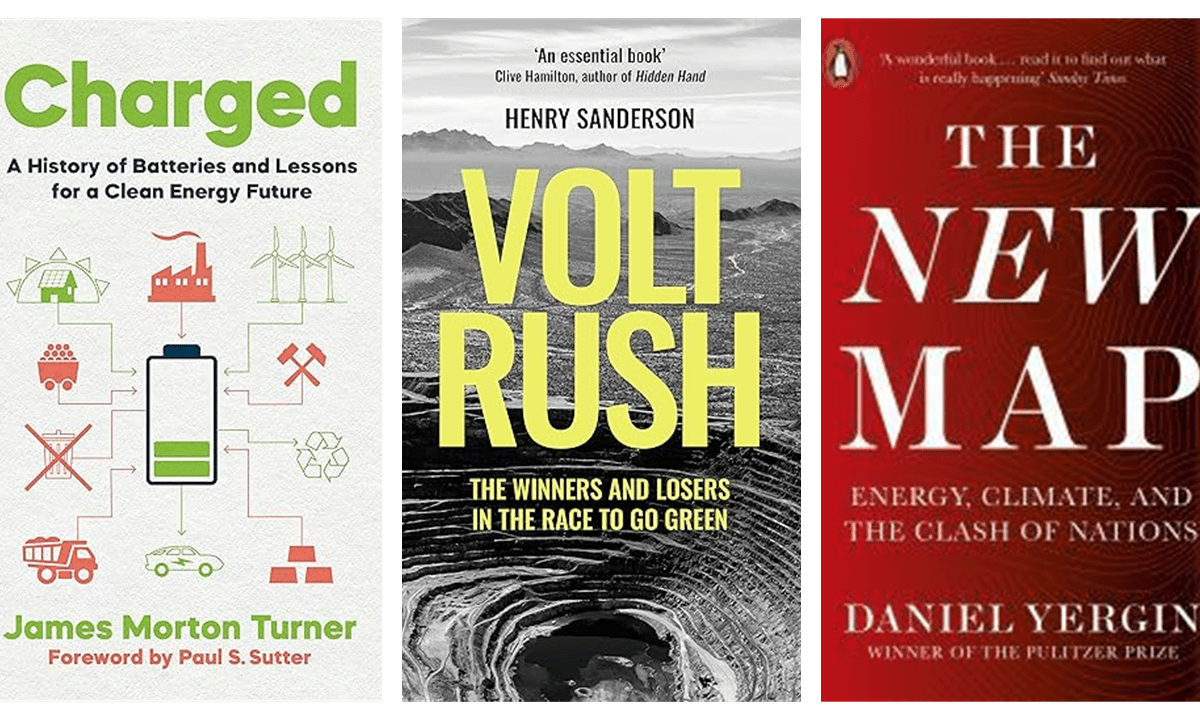
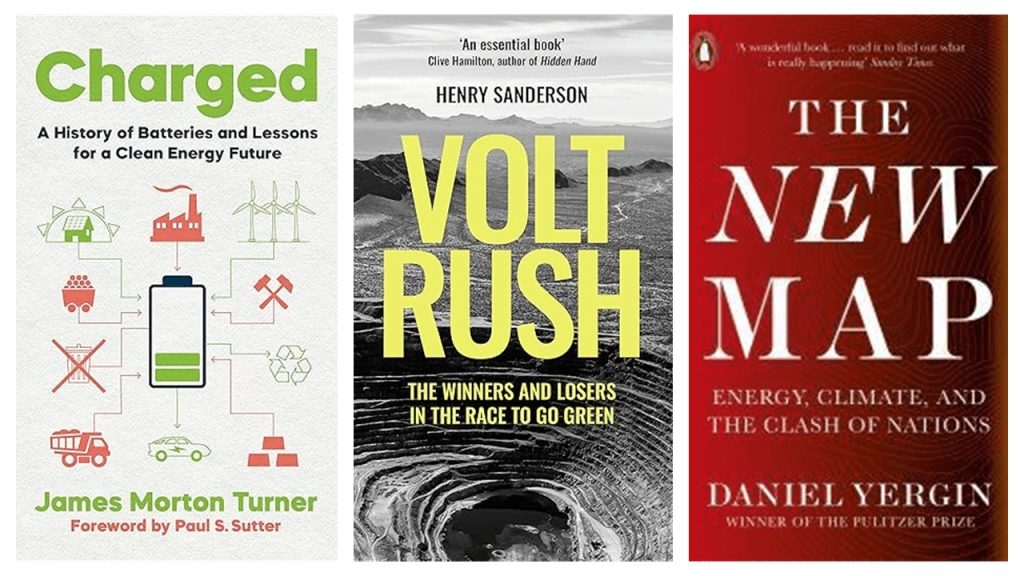
1. Charged – A History of Batteries and Lessons for a Clean Energy Future by James Morton Turner (2022)
Summary
Charged by James Morton Turner explores the history of batteries and their importance in modern society. Turner explains that batteries are not only scientific inventions but also political and environmental tools that shape economies and daily life.
The book follows the development of batteries from early experiments in electricity to today’s lithium-ion technology. It describes how scientists and engineers worked to improve energy storage so that devices could become smaller, lighter, and more powerful. Turner also explains the growing demand for rechargeable batteries in mobile phones, laptops, and especially electric vehicles.
A major theme of the book is the environmental cost of battery production. Mining for battery materials can damage ecosystems and create social problems in poorer countries. He also discusses recycling and the need for better systems to reuse battery materials in the future.
Overall, Charged helps readers understand that batteries are essential for the transition to renewable energy, but they also bring difficult challenges. The book encourages a balanced view: batteries can support a greener future, but only if they are developed and managed responsibly.
Why I liked it
Charged is highly readable and does more than simply focus on lithium-ion batteries. Instead, it guides the reader through a range of battery technologies, from lead-acid batteries to smaller portable types such as nickel-cadmium and nickel–metal hydride, before arriving at lithium-ion batteries and the rise of electric vehicles.
Particular attention is given to the recycling of each battery technology. The recycling of lead-acid batteries is presented as a success story, while the challenges associated with recycling and disposing of other battery types are clearly highlighted. It is evident that establishing an effective system for recycling lithium-ion batteries will be crucial going forward.
The book explores the technology, industrialisation, and impact of various battery types, making it an excellent introduction for those new to the field who wish to learn more. At the same time, it offers valuable insights even for those with more experience. This is largely because the author, Turner, is a historian who places batteries in a broader context, illustrating their significant influence over time. For instance, he explains how the first commercially produced batteries enabled early telephone and telegraph systems. In addition, the book examines the human and environmental costs associated with the production and recycling of lead-acid batteries.
Generally, this book is an excellent choice for battery beginners as well as old foxes in the field.
2. Volt Rush – The Winners and Losers in the Race to Go Green by Henry Sanderson (2022)
Summary
Volt Rush by Henry Sanderson discusses the global race to secure the materials needed for batteries and electric vehicles. The book focuses on lithium, cobalt, nickel, and other critical minerals that are essential for the transition to clean energy. Sanderson explains how the rapid growth of electric cars and renewable energy systems has created intense competition between companies and countries.
A major theme of the book is China’s dominant position in the battery supply chain. Sanderson describes how Chinese companies invested early in mining, battery production, and electric vehicle technology, giving China a strong advantage over Western countries by securing the entire supply chain. He also explores the role of major car manufacturers and technology companies that are competing for access to raw materials.
The book highlights the environmental and ethical challenges connected to mining, especially in countries such as the Democratic Republic of Congo, where cobalt production has raised concerns about pollution and labour conditions. Sanderson argues that the clean energy transition depends not only on technology but also on stable and responsible supply chains.
Generally, Volt Rush provides a clear overview of the political, economic, and environmental issues behind the battery industry. It shows that the future of clean energy will depend heavily on access to critical minerals and global cooperation in managing these resources responsiblyTop of Form.Bottom of Form
Why I liked it
Volt Rush can make for a brutally honest read. Like Charged, it is very well written, with each chapter opening by recounting a key moment in the battery industry and its value chain—particularly the mining and procurement of the raw materials required for battery production.
One episode that stands out is Volkswagen’s 2017 invitation to cobalt traders to its headquarters in Wolfsburg. The company appeared to assume that suppliers would be eager—if not desperate—to sell cobalt simply because the buyer was Volkswagen. The episode starkly exposes the arrogance the company displayed at the time (an attitude that was likely shared by other legacy car manufacturers). Unsurprisingly, none of the traders agreed to supply Volkswagen.
This kind of unflinching account recurs throughout the book. While often shocking, it helps to explain how we arrived at the current situation, in which Western OEMs are largely dependent on Chinese companies for much—if not all—of their battery supply chain.
The book focuses primarily on the procurement of raw materials, examining in particular the challenges of securing nickel and cobalt. However, it also explores other parts of the supply chain.
Published in 2022, the book can at times feel somewhat dated. For instance, one might argue that the emphasis on nickel and cobalt is no longer quite as dominant an issue due to the rise of LFP (lithium iron phosphate) cathode chemistry. It also includes a chapter on Northvolt as the great hope of Europe’s battery industry—an assessment that, needless to say, has not aged especially well.
Nevertheless, the book remains highly readable and comes warmly recommended for anyone interested in understanding the global battery supply chain.
3. The New Map – Energy, Climate and the Clash of Nations by Daniel Yergin (2020)
Summary
The New Map by Daniel Yergin investigates how energy, politics, and technology are reshaping the modern world. The book explains how oil and natural gas continue to influence global power, while renewable energy and climate policies are creating major changes in international relations and economies as the world is slowly shifting towards an electrified future. Yergin shows that energy is not only about fuel, but also about security, trade, and political influence.
A large part of the book focuses on the changing balance of power between countries such as the United States, China, Russia, and nations in the Middle East. Yergin describes how the American shale revolution reduced US dependence on imported oil and changed global energy markets. He also examines China’s growing demand for energy and its investment in renewable technologies and electric vehicles.
The book also discusses the global transition towards cleaner energy. Yergin explains both the opportunities and the challenges of moving away from fossil fuels. He argues that the transition will take time because modern economies still depend heavily on oil and gas for transport, industry, and electricity production for some time to come.
In summary, The New Map provides a clear and balanced explanation of how energy shapes the modern world. It combines history, economics, and geopolitics to help readers understand the complex relationship between energy and global power in the twenty-first century.
Why I liked it
Unlike the first two books, The New Map is a somewhat slower read, but it is nonetheless highly informative.
Rather than focusing solely on battery technology and its impact, the book takes a broader view of energy, encompassing oil and gas as well. For instance, it examines the effects of the oil crises of the 1970s alongside the shale gas revolution in the United States. One of the book’s key strengths lies in the way it draws on such historical events to illuminate the present, skilfully weaving together the interdependencies between nations shaped by energy.
Yergin acknowledges that we are in the midst of a major transition away from fossil-based energy sources towards electrification. He also emphasises that the pace of this shift will depend on a range of factors, including government support and policy decisions. Written in 2020, the book predates both Russia’s invasion of Ukraine—which led to Western sanctions on Russian oil and gas—and the conflict between the United States, Israel, and Iran, along with its repercussions for the global oil market. It would have been fascinating to see how the author might have interpreted these developments.
What stands out most is the way the book sheds light on the broader economic and political context of energy, as well as the global connections and interdependencies that underpin the transition to an electrified future.
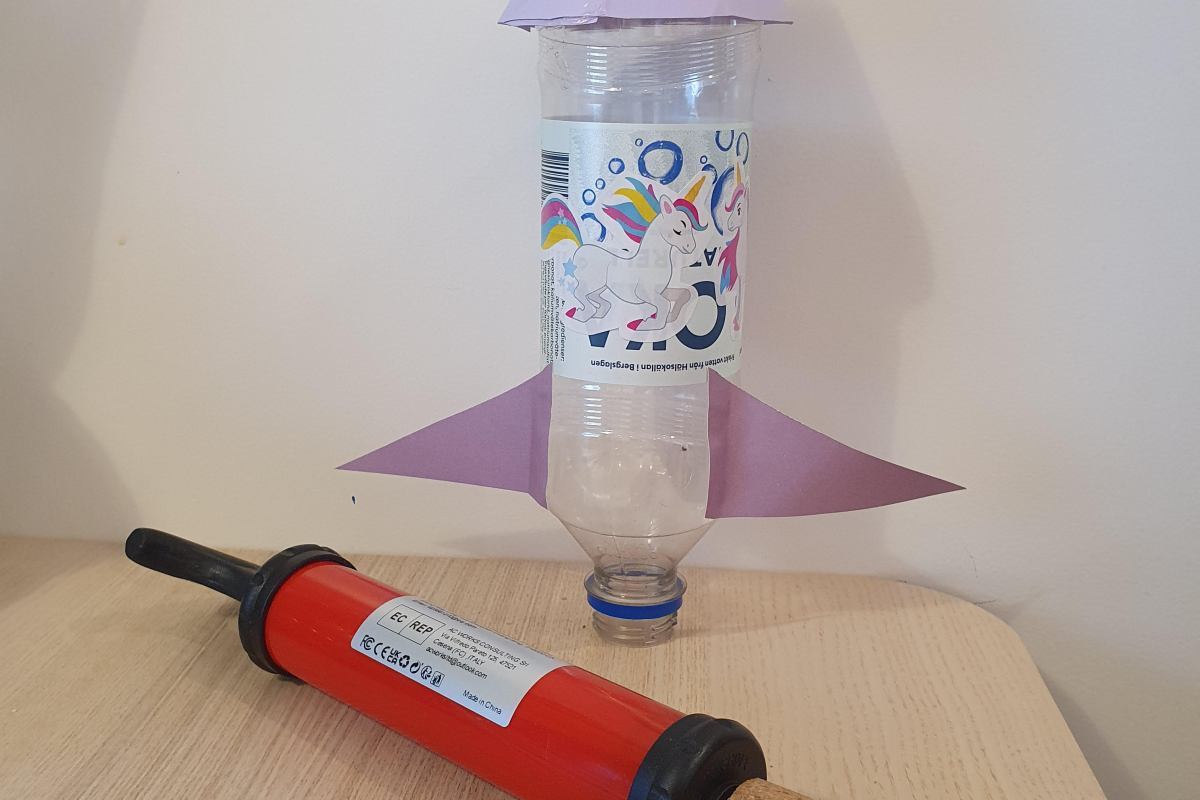
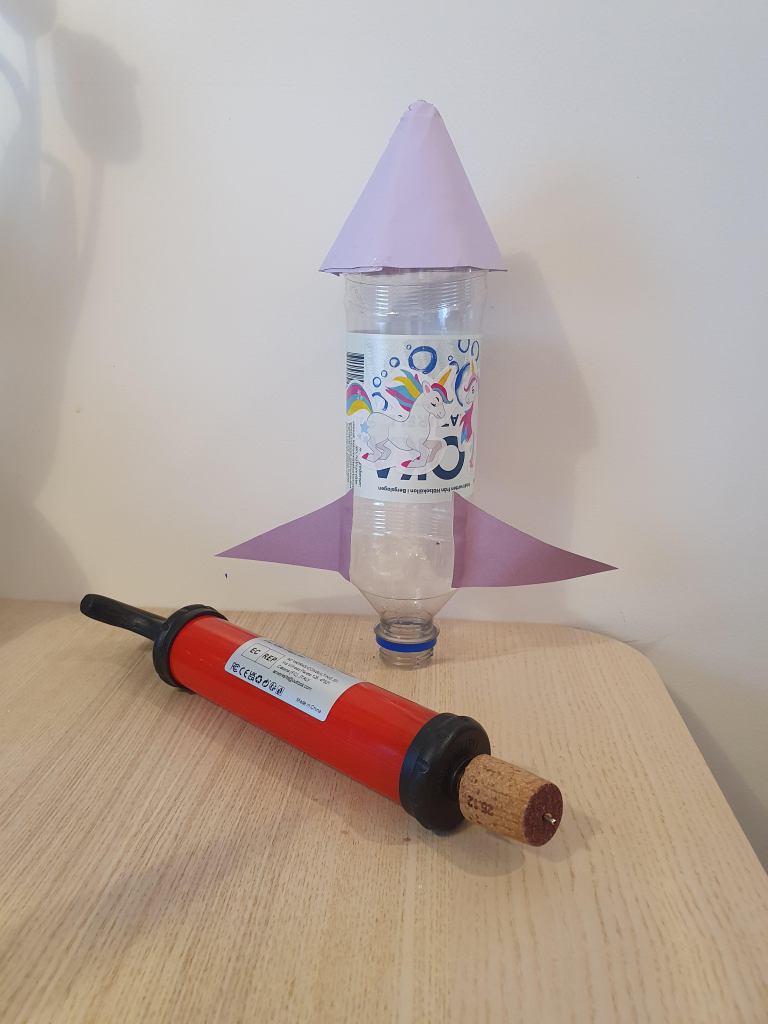
1 Empty plastic bottle (We found that smaller bottles like 500 ml work better than bigger ones.)
1 Cork that fits tightly in the bottle
1 Ball pump with a needle
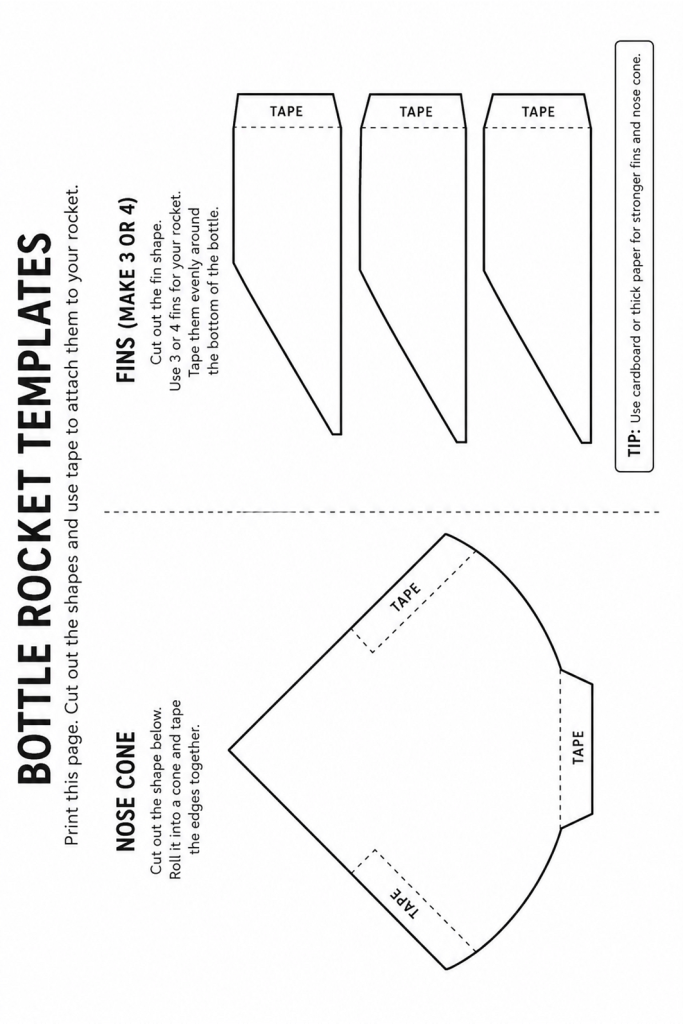
Paper or cardboard for nose cone and fins
Scissors
Universal glue or tape for the fins and nose cone
Tiny screwdriver or similar tool to make a hole in the cork for the ball pump
Stickers or acrylic paint and paint brushes for decorating
Step 1: Build the Rocket
Turn the bottle upside down. The bottle neck will be the bottom of the rocket.
Decorate the bottle with stickers or paint it with acrylic paint. If you use paint, wait for it to dry.
Cut the nose cone and fins from paper or cardboard. (We found that cardboard gives a more stable cone and fins.)
Glue or tape paper fins and a paper nose cone onto the bottle. Ask an adult for help if using universal glue.
Step 2: Put in the Cork
Select a cork that will fit tightly into the hole of the bottle.
Ask an adult to drill a small hole through the middle of the cork with a tiny screwdriver or a similar tool to fit the needle of the ball pump.
Push the cork tightly into the bottle opening. You can wrap it in tape to fit better if it is too small.
Step 3: Pump Air Into the Bottle
Take the rocket outside.
Place the needle of the ball pump through the hole prepared for it. It should fit quite tightly.
Point the bottle away from you and hold ONLY onto the ball pump or the cork outside the bottle. (Do NOT hold onto the bottle itself!)
Start pumping with the ball pump. You may need an adult to help with this (because it can require a lot of strength to pump the bottle completely full of air).
Step 4: Blast Off!
As more air goes inside, the pressure gets stronger.
Finally, the cork pops out and the rocket shoots away!
Why Does It Fly?
The pump pushes air into the bottle. The air pressure builds up inside. When the cork pops out, the fast-moving air pushes the rocket away.
The fast-moving air is an action which causes a reaction which is the rocket moving away.
This concept of action and reaction is also called Newton’s 3rd Law of Motion. This effect is also used by real rockets when they push of the ground. The main difference is that real space rockets use very strong fuels (hydrogen and oxygen) to create even more pressure and fast-moving gasses for the action part.
Safety Tips
Always launch outside.
Never point the rocket at yourself, other people or animals.
Always bring an adult to assist in your launch.
Ask an adult to help with universal glue and to make the tiny hole into the cork.
When taking a walk in the forest in early spring you can find many feeding traces of different animals. Join us in exploring some of them.
1 Traces left on trees
Deer, rabbits and hares all feast on the bark of trees during the winter months when grass and other plants do not grow well. But they leave different clues on trees that help us tell them apart.
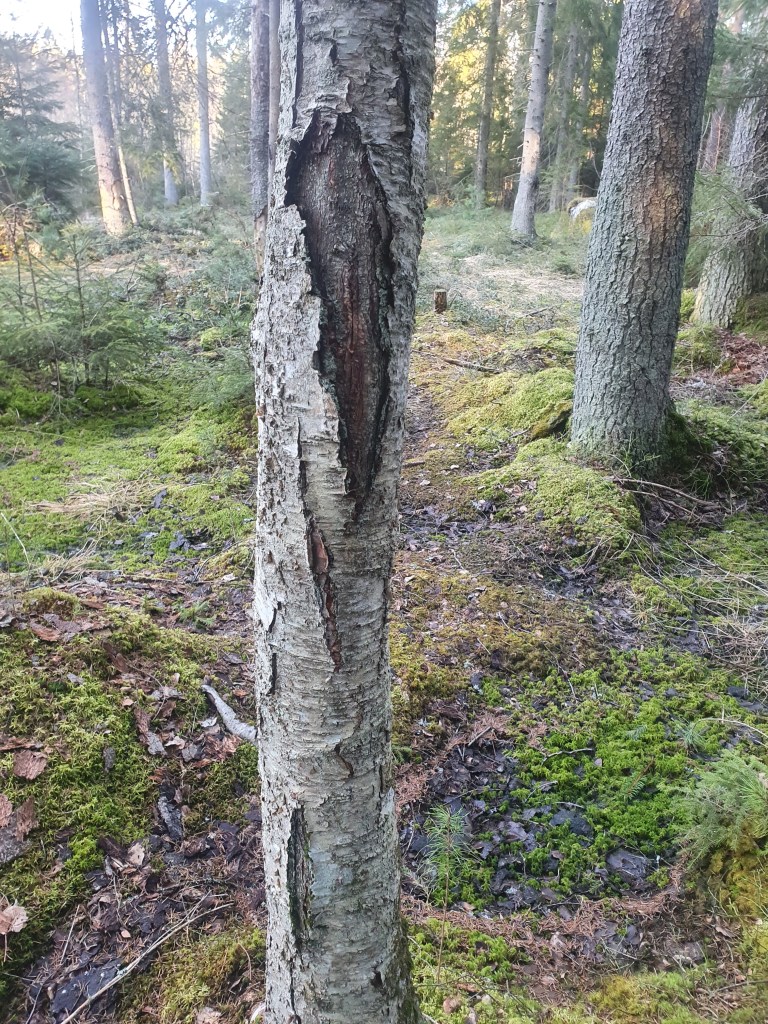
Deer are quite tall, so they can reach higher parts of a tree. When deer eat, they often tear the bark with their mouths. This can leave rough, jagged edges on the tree. You might also see damage higher up, about as tall as your chest or even above your head. In addition, roe deer and red deer normally pull of strips of bark, while fallow deer are more content to nibble.
The image below shows a tree which had some of its bark most likely stripped of by a roe deer during winter. The dark colour shows that the tree has begun to heal in this part.
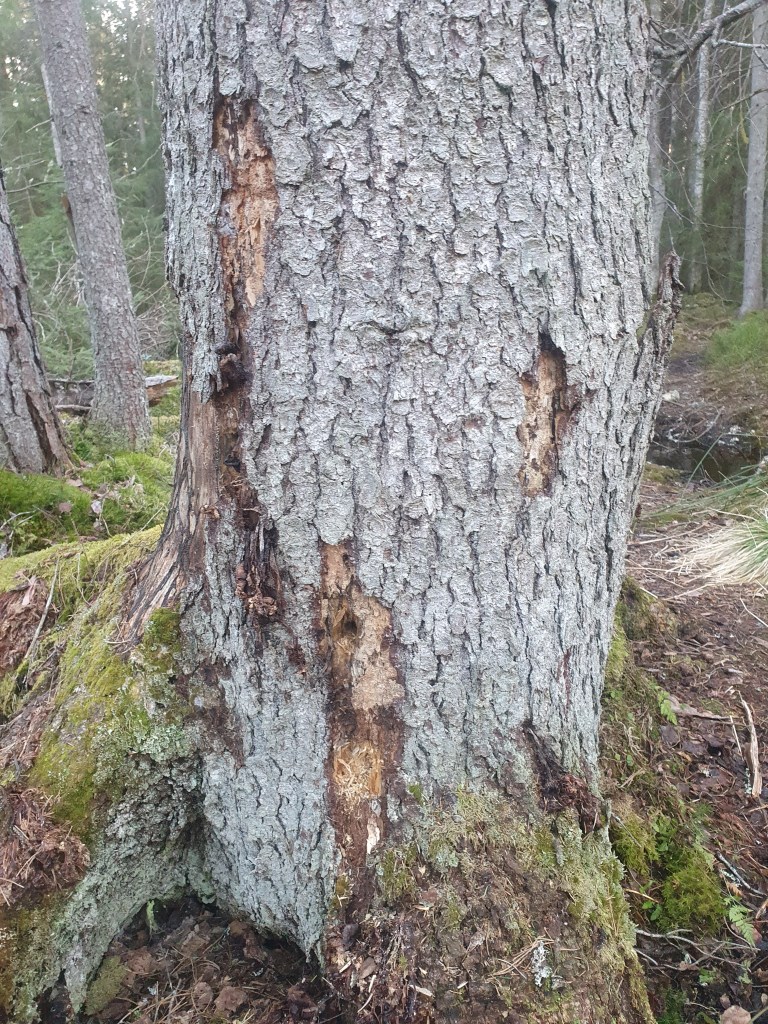
Rabbits and hares are much smaller than deer, so they can only reach low parts of a tree. They have very sharp front teeth, and they nibble neatly. This means the bark or twigs they eat often look cleanly cut, almost like they were snipped with tiny scissors. The damage is usually close to the ground.
This image shows the damage in the bark close to the ground which means that it may have been eaten by a rabbit or hare.
In summary, if the tree is damaged high up with rough edges, it was likely a deer. If the damage is low down with neat, tidy bites, it was probably a rabbit or a hare.
2 Traces left by wild boar
Wild boar leave very noticeable signs when they search for food in the forest.
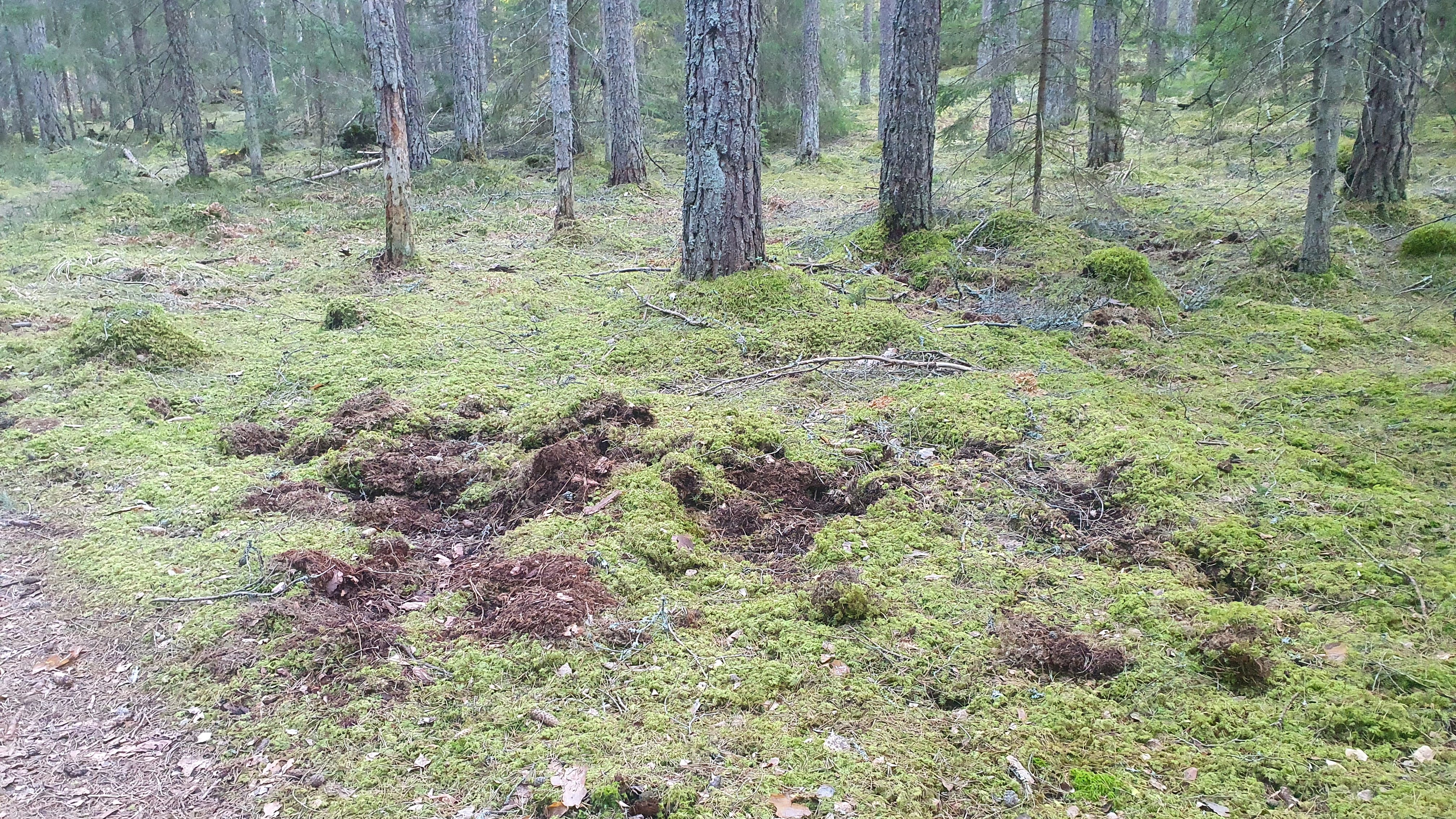
They use their strong snouts to dig in the ground. This is called “rooting.” When they do this, they turn over the soil looking for roots, insects, worms, and bulbs. The ground can look messy, with patches of earth all churned up, almost like it has been ploughed.
You might also see small holes and uneven ground where they have been digging. Sometimes large areas are disturbed, not just one spot.
Wild boar can also leave footprints. Their tracks look a bit like a deer’s, but they are rounder and wider. If the ground is soft, you may see many of these prints together.
So, if you see torn-up soil, lots of digging marks, and hoof prints in the forest, a wild boar has probably been there looking for food.
The image below shows a small area in a forest where wild boar have rooted for food.
3 Traces left on gnawed cones
In the forest, you can often find eaten spruce cones on the ground. By looking closely, you can tell which animal has been feeding on them.
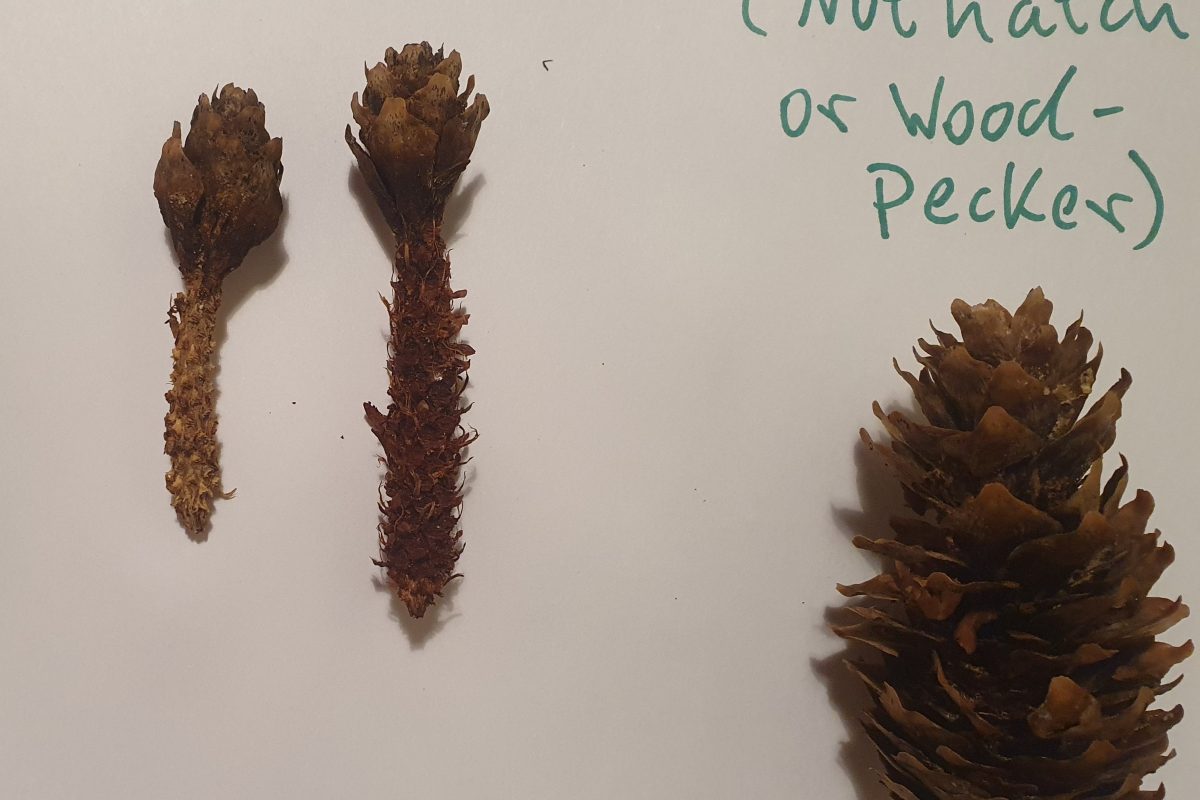
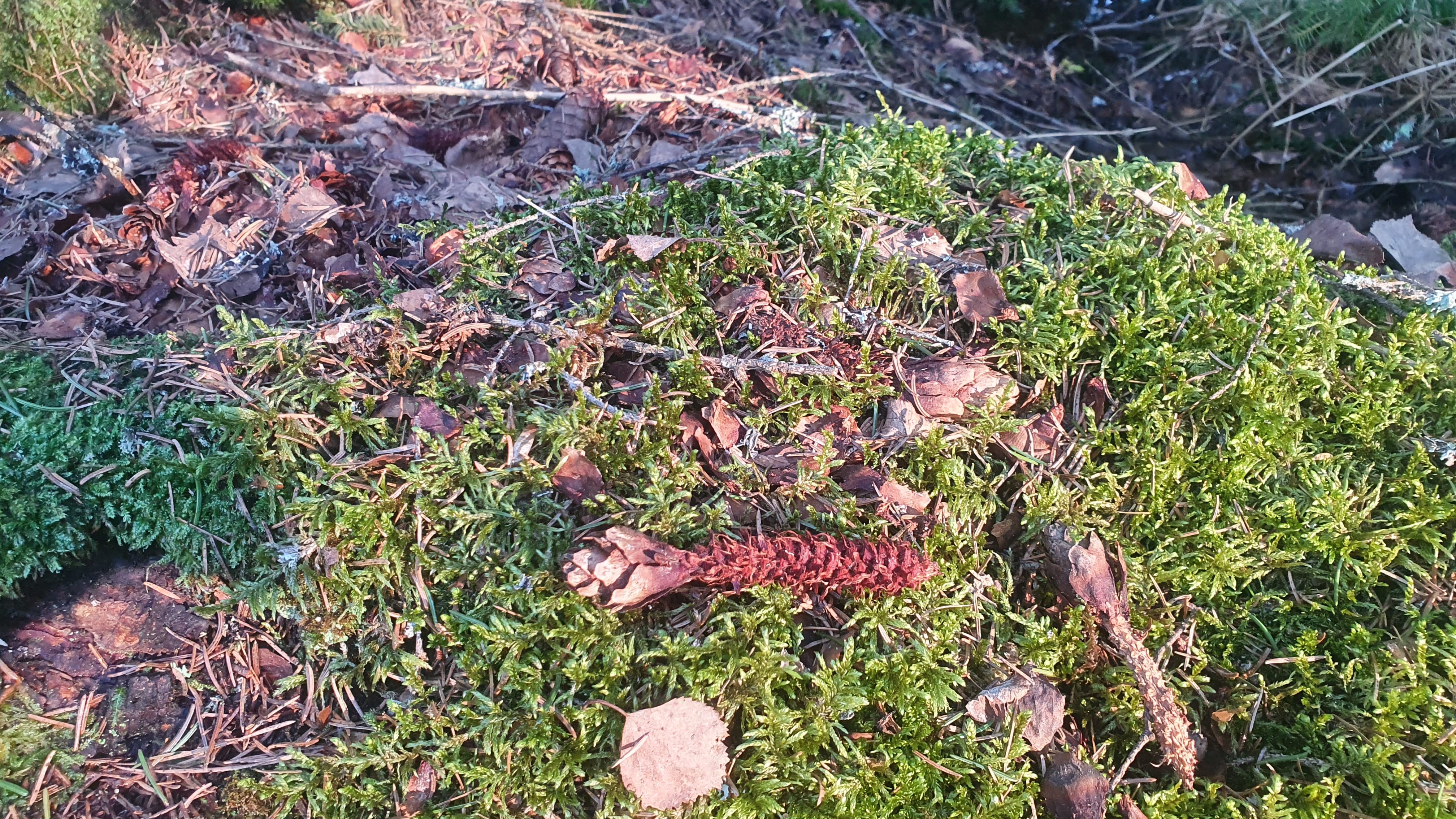
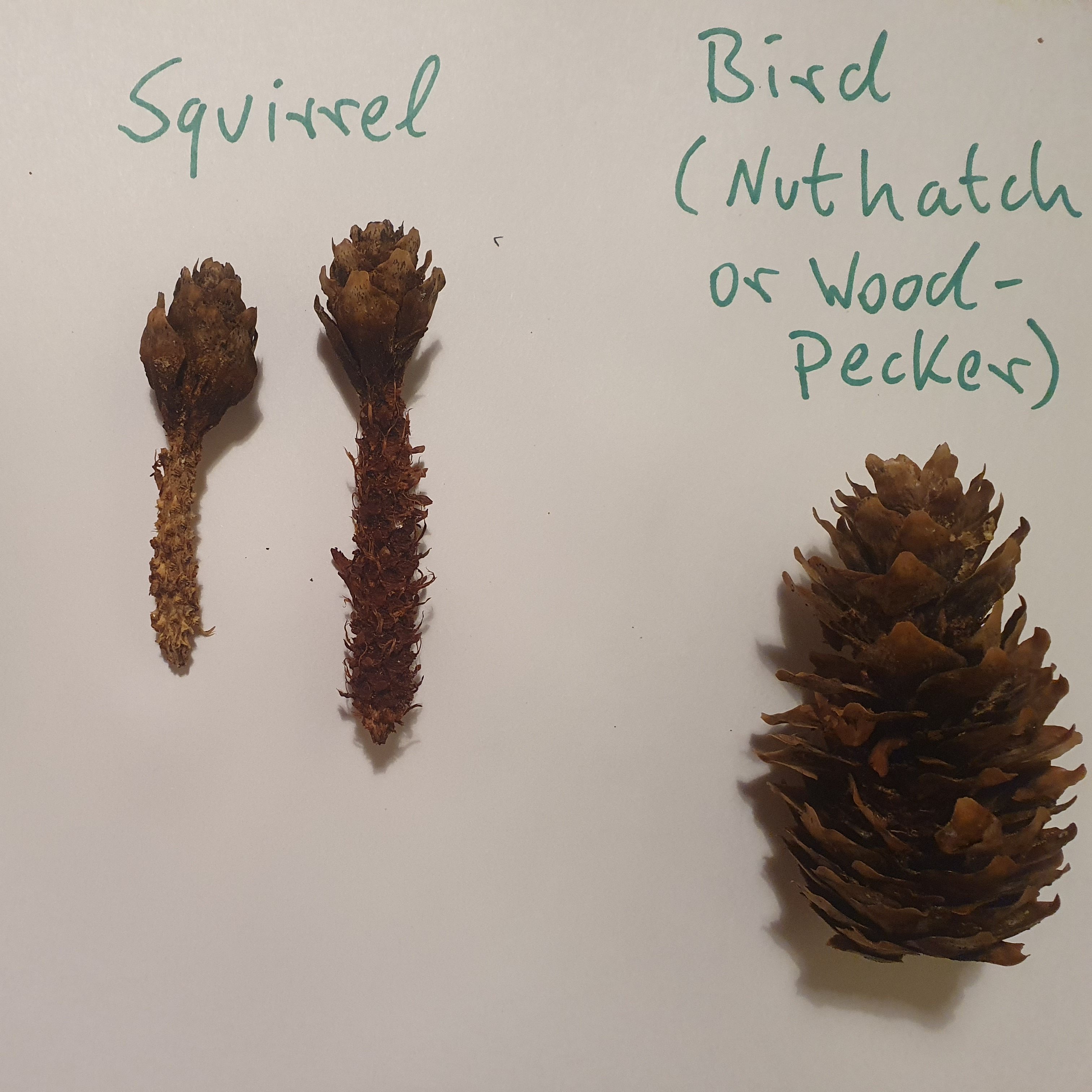
A squirrel leaves quite a tidy cone behind. It holds the cone and nibbles off the scales one by one. When it is finished, mostly the middle part, called the core, is left. Squirrels normally leave some scales at the tip of the cone where they have been holding it. The image below shows a cone left by a squirrel under a tree. You can even see some scales around it on the ground.
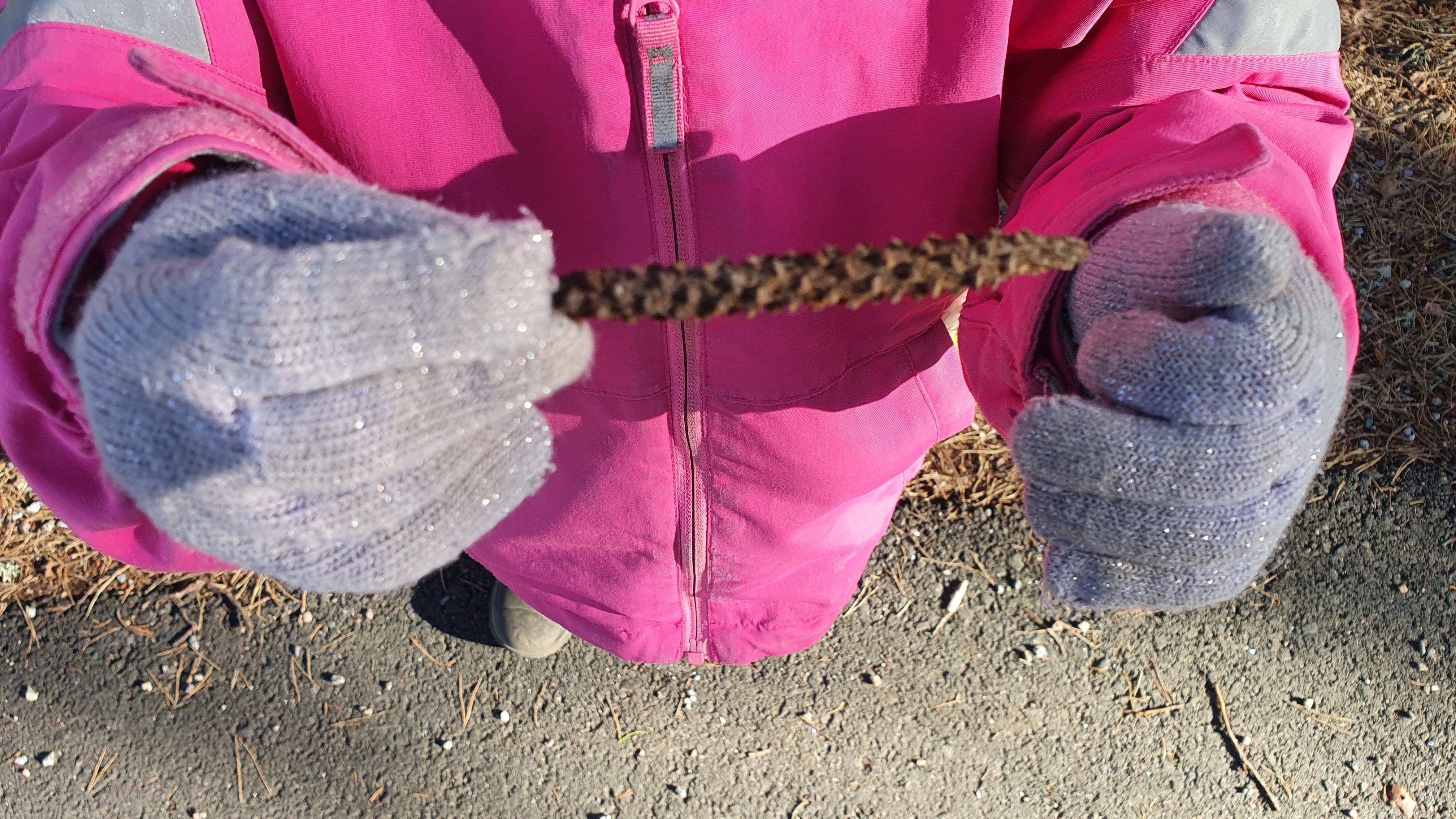
A wood mouse eats in a different way. It strips the cone of every last scale and only the clean core is left, which may almost just look like a stick which can be seen in the image below.
Birds like woodpeckers and nuthatches have a special way of eating cones. They often wedge the cone into a crack in the bark of a tree to hold it still. Then they peck at it to get the seeds out. The cone may look pecked and broken, with rough marks. Sometimes you can even find the place in the tree where the cone was held, called a “cone anvil.”
So, a clean, stripped core is likely from a wood mouse, a cone with scales left at the top from a squirrel and a pecked cone, often near a tree crack, from a bird like a woodpecker or nuthatch.
Have you ever wondered how much rain falls from the sky? Scientists use a tool called a rain gauge to measure rain. You can make your own at home or at school. It is simple and fun.
What you need
An empty, clear plastic bottle
A pair of scissors
A ruler
Sticky tape
A waterproof marker pen
What to do
Cut the bottle. Ask an adult to help you cut the top part off the plastic bottle.
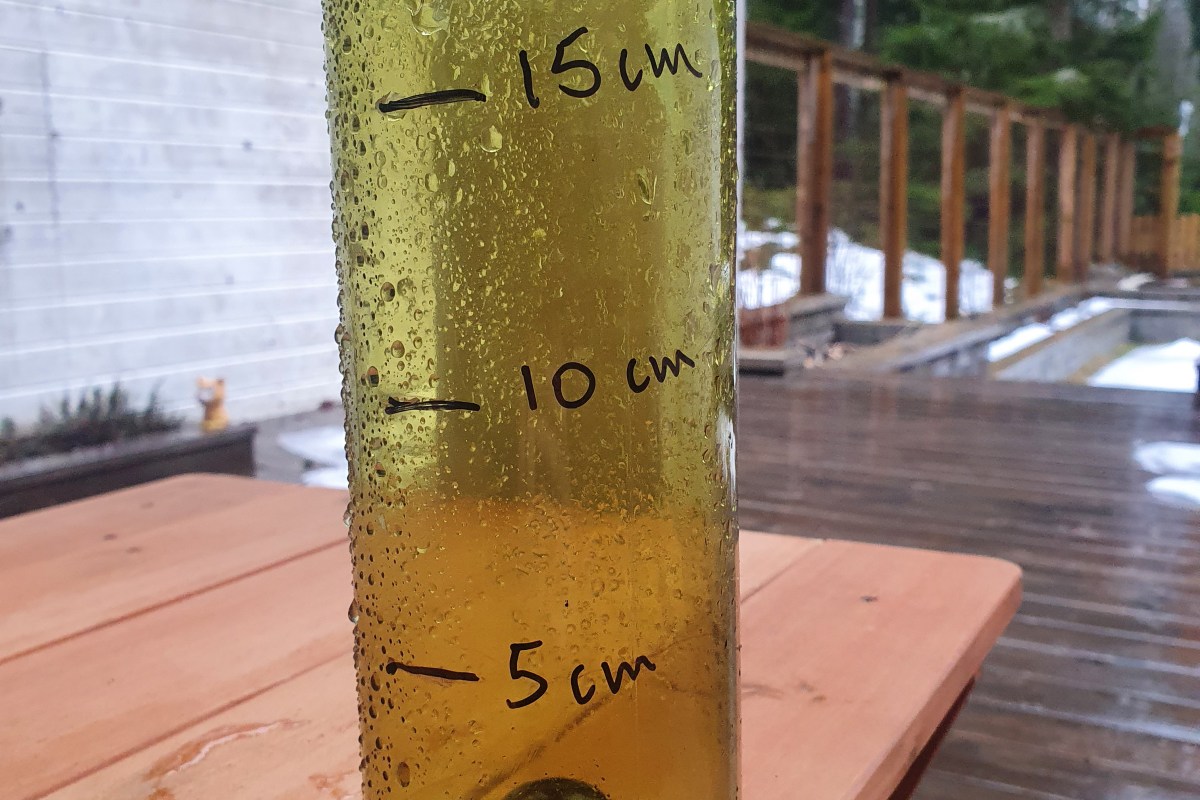
Mark the ruler lines. Use the ruler and marker pen to draw lines up the side of the bottle. These lines will help you measure the rain.
Optional: Turn the top upside down. Place the cut top of the bottle upside down like a funnel. Use sticky tape to hold it in place.
Tape the edges of the bottle. Place sticky tape around the edge at the top of the bottle. This is done because the edge is quite sharp to avoid cutting yourself.
How to use your rain gauge
Put your rain gauge outside in an open space.
Make sure it is not under a tree or roof.
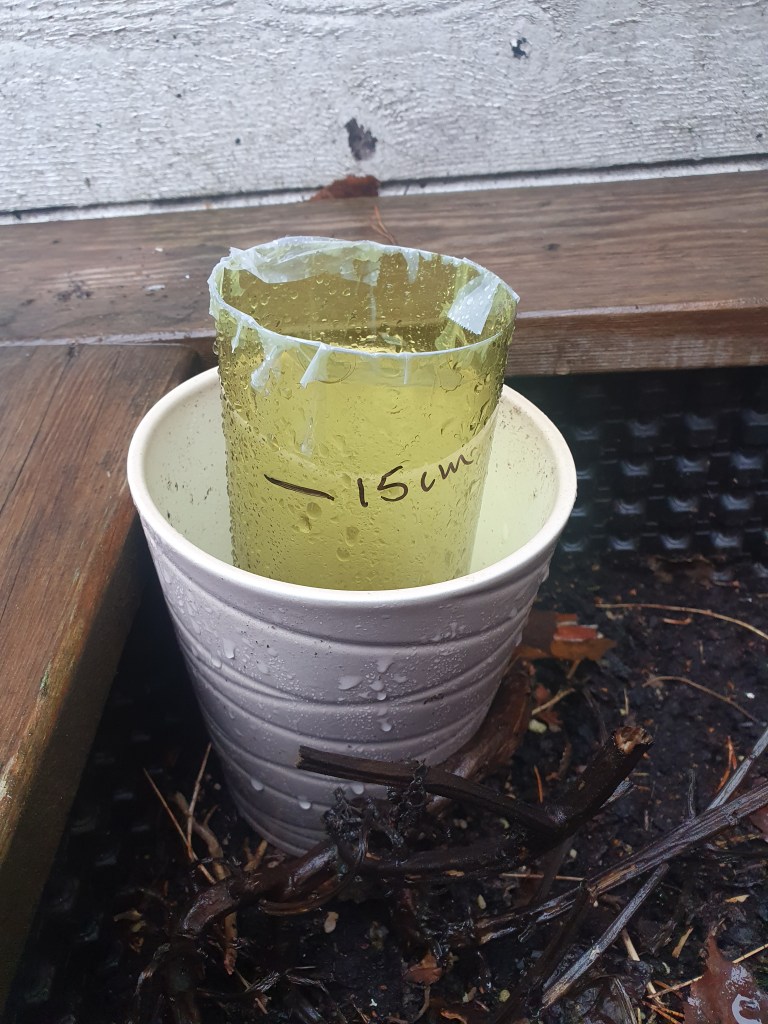
Make sure that the rain gauge cannot easily be blown away by the wind, e.g. place it inside a flowerpot or dig a small whole where you can place the rain gauge. See image below for an example.
After it rains, look at the water level.
Use the ruler marks to see how much rain has fallen.
Why this is interesting
Measuring rain helps us learn about the weather and how it changes. Farmers, gardeners, and scientists all use rain gauges to understand weather and climate change better.
You can check your rain gauge every day and keep a weather diary. This turns you into a real scientist!