
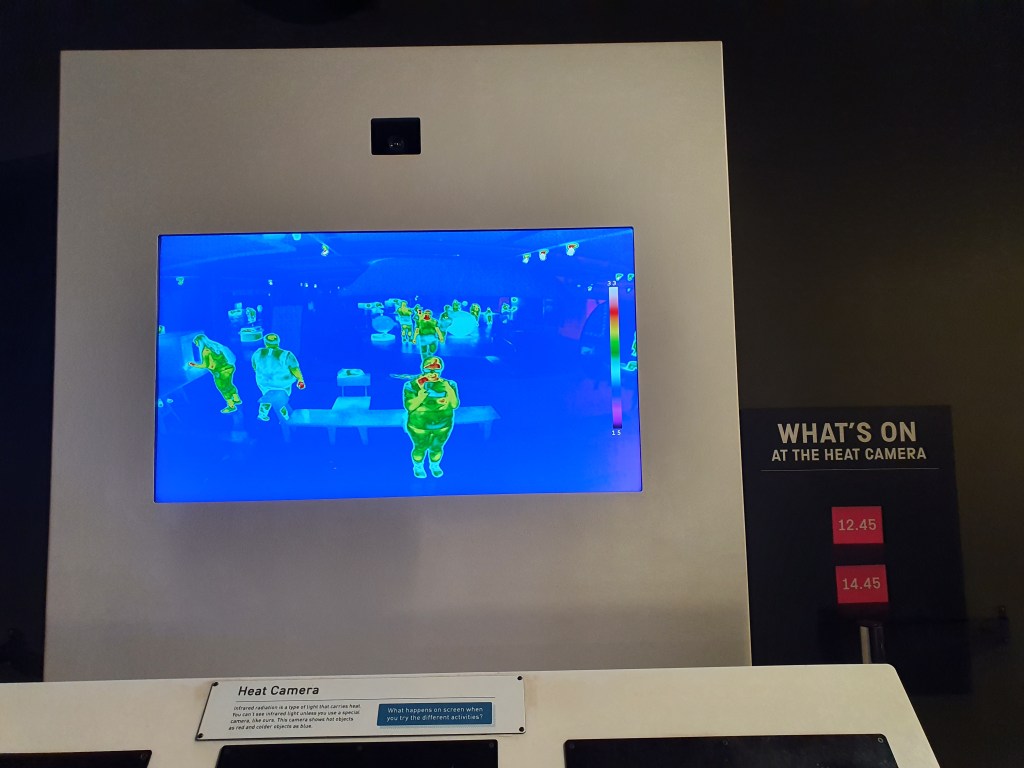
Image: Me in front of the thermal camera in the Wonderlab Gallery at the Science Museum, London.
Our family recently visited London, and among the many things we did, we discovered some excellent family-friendly science-related attractions. I am sure there is even more to explore in London if you are interested in science and technology, but these were the places we found best suited to families with children.
1. Science Museum: A Favourite for the Whole Family
https://www.sciencemuseum.org.uk
The Science Museum in London is so large that you could easily spend an entire day there and still not see all the exhibitions. Admission is free, although some attractions, such as Wonderlab and the IMAX cinema, require an additional ticket.
I cannot emphasise enough how ideal this museum is for children — and, in fact, people of all ages! Our pre-schooler loved the Flight Gallery, with its collection of aeroplanes, as well as the medical exhibition, where they learnt how unborn babies can be seen in their mother’s belly.
One of the real highlights was the space exhibition, which features the Soyuz capsule that brought British astronaut Tim Peake back to Earth, as well as an Apollo 10 spacecraft. Close to the space exhibition, you will also find the Pod, which offers sensory experiences and experiments that are suitable even for very young children.
Another favourite was Wonderlab, an interactive gallery where visitors can explore a wide range of hands-on experiments. It is an excellent attraction for a broad age range. Our child was particularly fascinated by the thermal camera (see image), the magnetic fluid and a large model showing the Earth and Moon moving around the Sun.
For children under six, there is also a play area called The Garden, located in the basement.
At the time of our visit, there was also an exhibition about careers in engineering and technology. This could be particularly interesting for teenagers who are beginning to think about their future careers. The museum’s IMAX cinema also shows 3D films about space, dinosaurs and other subjects, which are likely to appeal to older children and teenagers.
Of course, the Science Museum has many more exhibitions, but we simply did not have time to see them all.
2. Natural History Museum: For the Dinosaur Lovers
Like the Science Museum, the Natural History Museum offers free admission, although some services, such as the cloakroom, may cost extra.
This museum is a fantastic place for anyone who loves dinosaurs and other prehistoric animals. Our pre-schooler particularly enjoyed the plesiosaur fossils in the marine reptiles gallery, including fossils collected by Mary Anning.
At the time of our visit, there was also an exhibition about prehistoric marine life, featuring lots of animations and models that visitors could touch. This was a great way for children to explore the subject.
The dinosaur exhibition felt quite crowded, but it was still fascinating. It contains plenty of amazing fossils, including skeletons of Triceratops, T. rex and Stegosaurus, as well as fossilised dinosaur eggs. There are also animatronic models that bring the dinosaurs to life. Children can even touch some of the exhibits, including a Triceratops horn, a Velociraptor claw and an Iguanodon thumb spike.
We also enjoyed the mammal exhibition, which includes displays about the evolution of elephants, among other things. Once again, we did not have time to explore every exhibition.
One disadvantage of the Natural History Museum, compared with the Science Museum, is that it has no playroom or other dedicated areas offering the same kind of hands-on experiences for younger children. As a result, younger visitors may get tired more quickly.
For older children, the museum also offers some interesting special tours and events. For example, Visions of Nature is a mixed-reality experience that combines a museum tour with virtual reality. There are also Dinosaur Discos on selected dates. These activities require advance booking and an additional fee.
3. London Zoo
Unlike the two museums mentioned above, London Zoo charges an admission fee. Nevertheless, it is a great destination, particularly for families with children from pre-school to primary school age.
Our child’s favourite animals were the lions, giraffes, pygmy hippos, penguins and goats in the petting zoo.
One of the special features of London Zoo is its range of walk-through experiences. Visitors can walk among different species of birds, monkeys and lemurs, as well as butterflies and even spiders. These experiences make it possible to observe the animals at close quarters and can be particularly engaging for children.
Another highlight for our family was Tiny Giants, an exhibition focusing on insects and other small creatures. It shines a spotlight on all sorts of fascinating animals that you might not normally get to see at other zoos.
The amphibian and reptile exhibition is also worth visiting. It showcases a variety of fascinating species, including the giant Chinese salamander.

