Making batteries with sulfur

Image credit: Ben Mills.


The yellow powder in the image above is the element sulfur, which I am sure many people have seen before in school science lessons. Normally in chemistry classes, we are mainly taught about how bad the compounds made from this element smell. Examples are hydrogen sulfide with the distinct smell of rotten eggs and sulfur oxides. But could there be more to this powder? To find out, I have talked to Dr Matthew Lacey at Ångström Advanced Battery Center who is trying to build rechargeable batteries from sulfur.

Lacey is working on lithium-sulfur batteries (Li-S batteries) which consist of sulfur as the positive electrode (cathode) and lithium metal as the negative electrode (anode). When discharging (or using) these batteries, lithium and sulfur react to form the compound lithium sulfide and the process is reversed during charge. The advantage is the light weight of both sulfur and lithium, which leads to a very high energy density by weight. This gravimetric energy density of the batteries themselves could be up to two or three times higher than for conventional lithium-ion batteries according to Lacey. In addition, sulfur is abundant as well as a biproduct of the oil industry and, for these reasons, very cheap.

Nevertheless, Lacey admits that Li-S batteries also still have some drawbacks compared to conventional lithium-ion batteries. During discharge, sulfur dissolves in the electrolyte (the liquid placed between positive and negative electrode), where it can exist as a large number of different compounds called ”polysulfides”. These polysulfides can react with each other or be transported to the lithium foil (negative electrode) and react there. Especially, the reaction between polysulfides lithium results in very short lifespans for Li-S batteries. Strangely, the dissolution of sulfur in the electrolyte is an important part of how Li-S batteries work, but at the same time it is the source of severe problems. Another disadvantage is that, although the energy density per weight is high, the energy density per volume of Li-S batteries is rather low since lithium and sulfur are light, but have low densities.

Lacey is mainly working on a part of the battery called the ”binder”. In order to build a Li-S battery, sulfur and conductive carbon powder have to be attached to a conductive substrate, the current collector. Binders are the glue that stick sulfur and carbon powder to the current collector surface. Together these components form the positive electrode. Lacey is trying to find new binders that can do more than just be the glue of the electrode. The battery scientist wants his binders to interact with the polysulfides in the electrolyte (described above) to extend the lifetime of Li-S batteries. Lacey and his co-workers have been quite successful in this quest during the past years and more about it can be read in this recently published article.

The battery scientist is also proud about a new method called ”intermittent current interruption” that he developed during the past years. This technique makes it possible to track the resistance in batteries over long periods of time and can be used for all kinds of batteries, not only Li-S batteries.

Despite the challenges, Airbus Defence and Space are developing Li-S batteries for the Zephyr “High-Altitude Pseudo Satellite”. Li-S batteries are the only rechargeable batteries with a high enough energy density per weight to run this ”pseudo satellite” when sunlight is not available in the shadow of Earth. In addition, the UK based company OXIS Energy is working towards the commercialization of Li-S batteries.

Nevertheless, Lacey believes that due the low cost of lithium-ion batteries, they will keep dominating most markets such as electric cars and portable electronics in the foreseeable future. But, he also says, that Li-S batteries are still interesting for applications where battery volume and cost are less important. Examples are defence or space where Li-S batteries could power soldier equipment or satellites. Hybrid electric trucks could be another future market for Li-S batteries with battery volume being less of a problem for trucks than for smaller cars.


What is artificial photosynthesis?

Plants are truly amazing. To produce energy they basically ingest sunlight, water and carbon dioxide. As a result energy is chemically stored in sugars like glucose. (Scientists call them carbohydrates.) We all have heard about this process in school, photosynthesis. The carbohydrates can be further modified by the plants into fats or proteins. Animals like humans rely on all three as food, but also on the oxygen produced as a byproduct. In fact, there was no oxygen in the Earth atmosphere before the first cyanobacteria invented photosynthesis. These cyanobacteria later evolved into the chloroplasts inside plant cells where photosynthesis takes place.

Photosynthesis is very effective in transforming the energy of sunlight into chemical energy in sugars without creating any toxic or polluting waste. For this reason scientists today are trying to artificially create photosynthesis. The goal of these systems is to produce hydrogen or other fuels for engines and electricity. Another advantage would be that carbon dioxide released by the use of fossil fuels could be ”mopped up” from the atmosphere by artificial photosynthesis.

The main difference between artificial and natural photosynthesis is that plants produce carbohydrates, fats and proteins while humans are looking for suitable fuels that can power airplanes or cars. These fuels should ideally resemble fossil fuels and thus enable the use of already existing combustion motors. For this reason, chemists are trying to create different end-products than plants while using the same energy source (sun) and building blocks (carbon dioxide and water).

Plants use their chlorophyll to capture the sunlight while a collection of enzymes and proteins uses this energy to split water molecules into hydrogen, electrons and oxygen. Hydrogen and electrons then form carbohydrates (sugars) with the carbon dioxide and oxygen is released.

For artificial photosynthesis, scientists are mainly interested in the first two steps above. Capturing sunlight is the easy part, as there are plenty of solar-power systems available. Splitting water, however, is trickier and the main challenge. Water is a very stable compound and catalysts are required to initiate the splitting reaction. Catalysts are materials that can accelerate chemical reactions, without being depleted in the process. A great amount of research is being carried out  in order to find suitable catalysts for artificial photosynthesis. Among recently published very succesful catalysts were cobalt-based materials. Nevertheless, these systems still require more work and research in order to be optimized for commercialization.

Theoretically, the produced hydrogen could be directly used as a fuel. However, right now it is still more practical to transform hydrogen and carbon dioxide to fuels that closely resemble fossil fuels. This last step can be carried out either with the help of bacteria or other inorganic catalysts like copper. The conversion makes it possible to use the products of artificial photosynthesis in already existing car and airplane engines.

Maybe it will not take too long before we are able to drive cars with fuels directly produced with sunlight and carbon dioxide.

What will come after lithium-ion batteries?

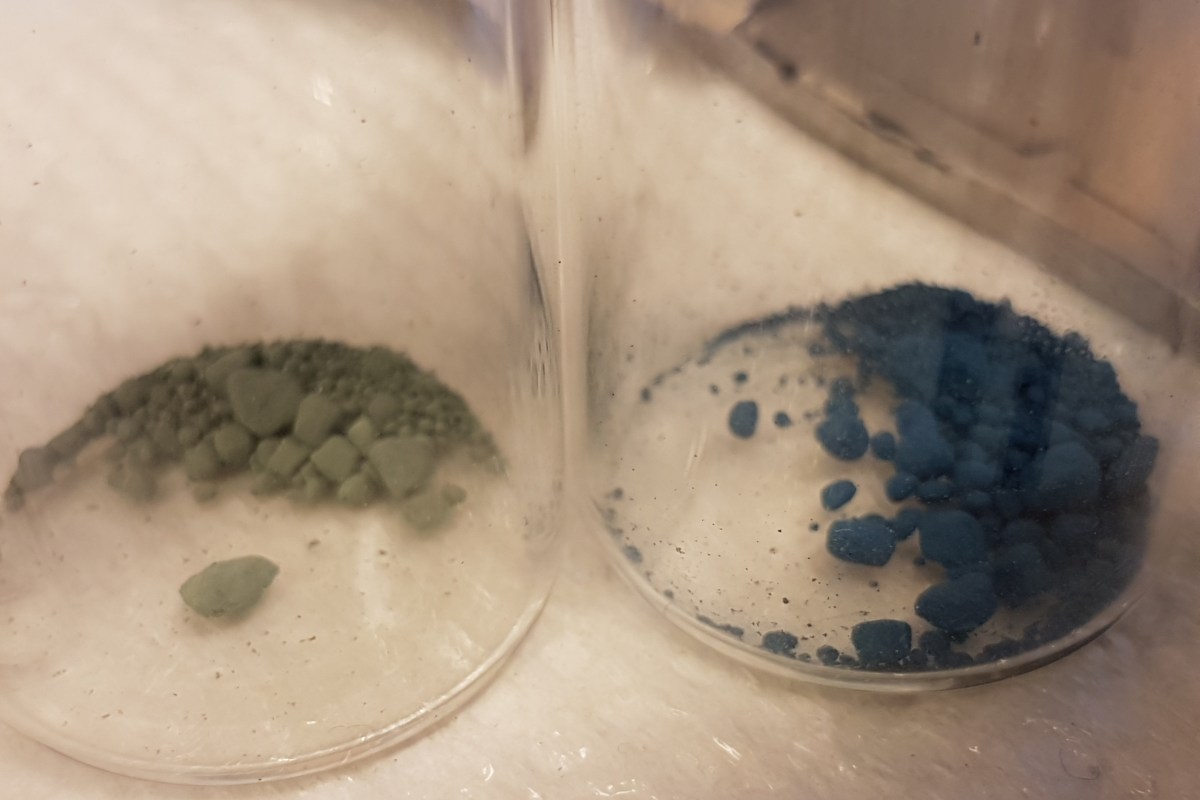
Image credit: Ronnie Mogensen, 2017. The materials ”Prussian white” (left) and ”Prussian blue” (right) are studied for the use in new battery technologies. CC BY-SA IGO 3.0.

With the dawn of electric vehicles and plummeting costs for renewable energies, battery technology is playing an ever more important role in our lives. Today lithium-ion batteries (LIBs) are being used in electric vehicles and for stationary power storage of renewable energy, for example in the Tesla powerwall. They can also be found in portable electronics such as laptops and mobile phones.

The problem is that lithium is a rather rare element with an abundance of only 0.0017 % in the Earth crust, most of which is found in South America. This inherent shortage combined with the high demand have lead to an increase of the lithium price by 14 % in 2016 with the price surges most likely continuing in the future. It is even doubtful if Earth has enough lithium resources to support the transformation from the fossil fuel-based society we are today to one depending mainly on renewable energy.

I have talked to two scientists who are trying to tackle this problem, Assistant Professor Dr. Reza Younesi and PhD student Ronnie Mogensen from the Ångström Advanced Battery Center (Uppsala University, Sweden). They are working on new kinds of batteries called sodium-ion batteries (SIBs) and magnesium-ion batteries (MIBs). These batteries rely on the use of sodium or magnesium instead of lithium, but work based on the same ”rocking-chair-principle”. In these batteries, metal-ions travel between two different electrodes during charge and discharge. The main difference is the nature of the travelling metal-ions, i.e. sodium-ions are used in SIBs, magnesium-ions in MIBs and lithium-ions in LIBs.

The huge advantage of these new batteries is, according to Younesi, the high abundance of sodium (2.3 % in Earth crust, atomic number 11) and magnesium (2.9 % in Earth crust, atomic number 12) as compared to lithium (0.0017 % in Earth crust, atomic number 3). In addition, large amounts of sodium can be found dissolved in sea water. Their good abundance enables the production of cheaper batteries from sodium and magnesium.

Nevertheless, Younesi admits that these battery technologies also have some drawbacks. Both sodium and magnesium are for example heavier than lithium, which is indicated by their higher atomic numbers. This leads to an overall lower energy density of these materials in batteries. This means that sodium-ion and magnesium-ion batteries need to be much heavier than lithium-ion batteries in order to store the same amount of energy.

Another challenge is the search for new electrode materials as not all state-of-the-art-materials used in lithium-ion batteries work for sodium- or magnesium-based systems. In addition, electrodes in lithium-ion batteries usually contain other scarce, toxic and expensive elements like cobalt, nickel or manganese. But, Younesi says, in order to truly produce cheap batteries, even the electrodess have to be made from abundant and inexpensive raw materials. For this reason one focus of Younesis and Mogensens research are iron- and carbon-based electrodes for sodium-ion batteries.

The most promising material they are studying at the moment together with researcher Dr. William Brant is called ”Prussian white”. It is derived from ”Prussian blue”, a compound that you might remember from high school chemistry lessons for its bright blue colour. It can be seen to the right in the image above. Prussian blue is a salt containing potassium, iron, carbon and nitrogen. In Prussian white the potassium has been replaced with sodium making it suitable for the use in sodium-ion batteries. It also gives the material a more ”whitish” colour as seen to the left in the photograph above. According to Mogensen, the beauty of this compound is that it only consists of very abundant elements (i.e. sodium, iron, carbon and nitrogen) and that it is  non-toxic.

In the future, Younesi sees great potential for sodium- and magnesium-ion batteries to replace lithium-ion batteries in stationary applications such as the energy storage in solar and wind power plants or ”home wall” batteries. The reason for this is that the higher weight of sodium and magnesium is less important in these applications than in portable electronics or cars.

In fact, sodium-ion batteries have already been commercialized in other fields. The battery company Faradion based in Sheffield (UK) produces sodium-ion batteries, e.g. for electric bicycles. Other steps have been taken in France by the Centre Nationale de la Recherche Scientifique (CNRS) where a sodium-ion battery prototype has been built that can fit and run in a conventional laptop. Also, Younesi and Mogensen in Sweden are not missing out on this rapid development. They are working towards the commercialization of their Prussian white material in sodium-ion batteries. With such a high innovation speed, it seems only a matter of time until we will see a wide-spread utilization of these new battery technologies.

A short history of solar cells

Image Credit: U.S. Department of Agriculture, 2011, CC by 2.0.

The photocoltaic effect

In 1839 the photovoltaic effect was first observed by the French physicist Alexandre Edmond Becquerel (the father of Henri Becquerel – yes, they are related).  This phenomenon occurs when two different materials are in close contact with each other. When light hits one of the materials, energy is consumed and electrons are lifted to an excited state where they have a higher energy than in the ground state. As a result an electric field is formed along the contact to the second material. This field applies a force on the excited electrons and can force them into an external electrical load where their energy can be used to power an electronic device.

The photoconductivity of selenium

The English engineer Willoughby Smith experimented on selenium and found in 1873 that the normally insulating material becomes electronically conductive when exposed to light. This phenomenon is called photoconductivity. William Grylls Adams and Richard Evans Day discovered three years later that selenium can also produce electricity when light is shone on it. The first solar cell was finally created in 1883 by the American engineer Charles Fritts when he coated selenium with a thin layer of gold. His results were reproduced and confirmed later by the German engineer Werner von Siemens. Nevertheless, these prototype cells could only convert about 1 % of sunlight into electricity (in other words they had an efficiency of 1 %) and the phenomenon could not be well understood at the time. For these reasons solar cells were not developed further back then.

The photoelectric effect

The photoelectric effect was first observed by the German physicist Heinrich Hertz. This effect occurs when solid materials emit free electrons under exposure to light (or other electromagnetic radiation like X-rays). Modern silicon solar cells rely on this phenomenon to create electricity from sunlight. Albert Einstein later received the Nobel Prize in Physics for explaining the photoelectric effect in detail. (No, he did not get it for the relativity theory.)

The silicon solar cell

Daryl Chapin, Calvin Fuller and Gerald Pearson from the Bell Laboratories (New Jersey, US) discovered in the early 1950s that silicon is much better at converting sunlight into power than selenium. This lead to the first practical silicon solar cell being demonstrated in 1954 which showed an efficiency of 6 %. The first commercial silicon solar cells entered the market 1956, but they were still very expensive and not very succesful at first. The situation changed with the dawn of spaceflight where solar cells were used by NASA to power satellites like Vangguard 1 from 1958 onwards. This application enabled further research which resulted in lower prices for solar power. Nevertheless, it was not before 1982 that the first solar park was installed in California (US). Today silicon solar cells reach an efficiency of 15 – 20 %. Due to climate change, smog and pollution, solar cell technology has received a lot of interest during the past years as a clean alternative to burning of fossil fuels like coal. Now we are at a point where the cost for silicon solar cells if falling rapidly which could make them even more popular in the future.

The future of solar cell technology

Despite the historically low prices of silicon solar cells, they might soon encounter some serious competition as new materials and concepts are being studied. One contender could be perovskite solar cells (discovered 2009 in Japan) which promise a cheaper and simpler manufacturing process than silicon solar cells. In addition, dye-sensitized solar cells, which were discovered already in the 1960s and rely on the photovoltaic effect, could eventually prove another low-cost competitor. Up to now these new technologies are less efficient than silicon solar cells, but especially perovskite solar cells are on a good way to reach an efficiency of 15 – 20 % within just a few years. Another strategy could be the combination of perovskite solar cells and silicon solar cells in hybrid modules. It remains exciting to see which road solar cell technology will take next.

How does carbon dioxide cause global warming?

carbon dioxide

Every sixth grader today knows that carbon dioxide causes global warming. Or at least every sixth grader outside the United States knows this. But why is carbon dioxide a green house gas? I tried to answer this question with the help of an infographic (see above).

From a chemical point of view, heat is motion of molecules and atoms. The more movement is happening on a molecular level, the more heat we feel on a human level (also called macroscopic level). Carbon dioxide is a molecule that is very good at this kind of movement, you could say it is a very athletic molecule. All molecules and atoms in any gas are able to move in all directions in space, but carbon dioxide can even carry out certain movements inside the molecule. These movements are called vibrations. Carbon dioxide can carry out three different vibrations, the symmetric stretch, the asymmetric stretch and the symmetric bend, which can be seen in the infographic above. You can even watch them here. One could say that while other gas molecules or atoms can only run around to create motion, carbon dioxide can additionally jump, wave with its arms and do sommersaults.

The three vibrations are the reason that carbon dioxide can store heat much more efficiently than other gases in the atmosphere where it takes up heat that would normally be lost into space. This means the more carbon dioxide we have in the atmosphere, the more heat is stored on earth. Other green house gases like methane (which eventually converts into carbon dioxide in the atmosphere) have a number of different vibrations as well and work on the same principle. Even water can carry out different vibrations and is a good heat store too. However, it normally falls back to earth as rain or snow within a few days and does not stick around in the atmosphere long enough to do much damage. Carbon dioxide, on the other hand, cannot easily leave the atmosphere and it takes about 100 years for it to do so.

So what about other gases in the atmosphere? Air consistes for the most part of nitrogen (78 %), oxygen (21 %) and argon (1 %). Argon consists of only one single atom and does therefore not have any vibrations. Nitrogen and oxygen both are made up of of diatomic molecules which means two atoms are held together by one bond. This enables them to carry out only symmetric stretches. This is, however, not enough to store heat as efficiently as carbon dioxide does.

A new, old material could transform solar cell technology

Image: Kári Sveinbjörnsson, 2017. Two perovskite solar cells from his research compared in size to a coin of one Swedish krona. CC BY-SA IGO 3.0.

In 2009 a Japanese researcher found out that a material called perovskite could convert sun light into electricity similar to silicon solar cells. Interestingly, this kind of material had already been known for quite some time. Perosvkite is the name of not only one particular material, but of different compositions sharing the same crystal structure, the perovskite structure. The first perovskites were discovered as early as 1839 in the Ural Mountains and were named after the Russian mineral expert Lev Perovski who first studied them. The new perovskite that has received a lot of attention for its possible use in solar cells is called methylammonium lead iodide, quite a tongue twister, which is why I will refer to it as perovskite.

I have talked to Kári Sveinbjörnsson, a PhD student in the Physical Chemistry Group at Uppsala University (Sweden), who is working on perovskite solar cells. He says that a great advantage of perovskite solar cells is the cheaper manufacturing processes. Producing silicon from sand (which consists of silicon dioxide) consumes large amounts of energy as temperatures over 2000 degrees Celsius are required. In addition, silicon in solar cells needs to be extremely pure which leads to a total of 14 manufacturing steps. Producing perovskite solar cells, on the other hand, requires lower number of  steps and much less energy. A solution of the perovskite is dropped on an electronically conductive glas substrate. It is then put into a rotating machine, called a spin coater, to evenly distribute the solution. This is carried out at 100 degrees Celsius to evaporate the liquid solvent.

One big drawback of perosvikite solar cells is their poor stability according to Sveinbjörnsson. Perovskite is especially sensitive to moisture in air. Therefore, it has a much shorter lifespan than silicon solar cells and can not yet compete with their lifetime of 20 to 30 years. However, a lot of research is being carried out to change that. Another disadvantage is the presence of the toxic metal lead in the structure (indicated by the full name methylammonium lead iodide). For this reason scientists are trying to substitute lead with tin or bismuth, two less harmful metals. However, this exchange comes at a cost as the substitution of lead decreases the efficiency of the solar cells.

The extremely fast development of their efficiency has resulted in great interest for perovskite solar cells. While only a few percent of sunlight energy were converted into electricity with the first perovskite cells in 2009, we are today at an efficiency of 22 %, not far from the 25 % of silicon cells. This is an incredibly rapid increase within only eight years. At the moment a lot of research is focussed on the upscaling of the production process. It can be seen in Sveinbjörnsons image above that perovskite cells for research are not much bigger than one Swedish krona coins. Therefore, upscaling is important to make perovskite cells large enough to cover big roof parts.

Perovskite solar cells need one transparent electric contact on the top, facing the sun, and one electric contact at the bottom (which does not have to be transparent) in order to create electricity. Normally, thin layers of gold or silver are used for this task, but they can easily disintegrate and start to move through the entire solar cell which lowers its efficiency and stability. The most important part of Sveinbjörnssons research has been carried out on this issue in a collaboration with Aalto University (Finland) and École Polytechnique Fédérale de Lausanne (EPFL, Switzerland). In this work so-called carbon nanotubes, in other words extremely thin threads made of carbon, were used as the bottom electronic contact instead of silver or gold which resulted in more stable cells. This approach could eventually lead to cheaper perovskite cells with longer lifespans.

To the question when we will be able to buy commercialized perovskite solar cells, Sveinbjörnsson answers that the falling prices of silicon solar cells make predictions difficult. But he believes that we could see the first large-scale perovskite modules with 15 to 20 % effeciency within the next five years. Some more research revealed that there are already a few companies working towards the commercialization of perovskite solar cells. One approach is for example to combine perovskite with silicon by putting a thin perovskite cell on top of a silicon cell. This way the total efficiency can be increased as silicon absorbs the red part of the sunlight and perovskite the blue-green part. It remains interesting to see when and in which form perovskite will be commercialized in solar cells in the next years.

Is the future of the lithium-ion battery green?

Image credit: Stéven Renault, 2014, CC BY-SA IGO 3.0.

Lithium-ion batteries (LIBs) are normally considered an environmentally friendly technology, for example in electric vehicles where they are replacing climate gas spewing combustion engines. A widely unknown fact is that the production of these batteries causes a lot of pollution and climate gas emission too. I have talked to Dr. Stéven Renault, a researcher at Ångström Advanced Battery Center, Uppsala University (Sweden), who is trying to tackle this problem regarding the manufacturing process of LIBs.

Materials currently used in commercial LIBs are graphite and metal oxides such as cobalt oxide and manganese oxide. They are obtained via mining and subsequent chemical extraction. These processes create a lot of climate gas emission, pollution and waste. Metal oxides like cobalt oxide are also mainly mined in central Africa where unethical working standards and child labour are involved. In addition, it is very difficult to recycle lithium from these batteries when they reach the end of their life time.

The goal of Renaults research is to develop batteries from organic materials with a completely sustainable life cycle, in other words a ”green” battery. This means that the battery materials are produced from renewable sources like plants using environmentally friendly extraction methods. The contained lithium can also be easily recycled at the end of the batterys life span. This approach also focusses on using non-edible plants, for example trees, or parts of plants like the stems of crops to avoid conflicts with food production.

Nevertheless, Renault admits that green batteries still have some drawbacks, for example low energy densities. For this reason, they cannot yet compete with state-of-the-art materials (like graphite, cobalt oxide and manganese oxide) in mobile phones, laptops and electric vehicles. But the situation might change in the future if the lithium price keeps rising and lithium recycling becomes more attractive. In 2016 alone the price of lithium has increased by 14 %. Another issue is the lack of studies regarding battery safety. (We all have seen the images of burning mobile phones and laptops.)

To the question, if it is possible to buy these green batteries yet, Renault says that a Japanese company had unsuccesfully tried to commercialize them. But the competition of the standard batteries was too strong. Now a German company is working on green batteries for niche-markets where energy density matters less than in portable electronics and cars. This is where we will probably see the commercialization within the next two years.

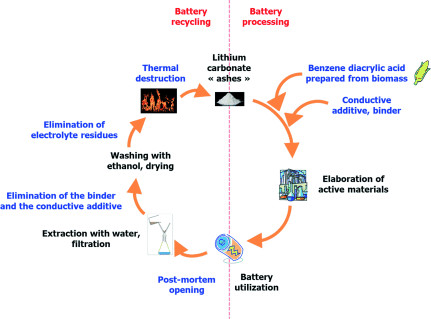
Renaults own greatest accomplishment is the development of dilithium benzene diacrylate, a compound for use in LIBs that can be extracted from pine resins or alfalfa. When the end of the battery life cycle is reached lithium carbonate can be retrieved via ”thermal desctruction”, in other words burning, of the material. The lithium carbonate can then be used together with a precursor (benzene diacrylic acid) extracted from pine resins or alfalfa to create new dilithium benzene diacrylate to be used in another battery. This recycling process is shown in detail by the image above.

It will be very interesting to see when and in which form green batteries will be commercialized. Maybe we will be able to buy them for certain applications not too long from now.

A short history of batteries

Image: Voltaic Pile by I, GuidoB, CC BY-SA 3.0, https://commons.wikimedia.org/w/index.php?curid=2249821

Ancient batteries

Batteries have actually been around much longer than most people think. The first battery that we have proof of dates back to about 200 BC. This ”Bagdad battery” was discovered 1938 by archeologists in Khujut Rabu close to Bagdad. It consisted of a clay jar which contained an iron rod encased in a copper cylinder. This primeval battery was able to deliver a potential of 1.1 V when the jar was filled with vinegar as the electrolyte. Though there are no written records about their application, scientists assume that they were used to electroplate items, i.e. to put gold coatings on metal objects.

The Voltaic Pile

We have to fast-forward to the year 1800 to find the next historic battery, the ”Voltaic pile”. It was developed by Alessandro Volta in Italy and consisted of alternately stacked zinc and silver discs. In between the discs Volta placed cardboard soaked in salt water. When a wire was connected from the bottom zinc to the top silver disc it could produce sparks. Another discovery we have to thank Volta for is the electrochemical series which arranges metals according to the potential they can deliver against a standard electrode.

The Daniell Cell

The next step was taken by the British researcher John Frederich Daniell who developed the Daniell cell around 1820 which could deliver more stable currents than the voltaic pile. It consisted of a zinc plate and a copper plate that were placed in separate vessels filled with a liquid electrolyte. A salt bridge was added between the two vessels and a potential of about 1.1 V could be delivered. The Daniell cell was used to power, e.g. telegraphs and telephones for over 100 years.

The Lead Acid Battery

In 1859 French physicist Gaston Planté started experimenting on what would later be known as the lead acid battery, also being the first rechargeable battery. It consisted of two rolled-up lead sheets with a piece of flannel placed in between them. This assembly was immersed into dilute sulphuric acid. Many improvements have been made since then to reduce the amount of liquid acid in the battery, but their working principle has not changed. They are still widely used today, for example as car batteries.

The Leclanché Cell

French scientist Georges Leclanché developed a smaller and lighter, but non-rechargeable, battery in 1866, the Leclanché cell. It was made up from zinc, manganese oxide mixed with carbon and an ammonium chloride electrolyte. These cells were widely used for almost 100 years until they had to give way for the newer alkaline-manganese batteries in the 1960s.

Nickel-Based Batteries

From 1893 to 1909 the nickel-cadmium battery was developed as a rechargeable cell in Sweden by Waldemar Jungner. These efforts were similar to work carried out by Thomas Edison in the USA around the same time. However, Edison`s nickel-iron battery failed quite spectacularly when it was employed to power cars. Jungner`s nickel-cadmium battery, on the other hand, is still widely used today based on the same chemistry he invented. In the 1970s the nickel-cadmium battery was refined and the nickel-metal hydride battery was created in Switzerland. The goal was to avoid the toxic metal cadmium in batteries. These cells can still occasionally be found in portable electronics today.

The Alkaline-Manganese Battery

The alkaline-manganese battery (or alkaline battery) was developed as a small, light and non-rechargeable cell in 1949 by the Canadian engineer Lewis Urry. It was based on the same chemistry as the Leclanché cell using zinc and manganese oxide. But the ammonium chloride electrolyte had been substituted with potassium hydroxide. These cells are the most popular non-rechargeable battery system today.

The Lithium-Ion Battery

The lithium-ion battery is probably the most reasearched battery system today. It was first introduced in 1991 by Sony after several seperate inventions of John Goodenough, Rachid Yazami and others. These batteries are the most energetic rechargeable batteries available and power almost all portable electronic devices like computers and mobile phones. Lithium-ion batteries are based on a rocking-chair-principle were lithium ions can be transported through an electrolyte between two electrodes. Common commercial electrode materials are graphite and lithium cobolt oxide or lithium manganese oxide. However, there is still a huge amount of research being carried out in order to find better materials.

Beyond Lithium-Ion Bateries

At the moment there is also a growing amount of research on new battery chemistries, which include the sodium-ion battery, magnesium-ion battery, potassium-ion battery and more. They normally orperate on the same rocking-chair-principle as lithium-ion batteries. The reason for this kind of research is that lithium is a very limited raw material, while other materials like sodium are much more abundant on Earth and therefore cheaper. It will be very interesting to find out if any of these batteries will be commercialized on a large scale in the future.