Of Poinsettia and Gingerbread – Christmas Chemistry Experiments

Title image credit: Maurice Snook, ACS (2011).

Why not try some Christmas chemistry with your science and chemistry students during the last week before Christmas? The easy-to-do Christmas experiments in this article can be used to shake things up a little just before you break up for turkey roast and minced pie. With the instructions come suggestions about what previous knowledge can be discussed together with these experiments.

1 Orange Peel Flamethrower

This experiment is very easy and can be done by the students or as a demonstration. It is suitable for ages 11 to 16. It can even be done with or demonstrated to primary children if you trust them with candles.

All you need is a candle and some orange peel. First, you have to light the candle. Then fold your orange peel, the shiny, orange side should face the candle. As you squeeze the peel, oils from the peel will squirt into the flame. The oils ignite and produce beautiful sparks in the candle flame. In addition, this experiment smells very nice and Christmassy.

This short practical or demonstration can be used to discuss the flammability of different organic substances. The oil burning in the flames is a fat, which can be used to recap carbon chemistry. The combustion of the oil can be linked to oxidation reactions and exothermic/endothermic reactions.

2 Poinsettia pH Paper and Indicator

2.1 Background

This experiment is suitable for ages 11 to 18. It is adapted from a procedure by A.M. Helmenstine (2017).

The poinsettia flower originates form warmer climates. Nevertheless, many people use them as a decoration in their house during the winter holidays. Their red leaves contain substances that change colour when they are in contact with an acid or a base. For this reason, poinsettias are one of the natural pH indicators such as turmeric and red cabbage.

2.2 Procedure

You will need a poinsettia flower, a beaker, water, scissors, filter paper, a bunsen burner or a heating plate, a tripod, a funnel, a pH meter or universal indicator paper, 0.1 M HCl (hydrochloric acid), vinegar (dilute acetic acid), baking soda solution (10 g/ 1 dm3)  0.1 M NaOH (sodium hydroxide) and any other acids or bases you would like your pupils to test.

With scissors cut a few petals of a poinsettia plant into very small pieces and put them into a beaker. Add just enough water to cover the petal pieces and boil with Bunsen flame or heating plate for a few minutes until the water has taken the colour of the petals. Then, filter the liquid with a funnel and filter paper into a conical flask. This solution can already be used as a pH indicator solution.

To make pH paper, some of the solution needs to be poured onto a petri dish. Afterwards, pH paper is placed onto the petri dish to soak in the indicator solution. The filter paper has to dry and can finally be cut into pH strips.

The pH paper and indicator solution can be tested against different acids and bases, such as 0.1 M HCl (hydrochloric acid), vinegar (dilute acetic acid), baking soda solution (10 g/ 1 dm3) and 0.1 M NaOH (sodium hydroxide).

Poinsettia-1024x679

2.3 pH Chart Challenge and Links to Previous Knowledge

The exact colour range for pH values can vary for different poinsettia plants. Students can be challenged to make their own poinsettia pH chart. For this, they will have to measure the pH of the test solutions above with a pH meter or universal indicator paper which already has a colour chart. They can then match their poinsettia indicator colour to the pH meter or universal indicator chart.

Obviously, you can link this practical to indicators and natural indicators as well as everything the pupils already know about acids and bases.

3 Thermal Decomposition of Sodium Bicarbonate and its Importance for Gingerbread

3.1 Background

This experiment is suitable for ages 14 to 18. A-level and more able KS4 students could even be challenged to plan their own investigation and experiment to answer the question. The question is: What happens to sodium bicarbonate when it is heated in the oven during the baking process?

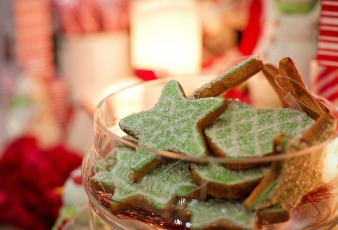
Sodium bicarbonate (NaHCO3) is an important part of many gingerbread and cookie recipes. Sodium carbonate is also the major ingredient in baking powder which is often used instead of sodium bicarbonate. The task of sodium bicarbonate is to release gases when heated. These gases form bubbles and are trap

ped inside the dough during the baking process. This is important since the gas raises the cake and provides the “fluffiness” in cakes and cookies.
christmas-cookies-2918172_960_720

This experiment can be adapted and shortened by omitting the calculations and deciding which reaction equation is right. This would still demonstrate that sodium bicarbonate loses mass when heated during baking as it releases water and carbon dioxide. The importance of this for baking can still be discussed and stressed with students.

3.2 Procedure

Pupils are provided with three possible reaction about what could happen during the reaction and they have to find out what is happening:

  1. NaHCO3 -> CO2 + NaOH
  2. 2 NaHCO3 -> H2O + 2 CO2 + Na2O
  3. 2 NaHCO3 -> H2O + CO2 + Na2CO3

For the experiment, pupils need to weigh in and write down an exact amount of sodium bicarbonate. 2 to 3 g are suitable. The scales should be as exact as possible for this task. The sodium bicarbonate is put into a crucible. NOTE: It is important that the students write down the weight of the empty crucible as they will have to weigh the thermal decomposition product inside the crucible. They should also mark their crucible with their name.

The crucible should be heated for 15 to 20 minutes at 180 degrees Celsius. This can be done in any oven. (Maybe your food department can help you out, if you do not have any oven and the crucibles have been thoroughly cleaned before the experiment.) It is also possible to heat the crucible over a bunsen flame for about 20 minutes.

More able pupils and A-level students can be asked to decide themselves at which temperature and for how long they want to heat their sample. (Having been told about the use of sodium bicarbonate in baking powder, they should be able to tell that a normal baking temperature and time for cookies should be sufficient.)

After heating the sample, students need to weight it again and write down the new mass.

3.3 Calculations

This part can be omitted. If you do, you should provide your pupils with the information about chemical reaction directly and discuss the importance of it for baking.

Their task now is to figure out which reaction is taking place during the thermal decomposition of sodium bicarbonate. They need to be given the information that the gasses formed are carbon dioxide (CO2) and water (H2O).

A-level and more able KS4 students can try to have a go at these calculations themselves. In other classes, I would do the calculation together with the class. Or at least model one of the three possible calculations,

The reaction actually happening is the third one from the list above:

2 NaHCO3 -> H2O + CO2 + Na2CO3

Molar masses (M):  NaHCO3: 84 g/mol;  H2O: 18 g/mol;  CO2: 44g/mol;   Na2CO3: 106 g/mol

Key equations:  substance amount = mass/molar mass     n = m/M

mass = substance amount x molar mass    m = n x M

The mass of sodium bicarbonate before the experiment is sodium bicarbonate NaHCO3, let us assume it was 2.0 g. This means we had 0.024 mol of sodium bicarbonate in the beginning (n = 2/84). For two mole of sodium bicarbonate, one mole of sodium carbonate, Na2CO3, is formed. This means we have 0.012 mol sodium carbonate which equals 1.272 g (m = 0.012 x 10⁶).

Does this mass, 1.272 g, match the mass that we have after the experiment?

You can do the calculation also for sodium hydroxide (NaOH; M = 40 g/mol) and sodium oxide (Na2O; M = 62 g/mol) to show that it must be sodium carbonate which is formed. The calculated masses for sodium hydroxide and sodium oxide will not match the mass from the experiment after heating!

For sodium hydroxide, we would have a mass of 0.48 g (m = 0.012 x 40) and for sodium oxide 1.488 g (m = 0.024 x 62), if 2.0 g (= 0.024 mol) sodium bicarbonate are weighed in before the experiment.

3.4 Gingerbread and Links to Previous Knowledge

This experiment can be used to discuss thermal decompositions and endothermic reactions. As seen with the calculations, conversions between mas and amount of substance can be practiced and revised. In addition, the conversion of mass can be discussed.

My experience is that pupils really like the link to everyday life which is baking, especially during Christmas time. This aspect should really be stressed when doing this experiment.

When teaching this experiment earlier, I provided my students with gingerbread recipes when they left after the session. The students really appreciated this little give-away and I can recommend if you want to do this experiment.

4 Silver Christmas Decorations with Tollen’s Reagent

4.1 Background

This experiment is most for A-level students if they are to conduct it themselves. For younger ages, it is better as a demonstration. It is essentially Tollen’s test and demonstrates how reducing sugars reduce silver ions to silver. The method is adapted from the Royal Society of Chemistry and the Nuffield Foundation (2015).

4.2 Procedure

You will need bottles that should be as small as possible. (Small booze bottles are useful.)  These bottles need to be cleaned thoroughly and rinsed with purified water before the experiment. Further, 25 cm3 beakers, funnels, pipettes, silver nitrate (AgNO3, s), potassium hydroxide (KOH, s), glucose (dextrose) (= reducing sugar), ammonia solution, (NH3, aq) and concentrated nitric(V) acid, (HNO3, aq) and purified water are needed.

The following solutions need to be prepared, but NOT mixed before the experiment. The solutions should suffice for about 10 experiments.

  1. 5 g of silver nitrate in 500 cm3 of purified water to make a 0.1 M solution
  2. dissolve 11.2 g of potassium hydroxide in 250 cm3 of purified water to make a 0.8 M solution
  3. dissolve 2.2 g of glucose in 50 cm3 of purified water.

The following instructions are for a 50-cm3-bottle, the amounts will have to be adjusted for larger or smaller bottles. Place 15 cm3 of the silver nitrate solution in a 25-cm3-beaker. In a fume hood, add a few drops of ammonia until the brown precipitate dissolves. The colourless complex ion, [Ag(NH3)2]+ is formed.

Now, pour 7.5 cm3 of the potassium hydroxide solution into the 25-cm3- beaker and a dark brown precipitate of silver(I) oxide (Ag2O) is formed. Then, add a few more drops ammonia solution till the precipitate dissolves again.

The formed clear solution is called Tollen’s reagent. Pour this solution into your small bottle using a funnel and add 1 ml of the glucose solution with a pipette. Screw the cap on the flask and swirl the solution so that the whole of the inner surface of the flask is wetted. The solution will turn brown. Continue swirling until a silver mirror forms after 2 minutes.

4.3 Christmas Tree Decoration and Links to Previous Knowledge

After the experiment, wash the solution down the sink with plenty of water. Rinse out the flask well with water. A string can be added around the neck of the flask, so it can be hung up in a Christmas tree at home.

Obviously, this experiment can be used to link to learning about reducing sugars, but also to redox reactions. It can even be used to discuss noble metals and why silver is easily reduced considering the electrochemical series.

background-2937873_960_720

References

  1. Poinsettia pH Paper and Indicator: M. Helmenstine (2017), https://www.thoughtco.com/poinsettia-ph-paper-604229, (25 November 2017)
  2. Silver Christmas Decorations with Tollen’s Reagent: Royal Society of Chemistry and the Nuffield Foundation (2015), Learn Chemistry, http://www.rsc.org/learn-chemistry/resource/res00000822/a-giant-silver-mirror-experiment?cmpid=CMP00004158 (25 November 2017).
  3. Images: com (25 November 2017)

How to make your own soap – A science practical for homemade christmas presents

Chemistry pratical or Christmas present? This can be both…

Profilbild för tangofscienceA tang of science

Following my last article about the chemistry of soap, I have become interested in making my own soap. From my research I have put together a practical/experiment that can be used in science lessons for students to make their own soap. The available scents with this recipe are coconut and cocoa. You can of course also try this yourself if you want to make some nice christmas presents.

The experiment works via the saponification reaction between fats from vegetable oils and sodium hydroxide from lye. The students will learn about saponification, how soaps work and how they can be made industrially.

1. Introduction

Humans have been been making and using soap for at least 2300 years. In all that time the manufacturing process has not changed much. Fats from animals or plants are reacted with sodium hydroxide in a reaction called saponification where soap is produced and glycerol is a…

Visa originalinlägg 831 fler ord

The Isolation and Detection of Starch – A Practical for Science Lessons

1 Goal

In this lab you will isolate starch from potatoes and investigate if different food samples contain starch. This is done with the help of Lugol’s solution (iodine/ potassium iodide solution).

2 Introduction

Starch is an organic compounds that belongs to the carbohydrates. Carbohydrates are an energy storage for both plants and animals. Starch molecules are very long and the building blocks repeat themselves. They form long chains and belong to the so-called poly saccharides. The two building blocks of starch are amylose which forms spiral chains and amylopectin which forms branched chains. Both are built up from glucose rests which is why the chemical formula can generally be written as (C6H10O5)n. Starch can be found, e.g. in root crops and grains.

The presence of starch can be detected with with the help of Lugol’s solution which is a mixture of iodine and potassium iodide dissolve din water. Potassium iodide is added to increase iodine’s solubility in water. Iodine molecules (I2) are stored in the spiral chains of amylose when Lugol’s solution (brown solution due to the iodine) is added to the starch. This storage compound (”iodine starch”) causes a blue-black colour. A schematic of the compound is shown to the right in the figure above.

3 Materials and Chemicals

  • Two Potatoes
  • Different other foods: Flour, bacon, cheese, apples, pasta and rice are recommended
  • Lugol’s solution (= iodine/potassium iodide solution)
    – Preparation: Dissolve 10 g potassium iodide in 100 ml of distilled water. Then slowly add 5 g iodine crystals, while shaking. Finally, lter and store in a tightly stoppered brown glass bottle.
  • Knife and Spoon
  • Several Test Tubes with Gummy Plugs
  • Mortar
  • One 250 ml-Beaker and one 800 ml- or 1000 ml-Beaker
  • Heating plate
  • Linen cloth
  • Funnel
  • Two Bowls
  • Grater

    4 Implementation

    4.1 The isolation of starch

    First, the potatoes need to be cleaned and peeled. Thereafter, they are grated and put into a bowl. 500 ml of water are added and the mixture is stirred thoroughly with a spoon for at least five minutes. A linen cloth is placed in a funnel and the mixture is pressed through into a large beaker (800 ml or 1000 ml). A part of the grated potatoes, for example the cellulose, will stay behind in the linen cloth. The liquid in the large beaker needs to stand and rest for approximately ve minutes. Then more water is added, approximately 100 – 200 ml. The finely dispersed, solid starch particles will slowly settle at the bottom of the beaker. Afterwards, the
    water is decanted (= poured off). Then 100-200 ml of water are added again to
    the large beaker and decanted when the solid starch particles have settled on the
    bottom a second time. This cleaning step is repeated until the starch particles have
    a completely white colour. Afterwards, the starch is dried in a at bowl in air and
    at room temperature.

    4.2 The detection of starch

    The foods are crushed in a mortar and and small amounts of each are put into their respective test tube. The test tubes are filled up to a third with water and shaken vigorously. In case not all the food particles are suspended, the test tubes are heated in a water bath (water bath = a 250 ml-beaker filled with water and the test tube inside is heated carefully on a heating plate, the test tube is afterwards cooled under owing, cold water). Then one drop of Lugol’s solution is added to each test tube and the test tubes are shaken with a gummy plug on top.

5 Questions for Discussion

1. What is observed macroscopically when iodine is built into starch molecules? What happens when no starch is present?

2. Which function does starch have?

3. In which foods do you expect to detect starch? In which foods should there be no starch?

4. Do the results in the table match your expectations? If not, why could they be different?

References

Image retrieved from: Petra Mischnick, Skolan för kemivetenskap , Kungliga Tekniska Högskolan, Stockholm, 11 January 2013 (https://www.kth.se/che/archive/arkiv/molnov-1.272910, 30 August 2017).

How to make your own soap – A practical for science lessons

Following my last article about the chemistry of soap, I have become interested in making my own soap. From my research I have put together a practical/experiment that can be used in science lessons for students to make their own soap. The available scents with this recipe are coconut and cocoa. You can of course also try this yourself if you want to make some nice christmas presents.

The experiment works via the saponification reaction between fats from vegetable oils and sodium hydroxide from lye. The students will learn about saponification, how soaps work and how they can be made industrially.

1. Introduction

Humans have been been making and using soap for at least 2300 years. In all that time the manufacturing process has not changed much. Fats from animals or plants are reacted with sodium hydroxide in a reaction called saponification where soap is produced and glycerol is a biproduct.

Soaps are the sodium salts of fatty acids. It is the combination of the non-polar, long carbon chain of the fatty acid and the polar, ionic end consisting of carbonic acid anion and the sodium cation that let soaps dissolve dirt particles in water. The soap molecules are arranged around the dirt particles in spheres called micelles as the non-polar carbon changes are drawn to the non-polar dirt. The polar, ionic ends face the polar water and enable the removal of the dirt.

Today almost all liquid body washes and some bar soaps do not contain actual soap any more. Instead, they are made of soap-like molecules that are derived from petroleum and work the same way soap does. However, bar soaps can be produced in a more environmentally friendly process using only renewable sources and less energy.

You are going to make our own soap via a saponification reaction between vegetable fats (from olive oils, coffee and coconut oil or cocoa butter) and sodium hydroxide in lye. This is how many bar soaps are still made today.

2. Materials

  • Coconut oil or cocoa butter Depending on which smell you want for your soap. It will give your soap its smell, and also provide fats that the sodium hydroxide can react with.

  • Olive oil The main fat that will react with the sodium hydroxide.

  • Lye Sodium hydroxide solution in water of 25 mass-%, that can be bought in the cleaning section of supermarkets.

  • Coffee Not powder, the actual drink. This will provide the reaction medium, but also some fats that the sodium hydroxide can react with.

  • Coffee grounds They are a filler that will give the soap bar the right consistency. Otherwise it would be too soft.

  • Oat bran It is a filler that will give the soap bar the right consistency. Otherwise it would be too soft.

  • Scale

  • Thermometer

  • Protective gloves Latex gloves will suffice, but you can also use nitrile gloves.

  • Lab coat

  • Lab goggles

  • Glass stick or plastic spoon for stirring

  • 1 large beaker for cooking or stainless steel pot

  • Beakers or glass bowls for mixing

  • Measuring cylinders

  • Spoon or spatula

  • Soap mold A form in which you can pour the soap to let it set.

  • Heating plate

  • Baking paper

  • Towels

  • Sharp knife

    3. Procedure

The quantities used here will make soap for two students. They will have to be adjusted if larger groups works together.

  1. Using a scale, weigh out 50 g coconut oil or cocoa butter in a beaker. With a measuring cylinder, measure 75 ml (70 g) olive oil. In a second one, measure 45 ml (45 g) coffee. Weigh out 18 g lye in a beaker or bowl on the scale. Mix 1/2 tee spoon coffee grounds and 1 table spoon oat brain in another beaker or bowl.

  2. Work under a fume hood or in another well-ventilated area. Make sure to put on lab coat, lab goggles and protective gloves and keep them on until the soap is poured into the mold.

  3. Pour the coffee in a beaker or bowl and carefully add the lye to the coffee, and stir to dissolve. (Always add lye to liquid, not the other way around.) This will start a chemical reaction.

  4. Melt coconut oil or cocoa butter in a beaker or stainless steel pot over low heat on the heating plate until no solids remain. Add the olive oil. Check the temperature of the two fats with the thermometer. Compare against the temperature of the lye solution, and adjust until they are within a degree or two of each other, in a range between 40 and 45 degrees Celsius.

  5. Pour the lye solution into the beaker/bowl with the oils, and use a glass stick or plastic spoon and stir for 10 to 15 minutes. Then stir in the coffee grounds and oat bran with a spoon or spatula.

  6. Slowly pour the mixture into a soap mold. Baking paper should have been put into the soap mold beforehand Carefully, lift and tap the mold against the table a few times to release air bubbles. Cover with baking paper, and then wrap the entire mold with a towel to insulate it.

  7. After four to five days, remove the towel, and take the soap out of the mold. Let the soap loaf sit for another day to harden further before cutting into bars with a sharp knife. Cutting only needs to be done if students shared one form for their soap.

  8. After the soap is cut into bars, you will need to let them cure in a cool and well-ventilated area for four weeks. This allows the soap to finish saponification and for all the excess water to evaporate.

    References

  1. M. Caudill. Homemade Coconut Oil Soap, 15 September 2015. Retrieved from: www.rodalesorganiclife.com/wellbeing/homemade-coconut-oil-soap (28 July 2017).

  2. A.S. Davidsohn, Soap and detergent, from Encyclopaedia Britannica Online, 2017. Retrieved from: https://www.britannica.com/science/soap (28 July 2017).

  3. American Cleaning Institute, Soaps & Detergents: Chemistry (Surfactants), 2017. Retrieved from: http://www.cleaninginstitute.org/clean_living/soaps__detergents_chemistry_2.aspx (28 July 2017).

My new hobby: Citizen Science

Image: Solveig Böhme, 2017. Picture of flowers taken for iNaturalist where they were identified as ”heartsease”.

The train ride from Stockholm to Gothenburg normally takes about three hours. The last time I went an accident on the railway South of Stockholm made it last more than double that time. This was, of course, quite annoying, but observing opossums, chipmunks, coyotes and the surface of Mars made the trip fun for me anyway.

Now, I guess you are like: Whaaaat? Opossums, chipmunks and coyotes do not live in Sweden. And how does Mars fit in? Did the train take a detour there? The answer is easy. Only a few days before I had joined the webpage scistarter.com which promotes and offers projects in citizen science.

Citizen science offers people the opportunity to support scientists in their work and take part in scientific projects during their free time. It was born out of the need for scientists to collect and analyse ever larger amounts of data. Citizen scientists help with the collection and the analysis of data which does not need any special training. The beauty of citizen science is not only that people volunteer their free time to help advance scientific progress, but also that it brings science closer to normal people. Citizen science projects are not conducted far away from the public, but rather by the public and in its midst.

One more thing we can learn from citizen science is that science can be a hobby as Dr Caren Cooper explained in a TED talk. At school if you liked music or PE, people did not necessarily think you would become a musician or a professional athlete. But if you liked science, you were almost automatically expected to take up a related profession. It was a bit like you could either be inside or outside of it, but not in between. A view that I have personally shared for a long time. No one thought so about music or sports at school. Of course, you could just pursue them as a hobby. Now, finally, citizen science shows us that the same is true for science. You can be a professional pianist of football player and still enjoy doing citizen science in your free time.

I guess many of you will think that citizen science is a bit like voluntarily doing extra physics homework at school. But it is much more fun than that and I am sure many teenagers would prefer it to their real science homework. For instance, one of my favourite citizen science projects right now is Mars Mapper, where you get to find and mark craters on images of Mars. (Therefore, the train detour to the red planet.) When else do you get to help out NASA? Another really cool example is Zooniverse where you can look at photos from camera traps in North America or Africa and identify the visible animals. (Hence, the opossums, chipmunks and coyotes.)

There are also many projects you can do on a hike, in a park or garden, or even at home. You can send in a handful of soil from your garden or water from your shower head to be analysed for chemicals and bacteria. If you have a cat you can submit a sample of her hair and food to find out what Kitty is eating when spending time outside. Perhaps at another family’s home? You can even monitor the water quality of a lake or stream close to your home with the LakeObserver mobile phone app or observe how many bees frequent a certain flower with the Great Sunflower Project. The possibilities are almost endless.

Personally, I have fallen in love with the mobile phone app iNaturalist. You can take photos of plants or animals and upload them together with the time and place of the observation. If you can not identify the species, no problem, other users mostly can and will do it. Once uploaded and identified, the observation can be used by scientists for their work. The beauty of this app is not only the contribution of data, but also that the user gets to learn a lot about wildlife.

There are also other webpages where you can upload the pictures of your wildlife sightings (wildlifesightings.net) or of environmental change you see in your surroundings due to global warming (iseechange.org). These two, as well as the Great Sunflower Project, can be very fun science homework for schools. Pupils not only get to go outside, but will also be forced to think outside the box of regular science lessons. In addition, they can feel proud as their work will actually contribute scientific progress. Another nice project for schools is the Ant Picnic where students prepare a picnic for ants and record which ant species show up and what food they like best. These and similar projects could be very valuable to teach pupils how to work scientifically and, most importantly, to enjoy science lessons.

If you feel like you do not have time to take part in any citizen science project, that is no problem either. Initiatives like Folding@home offer the opportunity to donate some computing power of your private computer to the calculation of folding patterns for proteins which is important to fight diseases like Alzheimer’s or cancer. This is what my private computer is doing now during its idle time. All you have to do for this project is to download the software.

All in all, there is a large amount of projects in astronomy, archaeology, biology, chemistry, environmental science, etc. that are just waiting to be discovered by you on webpages like scistarter.com and citsci.org. Enjoy exploring!