Make Things Sink, Then Float

You will need

  • Modelling clay or blue tag
  • Marbles (if you don’t have marbles, use small rocks)
  • Water
  • Glass bowl or a large glass jar

What to do

  1. Fill the glass bowl or jar with water.
  2. Drop the marbles into the water. They quickly sink to the bottom. Roll the clay into a ball and drop it into the water as well.
  3. The clay also sinks like the marbles.
  4. Remove the marbles and the clay ball from the water.
  5. Flatten the clay as much as possible, then shape it to make a boat and place it into the water. Now it floats!
  6. Add one marble as a cargo. The boat settles lower, but still floats.
  7. Add more marbles, one at a time. How many can you add before your boat sinks?

Background

Large ships float on water, even though they are very heavy.  However, a small object like a marble sinks. The mass of the object does not matter. Whether or not an object floats depends on its density and how much water it “displaces”, or pushes aside.

When the clay is shaped like a ball, it does not displace much water and it sinks. When shaped like a boat, the clay has a bigger area and displaces more water which makes it float. When adding your cargo of marbles, the boat settles lower to displace more water and carry the extra mass. When adding too many marbles, the boat will settle below the water line and sink.

This is important for ships. Too much cargo can lower them too close to the water line and make them vulnerable to sinking.

You can watch this experiment as a video here:

Test the Flow of Liquids

You will need

  • 3 Glass jars (empty and cleaned)
  • 3 Marbles (cleaned and dried)
  • If you don’t have marbles, use small rocks instead.
  • Water
  • Vegetable oil, for example olive oil or sunflower oil
  • Syrup or honey
  • Cooking oil and syrup or honey can still be used or eaten after this experiment.

What to do

  1. Fill each glass jar with a different liquid at least half full. Make sure that the liquids have the same height in each jar.
  2. Drop a marble into each one and observe how fast the marble falls through the liquid inside.
  3. The slower the marble falls, the higher is the viscosity of the liquid. Which liquid in this experiment has the highest and which the lowest viscosity?

Background

It takes much longer to pour syrup into a glass than to pour water. This is because syrup has a high “viscosity”. This means that it does not flow easily. The higher the viscosity of a liquid, the slower it will flow.

You can test the viscosity of a liquid by dropping a marble into it. The slower the marble falls, the higher is the viscosity of the liquid.

You can watch this experiment as a video here:
Red Cabbage Indicator

You will need

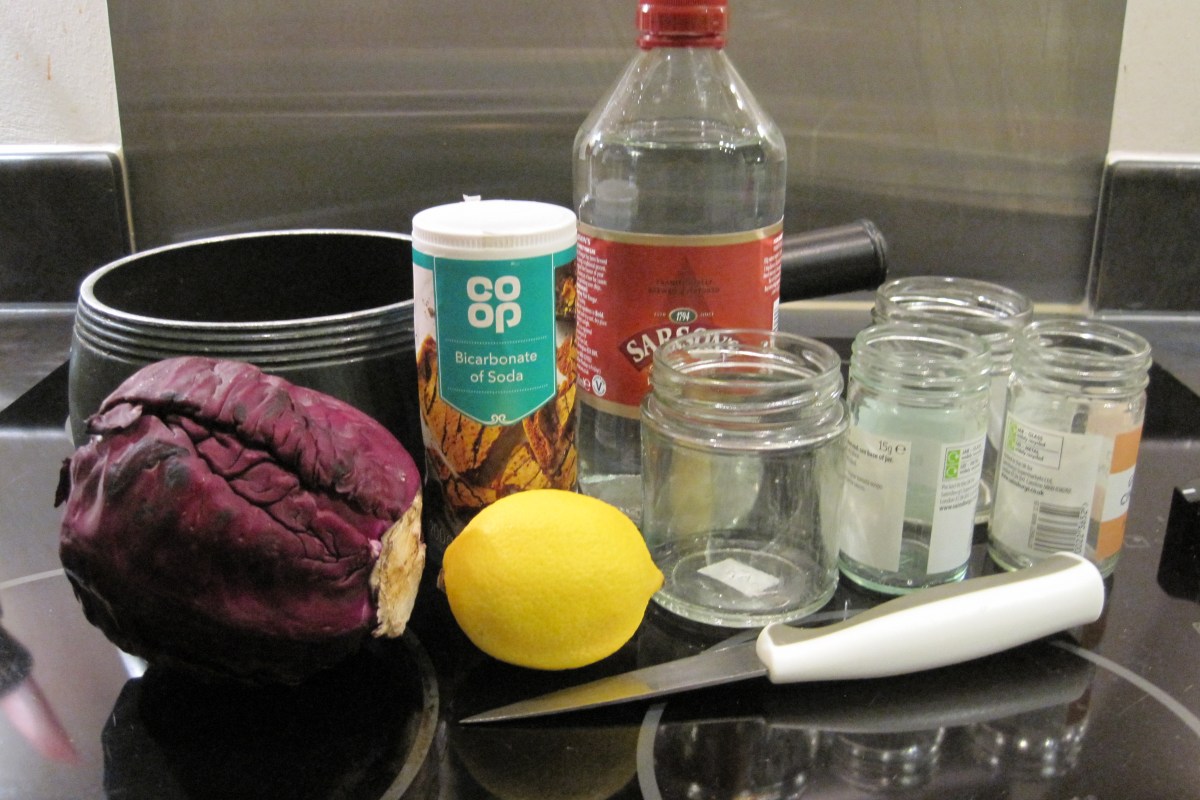
  • 1 Sauce pan
  • 1 Chopping board
  • 1 Knife
  • 1 large glass jar
  • 4 small glass jars
  • 1 Red Cabbage
  • Vinegar, lemon juice, water and bicarbonate of soda to test

What to do

  1. Carefully chop the red cabbage leaves into small pieces on the chopping board.
  2. Put the red cabbage in a sauce pan and add water until the red cabbage leaves are completely covered.
  3. Gently boil the red cabbage for 10 to 15 minutes.
  4. After the sauce pan has cooled down, collect the water in a large jar.
  5. To better see the red cabbage water’s colour add some water to dilute it.
  6. Transfer the red cabbage water into the 4 small jars.
  7. Add a dash of vinegar to the first small jar with red cabbage juice and observe what happens.
  8. Repeat step 7 for the other substances you want to test. Each substance goes into a new small jar with red cabbage juice.
  9. What colour changes do you observe?

Background

Red cabbage juice is a pH indicator. This means it changes colour depending on if it is in an acidic, alkaline or neutral environment. In this experiment you are testing some acids (vinegar and lemon juice), some alkalis (bicarbonate of soda) and a neutral substance (water).

Which colour changes can you observe in your experiment? What colour does red cabbage indicator have in acids, bases or with neutral substances?

You can watch this experiment as a video here:

Measure the Wind

You will need:

  • Scissors
  • Glue stick
  • Thin cardboard
  • Short pencil with rubber
  • Drinking straw
  • Small plastic pot, e.g. from yoghurt
  • Pin or needle
  • Blue tag or modelling clay
  • Compass, you can just use a Compass App on your mobile phone

What to do:

  1. Make a hole in the middle of the bottom of the plastic pot using the pencil. Then push the pointy end of the pencil through the hole.
  2. Carefully cut four small triangles from the cardboard using the scissors.
  3. Glue each of the 4 small triangles to the yogurt pot. Look at the image to see where they should go. These will show the direction of the wind.
  4. Cut two larger triangles from the cardboard using the scissors.
  5. Cut a short slit at either end of the straw. Insert the two large triangles into the slits to make and arrow-shaped pointer. This is called a “vane”.
  6. Carefully push the pin or needle through the middle of the drinking straw. Then push it into the rubber on the pencil end.
  7. Make a ring from blue tag or modelling clay and push the pot firmly into it, so it cannot blow away. Your wind vane is ready to use.
  8. Place your wind vane outside. Position it so that the small triangles point North, East, West and South. Use a compass to help you. The vane swings around in the direction of the wind.

You can watch this experiment as a video here: