Testing Acids and Alkalis in the Kitchen

Background

In this experiment you will investigate the properties of three substances in the kitchen to determine if they are acids or alkalis.

Acids have a sour taste. In high concentrations acids can burn your skin and other living tissue. But the acids you are working with in the kitchen have very low concentrations and safe to touch. Examples of laboratory acids are hydrochloric acid, sulphuric acid and nitric acid.

Alkalis have a bitter taste and feel slippery when you touch them. Alkalis in high concentrations can burn your skin or other living tissue too. But the alkalis in your kitchen have low concentrations and are safe to touch. One common alkali in laboratories is sodium hydroxide.

You will need:

  • 1 lemon or lemon juice
  • vinegar
  • dish washing soap (liquid soap for hand washing works too)

What to do:

  1. Copy the table below.
Substance Look Feel Taste Acid or alkali?
Lemon juice
Vinegar
Dish washing soap


  1. If you have a lemon instead of lemon juice you need to squeeze it now and collect some juice from it for your experiment.
  2. Look at the lemon juice, vinegar and dish washing soap and record in your table what they look like.
  3. In turns drop a bit of each of the substances on your hand and test what they feel like. Record it in your table.
  4. Now taste the lemon juice and the vinegar. Record what they taste like in your table. You do not have to taste the dish washing soap.

Questions

  1. Based on your data decide which substances are acids and which are alkalis and record it in your table. Use the text in the introduction to help you. It gives you information about the properties of acids and alkalis.
  2. What do you expect the dish washing soap would taste like? Why?
  3. Name two properties of acids.
  4. Name three properties of alkalis.
  5. Name two laboratory acids.
  6. Name one laboratory alkali.
  7. Which other acids and alkalis do you know that you have in the kitchen or the home?

The Science of Chocolate – Investigating the States of Matter

You will need:

  • Some pieces of chocolate (dark chocolate works best, but you can use milk chocolate too)
  • Pan
  • Bowls
  • Water

What to do:

  1. Put water in the pan and place it on the hob.
  2. Break the chocolate into small pieces and place it in a bowl over the pan with the water. (See image above.) Be careful not to mix any water with the chocolate.
  3. Turn on the hob and gently heat the water with the chocolate and bowl on top.
  4. Once the chocolate has melted, turn off the hob.
  5. Place half of the molten chocolate in a freezer to cool. If you do not have a freezer, you can use the fridge.
  6. Let the rest of the chocolate cool slowly at room temperature.
  7. Once both chocolates have frozen, compare what they look like. In addition, test how they taste differently and how they feel to the touch.
  8. Although both chocolates freeze and become solid again, they will be very different depending which temperature they are freezing at.

Questions

  1. A) Draw a diagram showing the arrangement of the chocolate particles in a solid.  B) Draw a diagram showing the arrangement of the chocolate particles in a liquid.
  2. What happens to the energy of the chocolate particles when it melts?
  3. What happens to the energy of the chocolate particles when it freezes?
  4. How is the chocolate that was cooled in the freezer different from the chocolate cooled at room temperature? Compare how they look, taste and feel when you touch them.
  5. The process of melting and freezing chocolate is quite important in food industry and chocolate making. Based on your experiment which temperature do you think is better for freezing chocolate, room temperature or the freezer/fridge? Why?

How to make an atomic model with sweets

You will need:

  • String
  • Scissors
  • Coloured sweets, for example smarties or skittles

What to do:

  1. Choose three colours that you want to use in your atom. Once colour for the protons, one for the neutrons and one for the electrons.
  2. Cut some string to make the electron shell.
  3. Put the sweets that represent the protons and the neutrons in the middle. The middle of the atom is called the nucleus.
  4. Arrange the string in a circle around the nucleus. It will form the electron shell.
  5. Put the sweets that represent the electrons on the electron shell (string). Make sure that the amount of protons and electrons is the same.
  6. Your atomic model is now complete. If you wish you can label the atom and add the charges for protons, electrons and neutrons.

You can watch this experiment on YouTube:

Active reading exercise: Isotopes

Isotopes

In 1932 James Chadwick, a British scientist, discovered the neutron. His discovery explains how isotopes are formed. Isotopes have the same number of protons, but different numbers of neutrons.

We can also say that the atomic number is the same, but the mass numbers are different. Isotopes are the same element because their atomic number does not change.

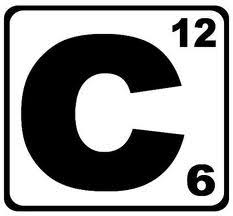
We refer to an isotope by adding its mass number to the element’s name. The isotope in the diagram below is called carbon-12.

carbon

Carbon isotopes

Carbon can occur as three different isotopes. They are called carbon-12, carbon-13 and carbon-14.

Carbon dating is used to identify the age of very old objects, for example the remains of extinct animals such as mammoths. The amount of the carbon isotope carbon-14 in an object is examined to determine its age.

Things to do

  1. Fill in the missing words and numbers to describe the similarities and differences between isotopes of the same element.                                                                                 a) Isotopes are atoms with the same            number but different                   number. b) They have the same number of protons and electrons but different numbers of                      .
  2. Name the scientist who discovered the neutron.
  3. Why are isotopes the same element?
  4. How do we refer to isotopes?
  5. Name the three isotopes of carbon.
  6. Why is the isotope carbon-14 useful?
  7. Using your knowledge about isotopes, fill in the gaps in the table a, b and c.
Isotope name Atomic number Mass number
 Tin-116  50 a
b c 118

Remember that the atomic number is the same for isotopes of the same element.

Active reading exercise: The Atom

A bit of history

In 1805 the English Chemist John Dalton published his atomic theory that said:

  • Everything is made up from tiny particles called atoms
  • Atoms are tiny hard spheres (= balls) that cannot be broken down into smaller parts
  • Atoms in one element are all identical

This helped to explain many properties of materials. However, later experiments showed that atoms contained even smaller particles. In 1897 another British scientist, JJ Thomson, discovered the electron. The nucleus which makes up the middle of an atom was discovered by Ernest Rutherford in 1913.

The Structure of the atom

Today we know that atoms are made from three subatomic particles: proton, neutron and electron.

Protons and neutrons are found in the centre of the atom which is called the nucleus. Both have a mass of 1. Protons have a positive (+) charge and neutrons are neutral (= no charge).

Electrons have a negative (-) charge and have almost no mass at all. They are found on the electron shells on the outside of the atom, circling the nucleus.

What you need to remember

  • Atoms are made from protons, neutrons and electrons called subatomic particles
  • Protons: found in nucleus, positive (+) charge and a mass of 1
  • Neutrons: found in nucleus, neutral (no charge) and a mass of 1
  • Electrons: found on electron shells, negative (-) charge and almost no mass


Things to do

  1. Name the scientist who first introduced atomic theory.
  2. Name the scientists who discovered the electron and the nucleus.
  3. State the names of the three subatomic particles as well as their masses and charges.
  4. State where in the atom protons and neutrons are found.
  5. State where in the atom electrons are found.
  6. Copy and label the image of the atom. Words: electron, proton, neutron, shellLithium atom
  7. Describe in your own words what an atom looks like. Include information about the charges and masses of the subatomic particles.

Reading Exercise: The History of the Atomic Model

Democritus’ atoms

Around 440 BC, Greek philosopher Democritus was the first to suggest the existence of atoms, tiny particles that make up all matter. The word atom comes from the Greek ”atomos” meaning indivisible.

However, most of his colleagues, especially Aristotle, did not agree with Democritus. Instead, they thought that matter was made up of the four ”elements” fire, water, wind and earth.

Dalton’s spheres

It took over 2000 years until another scientist would challenge Aristotle’s ”element” theory.

In 1803, John Dalton, an English teacher from Manchester, carried out experiments proving that all matter is made up of tiny particles. He chose to use Democritus’ name and called them atoms.

In Dalton’s model atoms were tiny, hard spheres that vary in size and mass, but cannot be split into smaller pieces.

Thomson’s plum pudding

It took a much shorter time to reach the next step in the discovery of the atomic model.

J.J. Thomson, another English scientist, discovered the electron in 1897 and developed the plum pudding model of the atom for which he received the Nobel prize in 1906.

The plum pudding model said that the tiny negative electrons were distributed in a positive mass inside the atom. The electrons were like negative raising in a positive plum pudding dough.

Rutherford’s gold foil experiment

The next experiment to develop the atomic model even further were carried out by one of Thomson’s former students, Ernest Rutherford, who was originally from New Zealand.

In 1909, Rutherford and his team conducted one of the most important experiments in the history of science. They used a gold foil which was bombarded with alpha particles (= Helium nuclei which have 2 protons and 2 neutrons).

If Thomson’s plum pudding model were true, you would expect all alpha particles to punch holes through the positive ”dough” and pass straight through the foil.

The results looked somewhat different. Most alpha particles did pass straight through the gold foil. However, some particles did not pass through and bounced back. This suggested that there were parts in the foil where mass was very concentrated, while the rest seemed to be empty space.

As a consequence, Rutherford introduced the modern planetary model of the atom where the electrons circulate around a nucleus. The nucleus is small, but contains most of the atom’s mass and is where the alpha particles bounced back in his experiment. The major part of the atom is empty space where the alpha particles could pass through.

By the way, Ernest Rutherford received a Nobel prize as well. However, it was for discovering the concept of half-life for radioactive substances rather than his work on the atomic model.

Tasks:

  1. Draw a timeline including the four stages of the atomic model’s development.
  2. Describe what the word ”atom” means.
  3. Describe what atoms were like in Dalton’s atomic model.
  4. State what Thomson discovered.
  5. Describe what atoms were like in Thomson’s atomic model.
  6. Describe the gold foil experiment Rutherford conducted.
  7. Explain how the gold foil experiment showed that Thomson’s theory was wrong.
  8. Describe what atoms are like in Rutherford’s model.
  9. Challenge: Find out how the atomic model developed further. You could look at the work of Niels Bohr, Werner Heisenberg and James Chadwick.

Which liquid dissolves candy canes fastest?

  1. Get four beakers. Fill one beaker with cold water, one with hot water, one with oil and one with vinegar. The hot water can be taken from the kettle.
  2. You need to put one candy cane in each beaker at the same time and start your timer.
  3. Record your observations.
  4. Record the time when the first candy cane has dissolved. BUT, do not stop the timer.
  5. Record the time when the 2nd and 3rd candy cane have dissolved too.
  6. Write your conclusion and state which liquid dissolves the candy cane fastest and which is the slowest.

Orange peel flamethrower

Here you can see the orange peel flamethrower in action.

The instructions are the following:

All you need is a candle and some orange peel. First, you have to light the candle. Then fold your orange peel, the shiny, orange side should face the candle. As you squeeze the peel, oils from the peel will squirt into the flame. The oils ignite and produce beautiful sparks in the candle flame. In addition, this experiment smells very nice and Christmassy.

So, go a head and surprise your family and friends with some amazing chemistry at Christmas dinner.

Of Poinsettia and Gingerbread – Christmas Chemistry Experiments

Title image credit: Maurice Snook, ACS (2011).

Why not try some Christmas chemistry with your science and chemistry students during the last week before Christmas? The easy-to-do Christmas experiments in this article can be used to shake things up a little just before you break up for turkey roast and minced pie. With the instructions come suggestions about what previous knowledge can be discussed together with these experiments.

1 Orange Peel Flamethrower

This experiment is very easy and can be done by the students or as a demonstration. It is suitable for ages 11 to 16. It can even be done with or demonstrated to primary children if you trust them with candles.

All you need is a candle and some orange peel. First, you have to light the candle. Then fold your orange peel, the shiny, orange side should face the candle. As you squeeze the peel, oils from the peel will squirt into the flame. The oils ignite and produce beautiful sparks in the candle flame. In addition, this experiment smells very nice and Christmassy.

This short practical or demonstration can be used to discuss the flammability of different organic substances. The oil burning in the flames is a fat, which can be used to recap carbon chemistry. The combustion of the oil can be linked to oxidation reactions and exothermic/endothermic reactions.

2 Poinsettia pH Paper and Indicator

2.1 Background

This experiment is suitable for ages 11 to 18. It is adapted from a procedure by A.M. Helmenstine (2017).

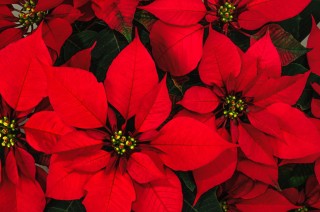
The poinsettia flower originates form warmer climates. Nevertheless, many people use them as a decoration in their house during the winter holidays. Their red leaves contain substances that change colour when they are in contact with an acid or a base. For this reason, poinsettias are one of the natural pH indicators such as turmeric and red cabbage.

2.2 Procedure

You will need a poinsettia flower, a beaker, water, scissors, filter paper, a bunsen burner or a heating plate, a tripod, a funnel, a pH meter or universal indicator paper, 0.1 M HCl (hydrochloric acid), vinegar (dilute acetic acid), baking soda solution (10 g/ 1 dm3)  0.1 M NaOH (sodium hydroxide) and any other acids or bases you would like your pupils to test.

With scissors cut a few petals of a poinsettia plant into very small pieces and put them into a beaker. Add just enough water to cover the petal pieces and boil with Bunsen flame or heating plate for a few minutes until the water has taken the colour of the petals. Then, filter the liquid with a funnel and filter paper into a conical flask. This solution can already be used as a pH indicator solution.

To make pH paper, some of the solution needs to be poured onto a petri dish. Afterwards, pH paper is placed onto the petri dish to soak in the indicator solution. The filter paper has to dry and can finally be cut into pH strips.

The pH paper and indicator solution can be tested against different acids and bases, such as 0.1 M HCl (hydrochloric acid), vinegar (dilute acetic acid), baking soda solution (10 g/ 1 dm3) and 0.1 M NaOH (sodium hydroxide).
Poinsettia-1024x679

2.3 pH Chart Challenge and Links to Previous Knowledge

The exact colour range for pH values can vary for different poinsettia plants. Students can be challenged to make their own poinsettia pH chart. For this, they will have to measure the pH of the test solutions above with a pH meter or universal indicator paper which already has a colour chart. They can then match their poinsettia indicator colour to the pH meter or universal indicator chart.

Obviously, you can link this practical to indicators and natural indicators as well as everything the pupils already know about acids and bases.

3 Thermal Decomposition of Sodium Bicarbonate and its Importance for Gingerbread

3.1 Background

This experiment is suitable for ages 14 to 18. A-level and more able KS4 students could even be challenged to plan their own investigation and experiment to answer the question. The question is: What happens to sodium bicarbonate when it is heated in the oven during the baking process?

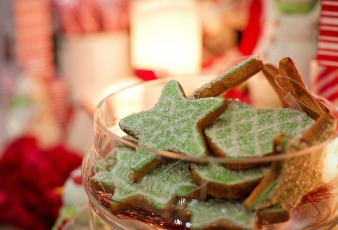
Sodium bicarbonate (NaHCO3) is an important part of many gingerbread and cookie recipes. Sodium carbonate is also the major ingredient in baking powder which is often used instead of sodium bicarbonate. The task of sodium bicarbonate is to release gases when heated. These gases form bubbles and are trap

ped inside the dough during the baking process. This is important since the gas raises the cake and provides the “fluffiness” in cakes and cookies.
christmas-cookies-2918172_960_720

This experiment can be adapted and shortened by omitting the calculations and deciding which reaction equation is right. This would still demonstrate that sodium bicarbonate loses mass when heated during baking as it releases water and carbon dioxide. The importance of this for baking can still be discussed and stressed with students.

3.2 Procedure

Pupils are provided with three possible reaction about what could happen during the reaction and they have to find out what is happening:

  1. NaHCO3 -> CO2 + NaOH
  2. 2 NaHCO3 -> H2O + 2 CO2 + Na2O
  3. 2 NaHCO3 -> H2O + CO2 + Na2CO3

For the experiment, pupils need to weigh in and write down an exact amount of sodium bicarbonate. 2 to 3 g are suitable. The scales should be as exact as possible for this task. The sodium bicarbonate is put into a crucible. NOTE: It is important that the students write down the weight of the empty crucible as they will have to weigh the thermal decomposition product inside the crucible. They should also mark their crucible with their name.

The crucible should be heated for 15 to 20 minutes at 180 degrees Celsius. This can be done in any oven. (Maybe your food department can help you out, if you do not have any oven and the crucibles have been thoroughly cleaned before the experiment.) It is also possible to heat the crucible over a bunsen flame for about 20 minutes.

More able pupils and A-level students can be asked to decide themselves at which temperature and for how long they want to heat their sample. (Having been told about the use of sodium bicarbonate in baking powder, they should be able to tell that a normal baking temperature and time for cookies should be sufficient.)

After heating the sample, students need to weight it again and write down the new mass.

3.3 Calculations

This part can be omitted. If you do, you should provide your pupils with the information about chemical reaction directly and discuss the importance of it for baking.

Their task now is to figure out which reaction is taking place during the thermal decomposition of sodium bicarbonate. They need to be given the information that the gasses formed are carbon dioxide (CO2) and water (H2O).

A-level and more able KS4 students can try to have a go at these calculations themselves. In other classes, I would do the calculation together with the class. Or at least model one of the three possible calculations,

The reaction actually happening is the third one from the list above:

2 NaHCO3 -> H2O + CO2 + Na2CO3

Molar masses (M):  NaHCO3: 84 g/mol;  H2O: 18 g/mol;  CO2: 44g/mol;   Na2CO3: 106 g/mol

Key equations:  substance amount = mass/molar mass     n = m/M

mass = substance amount x molar mass    m = n x M

The mass of sodium bicarbonate before the experiment is sodium bicarbonate NaHCO3, let us assume it was 2.0 g. This means we had 0.024 mol of sodium bicarbonate in the beginning (n = 2/84). For two mole of sodium bicarbonate, one mole of sodium carbonate, Na2CO3, is formed. This means we have 0.012 mol sodium carbonate which equals 1.272 g (m = 0.012 x 10⁶).

Does this mass, 1.272 g, match the mass that we have after the experiment?

You can do the calculation also for sodium hydroxide (NaOH; M = 40 g/mol) and sodium oxide (Na2O; M = 62 g/mol) to show that it must be sodium carbonate which is formed. The calculated masses for sodium hydroxide and sodium oxide will not match the mass from the experiment after heating!

For sodium hydroxide, we would have a mass of 0.48 g (m = 0.012 x 40) and for sodium oxide 1.488 g (m = 0.024 x 62), if 2.0 g (= 0.024 mol) sodium bicarbonate are weighed in before the experiment.

3.4 Gingerbread and Links to Previous Knowledge

This experiment can be used to discuss thermal decompositions and endothermic reactions. As seen with the calculations, conversions between mas and amount of substance can be practiced and revised. In addition, the conversion of mass can be discussed.

My experience is that pupils really like the link to everyday life which is baking, especially during Christmas time. This aspect should really be stressed when doing this experiment.

When teaching this experiment earlier, I provided my students with gingerbread recipes when they left after the session. The students really appreciated this little give-away and I can recommend if you want to do this experiment.

4 Silver Christmas Decorations with Tollen’s Reagent

4.1 Background

This experiment is most for A-level students if they are to conduct it themselves. For younger ages, it is better as a demonstration. It is essentially Tollen’s test and demonstrates how reducing sugars reduce silver ions to silver. The method is adapted from the Royal Society of Chemistry and the Nuffield Foundation (2015).

4.2 Procedure

You will need bottles that should be as small as possible. (Small booze bottles are useful.)  These bottles need to be cleaned thoroughly and rinsed with purified water before the experiment. Further, 25 cm3 beakers, funnels, pipettes, silver nitrate (AgNO3, s), potassium hydroxide (KOH, s), glucose (dextrose) (= reducing sugar), ammonia solution, (NH3, aq) and concentrated nitric(V) acid, (HNO3, aq) and purified water are needed.

The following solutions need to be prepared, but NOT mixed before the experiment. The solutions should suffice for about 10 experiments.

  1. 5 g of silver nitrate in 500 cm3 of purified water to make a 0.1 M solution
  2. dissolve 11.2 g of potassium hydroxide in 250 cm3 of purified water to make a 0.8 M solution
  3. dissolve 2.2 g of glucose in 50 cm3 of purified water.

The following instructions are for a 50-cm3-bottle, the amounts will have to be adjusted for larger or smaller bottles. Place 15 cm3 of the silver nitrate solution in a 25-cm3-beaker. In a fume hood, add a few drops of ammonia until the brown precipitate dissolves. The colourless complex ion, [Ag(NH3)2]+ is formed.

Now, pour 7.5 cm3 of the potassium hydroxide solution into the 25-cm3- beaker and a dark brown precipitate of silver(I) oxide (Ag2O) is formed. Then, add a few more drops ammonia solution till the precipitate dissolves again.

The formed clear solution is called Tollen’s reagent. Pour this solution into your small bottle using a funnel and add 1 ml of the glucose solution with a pipette. Screw the cap on the flask and swirl the solution so that the whole of the inner surface of the flask is wetted. The solution will turn brown. Continue swirling until a silver mirror forms after 2 minutes.

4.3 Christmas Tree Decoration and Links to Previous Knowledge

After the experiment, wash the solution down the sink with plenty of water. Rinse out the flask well with water. A string can be added around the neck of the flask, so it can be hung up in a Christmas tree at home.

Obviously, this experiment can be used to link to learning about reducing sugars, but also to redox reactions. It can even be used to discuss noble metals and why silver is easily reduced considering the electrochemical series.

background-2937873_960_720

References

  1. Poinsettia pH Paper and Indicator: M. Helmenstine (2017), https://www.thoughtco.com/poinsettia-ph-paper-604229, (25 November 2017)
  2. Silver Christmas Decorations with Tollen’s Reagent: Royal Society of Chemistry and the Nuffield Foundation (2015), Learn Chemistry, http://www.rsc.org/learn-chemistry/resource/res00000822/a-giant-silver-mirror-experiment?cmpid=CMP00004158 (25 November 2017).
  3. Images: com (25 November 2017)

How to make your own soap – A science practical for homemade christmas presents

Chemistry pratical or Christmas present? This can be both…

Profilbild för tangofscienceA tang of science

Following my last article about the chemistry of soap, I have become interested in making my own soap. From my research I have put together a practical/experiment that can be used in science lessons for students to make their own soap. The available scents with this recipe are coconut and cocoa. You can of course also try this yourself if you want to make some nice christmas presents.

The experiment works via the saponification reaction between fats from vegetable oils and sodium hydroxide from lye. The students will learn about saponification, how soaps work and how they can be made industrially.

1. Introduction

Humans have been been making and using soap for at least 2300 years. In all that time the manufacturing process has not changed much. Fats from animals or plants are reacted with sodium hydroxide in a reaction called saponification where soap is produced and glycerol is a…

Visa originalinlägg 831 fler ord