Air Pressure Experiments

You will need:

1st experiment:

  • Glass bottle
  • Balloon

2nd experiment:

  • One piece of card board
  • Glass
  • Water

What to do:

1st experiment:

  1. Stretch the opening of the balloon over the rim of the bottle’s mouth. Make sure that the body of the balloon is inside the bottle.
  2. Try to blow up the balloon.
  3. The air in the bottle has nowhere to go and pushes on the balloon. This increases the pressure in the bottle when you try to blow up the balloon and you will not be able to blow it up.

2nd experiment:

  1. Pour water into the glass until it reaches the rim of the glass.
  2. Place the piece of card board on the glass. Hold it down so the card board covers the rim all the way around.
  3. Still holding the card board, move above a sink.
  4. Turn the glass upside down while still holding the card board. Then let go of the card board.
  5. Air pressure forces the card upwards, against the glass. The pressure is strong enough to stop the weight of the water pushing the card away.

You can watch a video for this experiment here:

Home Experiment: Ghost in the Bottle

You will need

  • One glass bottle
  • One coin (2 Pounds or 2 Euros work well)
  • Freezer

What to do

  1. Place the open bottle in the freezer for 10 minutes.
  2. Remove the bottle from the freezer and moisten the rim of the mouth with some water.
  3. Cover the rim of the coin with some water, so that nor air can pass through.
  4. Place your hands around the bottle.
  5. Observe what happens.

Background

You will be able to observe the coin moving as if a ghost was in the bottle. The cold air in the bottle is warmed by your hands and expands. The coin and water prevent the air from escaping the bottle. However, if the pressure gets high enough, the coin acts like a valve and moves releasing the warm air from the bottle.

You can watch the video for this experiment on YouTube:

Home Experiment: Fire Extinguisher

You will need

  • Tea light
  • Tea spoon
  • Small bowl
  • Vinegar
  • Baking soda
  • Match to light the candle

What to do

  1. Place the tea light in the middle of the bowl.
  2. Arrange the baking soda in the bowl around the tea light using the tea spoon.
  3.  Light the tea light.
  4. Slowly add vinegar to the baking soda around the tea light. Be careful not to put the vinegar directly into the flame.
  5. Observe what happens to the candle.

Background

When vinegar reacts with baking soda, the gas carbon dioxide is formed. Carbon dioxide is heavier than air and stays in the bowl. Carbon dioxide gas replaces the air with the oxygen needed for the tea light’s flame in the bowl. Finally, the non-flammable carbon dioxide gas smothers the flame.

You can watch this experiment as a video here:

Vinegar and Baking Soda Bomb

Background

Vinegar is an acid and reacts with baking soda to form salt, water and carbon dioxide gas. The extremely fast formation of carbon dioxide gas will cause your zipper back bomb to explode.

You will need

  • Plastic zipper bag
  • Vinegar (any kind will do, but you will need quite a lot of it)
  • Baking soda
  • Cup, glass or mug
  • Table spoon

What to do

  1. Go outside to do this experiment.
  2. Check your zipper bag to make sure that it does NOT have any holes or rips before the experiment.
  3. Fill your glass or mug completely with vinegar
  4. Pour the vinegar from your glass or mug into the plastic zipper bag.
  5. Place the zipper bag on the ground.
  6. Add one heaped table spoon of baking soda and quickly close the bag.
  7. Quickly step away from the zipper bag and watch what happens.

You can watch this experiment here:

M&M Diffusion Experiment

Background

Diffusion is the movement of particles from a place of high concentration to a place of low concentration. We can also say that particles move from where there are lots of particles to where there are less particles.

In this experiment we are going to look at the diffusion of colour particles. You will observe the colour moving away from the sweets where lots of colour particles are found to places with less colour particles in the middle of the plate.

You will need

  • M&Ms or Smarties
  • Plate
  • Water

What to do

  1. Once you start this experiment, you cannot move it. So, make sure you choose a good spot to start.
  2. Pour the bag of M&Ms or Smarties onto your plate.
  3. Remove the sweets that landed in the middle of your plate.
  4. Place the remaining sweets in a circle around the outside of your plate.
  5. Remove any remaining M&Ms or Smarties that do not fit in the circle.
  6. Slowly add water to your plate. It needs to reach the M&Ms, but they should not float. From now on you cannot move the experiment.
  7. Observe what happens to the colour of the sweets.

You can also watch this experiment on YouTube:

Coke and Mentos Fountain

Background

Catalysts are substances that speed up chemical reactions. However, they do not directly take part in the reaction and are not used up themselves.

Cars contain catalysts in catalytic converters that split toxic substances released by the car’s engine into less harmful ones.

The gas bubbles inside coke are the result of a chemical reaction where carbonic acid decomposes to water and carbon dioxide gas. The bubbles you feel when drinking coke are carbon dioxide. The word equation for this reaction is:

Carbonic acid → Water + Carbon dioxide

Carbonic acid is the reactant. Water and carbon dioxide are the products.

Mentos can act as a catalyst and increase the speed of carbon dioxide production. This causes the foaming you can see when adding Mentos to coke. The scientific word for bubbles, fizzing or foaming is effervescence.

You will need:

  • 1 bottle with coke or diet coke (Normal coke and diet coke both work, but diet coke is less sticky and easier to clean up afterwards.)
  • 1 pack of Mentos

What to do:

  1. Go outside to do this experiment.
  2. Put the coke bottle on the floor and remove the lid.
  3. Put about 5 pieces of Mentos inside at the same time.
  4. Step back and watch.
  5. You should see a lot of foaming due to the increased carbon dioxide production.

Questions

  1. What is meant by a “catalyst”?
  2. What is the catalyst in this reaction?
  3. Is the Mentos used up in this reaction or not? Why?
  4. What is meant by the “reactant” in a reaction? What is the reactant in this reaction?
  5. What is meant by the “product” in a reaction? What are the products in this reaction?
  6. Where are catalysts used in our everyday lives?
  7. What is meant by “effervescence”?

You can watch this experiment on YouTube:

Disappearing Egg Shell

Background

In this experiment you will use vinegar to dissolve the shell of a raw egg. Vinegar is an acid and egg shells are made from calcium carbonate. Acids react with metal carbonates like calcium carbonate to form salt, water and carbon dioxide gas. The metal carbonate is dissolved in the process. You can find the word equation below.

Acid + Metal carbonate → Salt + Water + Carbon dioxide

You will be able to observe gas bubbles because carbon dioxide gas is formed. We also call this “effervescence”. The egg shell will dissolve leaving behind the raw egg in its membrane.

You will need:

  • Vinegar (= acid)
  • 1 raw egg
  • 1 glass

What to do:

  1. Place the raw egg carefully in the glass.
  2. Fill the glass with vinegar until the egg floats.
  3. Observe what happens on the egg shell. You should see effervescence.
  4. Leave your experiment for three days in a cool, safe place.
  5. After three days remove the egg from the vinegar and carefully dry it with kitchen roll paper.
  6. Take the egg in your hand and squeeze it gently. What does it feel like?

You can watch this experiment on YouTube:

Colourful Milk Experiment

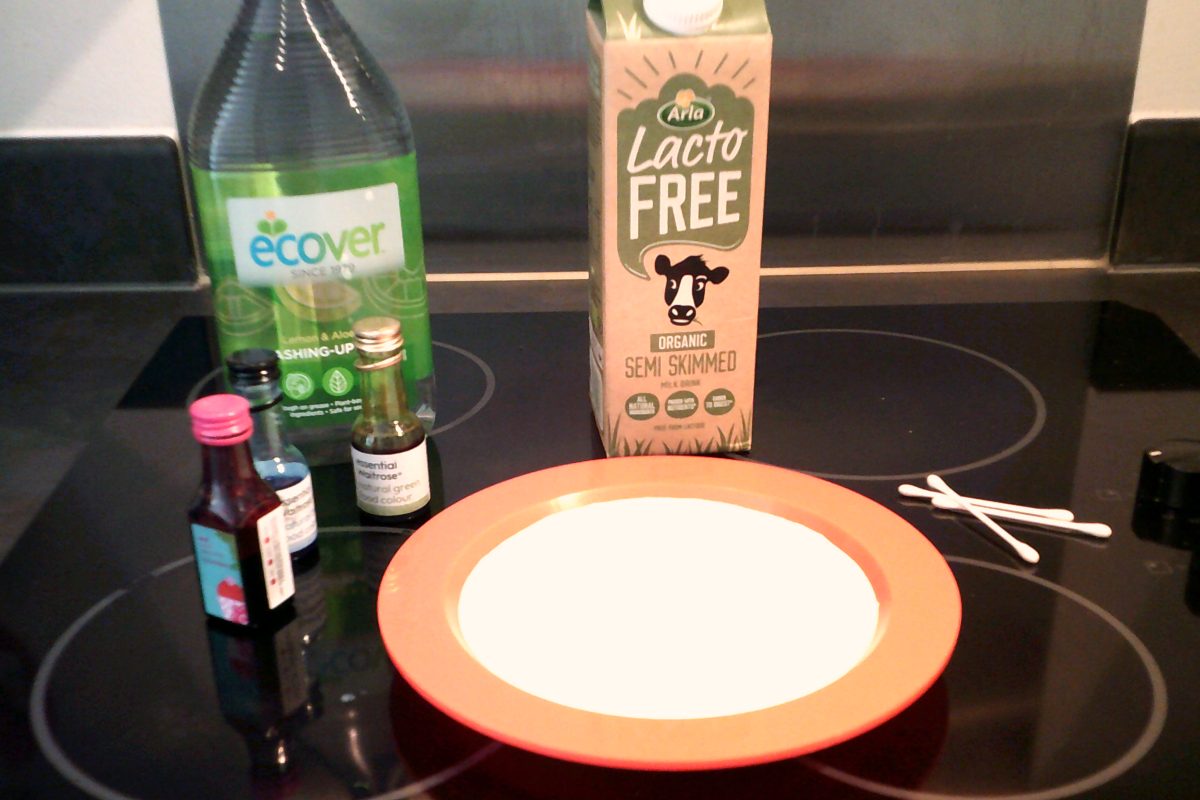
You will need:

  • 1 plate
  • milk
  • food colouring (2 to 4 colours)
  • washing-up liquid
  • 1 cotton bud

What to do:

  1. Pour the milk on the plate.
  2. Choose 2 to 4 colours of food colouring that you want to use.
  3. Add 8 to 10 drops of each food colour to the milk in different spots. (See image above.) Do NOT stir or mix.
  4. Put one drop of washing-up liquid on the end of your cotton bud.
  5. Hold the end of the cotton bud into the middle of the milk with the food colouring.
  6. Observe what happens.
  7. You can move the cotton bud around the plate to different places and observe what happens.

Where can we find acids and alkalis in nature?

Image: Richard Bartz, 2007. Bee stings contain formic acid and are slightly acidic. Wasp stings, on the other hand, are slightly alkaline.

What are acids and bases?

Before we delve into the different acids and bases found in nature, we need to be clear about what they actually are. In their simplest definition acids are solutions that have a pH below 7 and react with bases in neutralization reactions which means that the acid effect is cancelled out by the base. A more advanced explanation would add that acids release in hydrogen ions (H+) in water.

Bases are the chemical opposite of acids. Their pH values are above 7 and they react with acids in neutralization reactions. You may also have heard the word alkali being used for bases. Alkalis are bases that are soluble in water and release hydroxide ions (OH-). In this article we will use the word alkalis.

Food and digestion

There is one strong acid that you are carrying around with you all the time, the hydrochloric acid in you stomach. Your stomach acid is quite strong with a pH of 2. Its job is to break down food and kill pathogens that enter the digestive system. Pathogens are microorganisms like bacteria and viruses that can cause diseases.

Most of you will have heard that there is a lot of acid in citrus fruit like lemon. They contain an acid called citric acid which also gives them their sour taste. Lemon juice has a very acidic pH between 2 and 3. However, other fruits and vegetables contain acids too. For example, there is malic acid in apples. Tomatoes and pears contain citric acid as well as malic acid.

A sour taste will tell us if food or drinks are acidic. We can also tell from the taste if they are alkaline. The give-away for alkalis is a bitter taste. Examples of alkaline foods are leafy green vegetables like kale, spinach and parsley.

Insect bites and stings

So far we have only talked about beneficial acids and alkalis in food, drinks or our stomach. However, there are some unpleasant acids and alkalis to be found in nature as well.

Bee and ant venoms contain formic acid making their stings or bites slightly acidic contributing to the pain they cause. In fact, formic acid was first extracted from ants which lead to it being named after the Latin word for ant ”formica”. Nevertheless, we need to be aware that insect poisons are a mixture of different unpleasant substances that work together in a sting. Bees and ants do not rely on the formic acid in their venom alone.

Wasp venom, on the other hand, is slightly alkaline. Just like in bees and ants wasp poison too is a cocktail of various chemicals which contribute to the effect of a sting. Also wasps need other substances apart from the alkali in their venom.

The Chemistry of Making Jam

It is early autumn. Your fridge and freezer are overflowing with raspberries, black berries and other berries you have collected over the summer. What to do to make room? Make jam! Besides preserving fruits and berries, it is also great fun with some interesting chemistry involved. You can see the result of my first attempt to make jam from black berries I picked during late summer in the image above.

What do you need to make jam? You will need equal amounts of fruit and sugar in weight. I will refer to a recipe used for 1 kg of fruit and 1kg of sugar. The task of the sugar is to bind water and draw it away from the fruit. With no water available, no mould will be able to grow on jam which causes the preserving effect. As you can see, it is important to use enough sugar, but too much of it will lead to the formation of sugar crystals. In addition, acidity is needed, so the jam can set properly. Fruits naturally contain some acids, but more will have to be added for certain fruits like berries to reach the perfect pH for jam to set, which is at 2.8 to 3.3. To reach this pH-value, you can either add citric acid or use jam sugar where citric acid is already contained. I chose another method and added the lemon juce pressed from one lemon which naturally contains a lot of acid.

What happens after mixing together fruit, sugar and acid? The mixture is first heated and stirred until all the sugar has dissolved and the boiling point is reached. Then continue to boil gently for 15 to 20 minutes. What happens now is that the pectin molecules, which consist of long chains of sugar molecules linked together, react with each other to form a network of long chains. This reaction happens at 104.5 degrees Celsius and it gives jam its gel-like texture. Fruits contain pectin, but in different amounts. For example black berries that I chose to make my jam do not contain enough pectin to form a gel. In this case, jam sugar can be used, which contains pectin additionally to the citric acid. It is also possible to add one fruit that is high in pectin to the jam making process, which could be an apple or a citrus fruit. Instead, I decided to add four table spoons of grated lemon zest, which also contains pectin. In fact, pectin added to jam sugars is made from the peels of citrus fruit.

The jam is ready to pour into jars, when enough pectin molecules have reacted to form the gel-network. You can test when this point is reached by taking some of the jam up with a cold spoon and letting it cool. Then observe how the jam moves when you move the spoon around. It should just stick to the spoon and stay in one place, when the pectin network has set sufficiently. Make sure, to wash your glass jars with soap and hot water before using them. You can even heat them in an oven at 160 degrees Celsius for sterilization. To create a vacuum inside the glas jars, put them into a pan with hot water before filling them. Pour the jam into the jars when it is still hot, then screw the lit on and remove them from the hot water bath. As the glass jars cool, the vacuum will slowly come on. This is yet another precaution, to make the jam last as long as possible.

Making jam proved to be great fun for the chemist, the food enthsiast and the environmental activist inside me. It is a great way to preserve locally grown berries and fruits for the winter which is  much more environmentally friendly than buying berries in winter that have come all the way Chile or New Zealand. It is also better than having jam from a supermarket of which you have no idea where it comes from and under which conditions it has been been made. In addition, I found that opening a glass of my own home-made jam is far more exciting and satisfying.