Friction with Rice

You will need

  • 1 Plastic bottle (500 ml)
  • Rice (you can still eat it after the experiment)
  • 1 Funnel
  • 1 Chop stick or pencil

What to do

  1. Fill the plastic bottle to the rim with rice. You can use the funnel to help you.
  2. Pick up the bottle and hit its bottom against the table several times. This will compact the rice more and let air escape.
  3. There is some more room in the bottle now. Add more rice until it reaches the rim of the bottle.
  4. Now insert the chop stick or pencil into the rice. Push it down as far as you can.
  5. Take a hold of the chop stick or pencil and lift it up. What happens?

Background

There are different forces acting on the bottle. The force of weight or gravity pulls it down to Earth. When you insert the chop stick or pencil into the rice, there is an additional force of friction between the rice and the chop stick/pencil. The force of friction acts in the opposite direction of gravity.

If the forces of gravity and friction are equal, you are able to pick up the bottle when only holding on to the chop stick/pencil. If forces are equal and act in opposite directions, we say that they are balanced. In this experiment the forces of friction and of gravity are balanced.

You can watch a video of this experiment here:

Candle Experiment

You will need

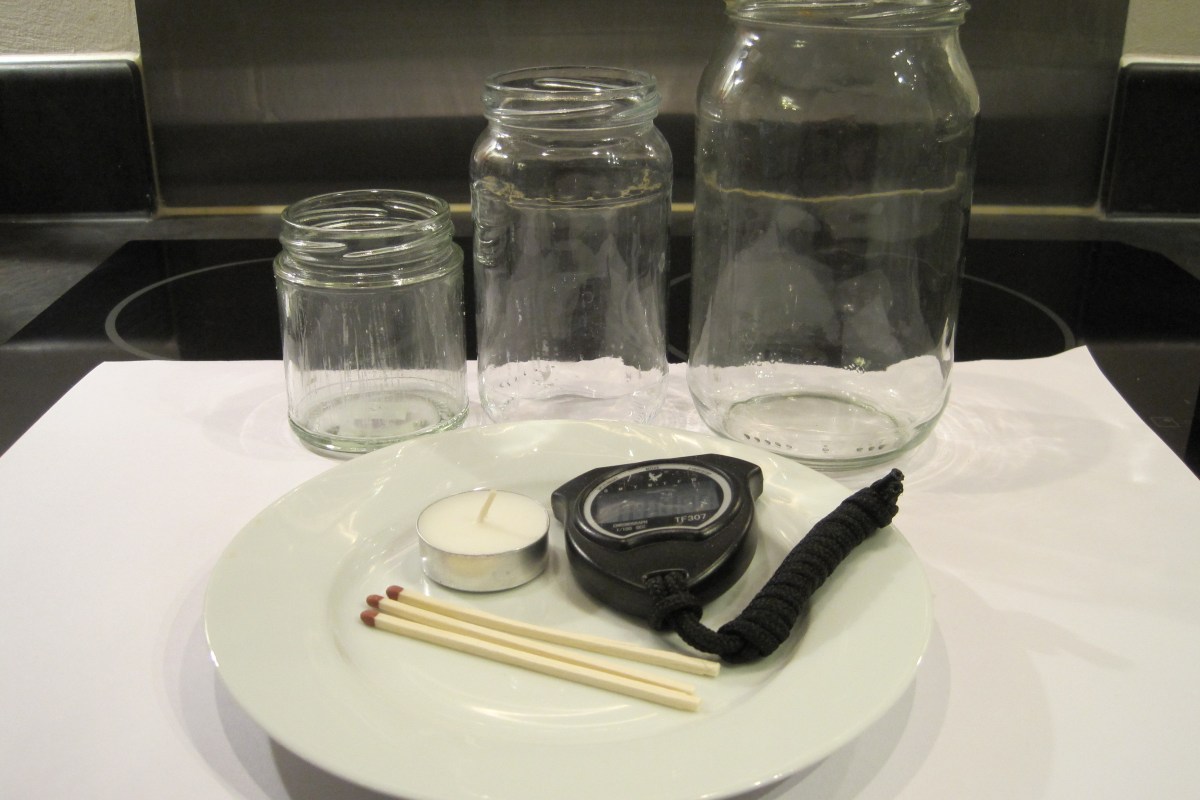
  • Candle
  • Matches or lighter
  • 3 Jars of different sizes
  • Heatproof base, for example a ceramic plate
  • Stopwatch/timer (your mobile phone will do)

What to do

  1. Put the candle on the heatproof base and light it.
  2. Put the smallest jar upside down over the candle and start the timer.
  3. Time how long it takes for the candle to go out and record the time.
  4. Repeat steps 2 and 3 for the medium sized jar and the large jar.
  5. Record for each candle how long it burns. Under which jar does the candle burn longest?

Background

Oxygen is needed for a fire to burn. This is also true for candles. The oxygen is normally supplied by the air.

When placing a jar over the candle, the amount of oxygen for the candle is limited. The candle goes out when all oxygen in the jar is used up. The amount of oxygen depends on the size of the jar.

Under which jar does the candle burn longest? Why do you think that is?

You can watch a video of this experiment here:
Build a Compass

You will need

  • Fridge magnet
  • Small bowl
  • Water
  • Needle
  • Piece of cork

What to do

  1. Rub the fridge magnet along the needle several times. You always need to move the magnet in the same direction along the needle. This is done to magnetize the needle and turn it into a temporary magnet.
  2. Gently push the needle through the middle of the cork. Be very careful not to sting yourself.
  3. Fill the bowl with water.
  4. Place needle and cork in the water.
  5. If left alone the needle will align in a North-South direction in the water. Just like a compass needle would.
  6. If you wish you can use the fridge magnet to manipulate the needle and move it in the water.

Background

Rubbing the fridge magnet along the needle magnetizes it and turns it into a temporary magnet. Temporary magnets only remain magnetic for a short amount of time. Permanent magnets like the fridge magnet are always magnetic.

When inserted into the cork and floating in water the needle acts like a compass. Earth has a magnetic field where the poles are located at the North and the South pole. Therefore, the needle will move to align in a North-South direction when floating in water.

You can watch this experiment as a video here:

Grow a Crystal

You will need

  • Short length of wool or string
  • Warm water
  • 2 Paperclips
  • 1 Plate
  • 1 Spoon
  • 2 Glass jars
  • Washing soda

What to do

  1. Fill both jars with warm water. (From the tap is fine.)
  2. Add washing soda to both jars and stir until no more washing soda dissolves.
  3. Attach a paperclip to each end of the string or wool.
  4. Place the ends of the string in the jars, so the string hangs between the jars.
  5. Place a plate between the jars to catch the drips of the solution flowing along the string or wool.
  6. Leave the jars for one to two weeks in a safe place and observe what happens.

Background

The washing soda solution slowly soaks the string or wool and flows along it. As the solution drips off some washing soda is deposited slowly forming a crystal.

Water flowing underground dissolves minerals when it seeps through rocks. The minerals are deposited when the water drips of a cave roof. A crystal is formed that hangs off the cave rood which we call “stalactite”. When the water drips to the floor it deposits minerals there forming a crystal growing up from the ground which we call “stalagmite”.

In your experiment a stalactite grows hanging from the string or wool.

You can watch a video of this experiment:

Combustion of Christmas Nuts

You will need

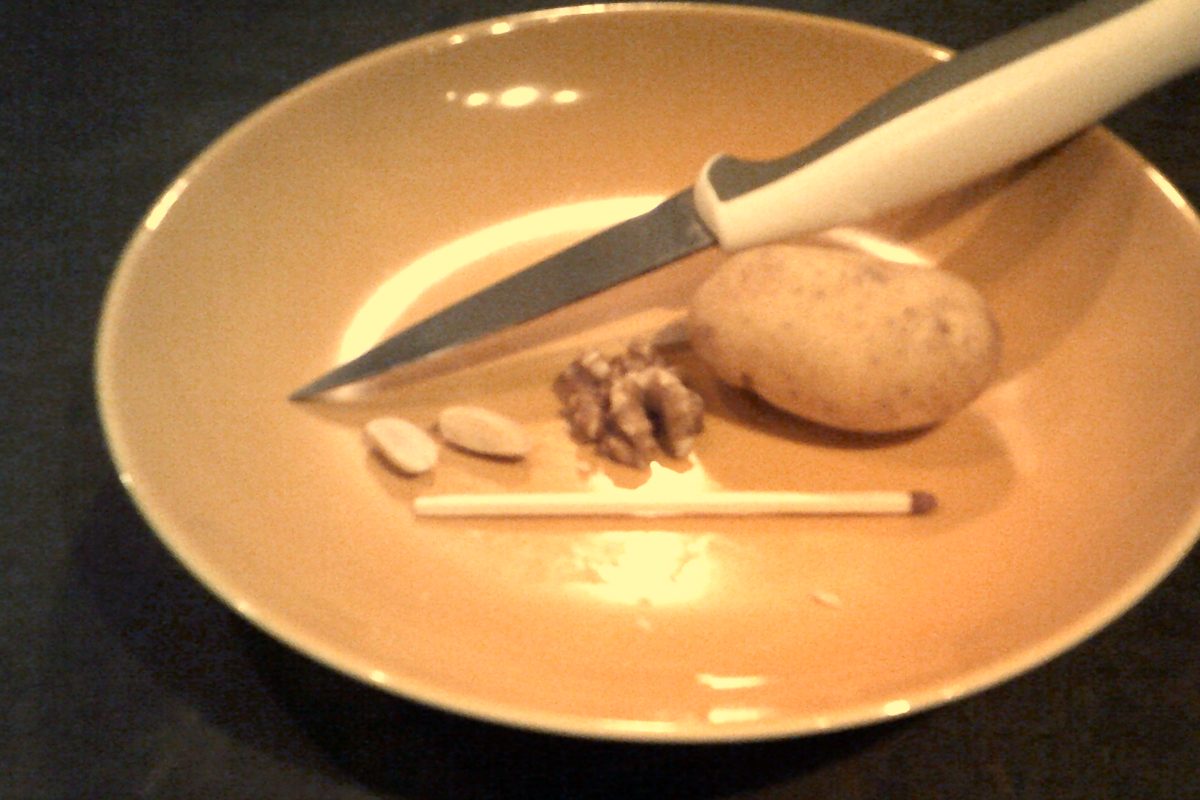
  • 1 Sharp knife
  • Matches
  • Heat proof surface, for example a pan or a ceramic plate
  • 1 Potato
  • 1 Peanut
  • 1 Almond
  • 1 Walnut
  • If you are allergic to nuts you can use sunflower and pumpkin seeds instead.

What to do

  1. Cut a potato into a long cylinder or a tall rectangular cube.
  2. Carefully cut a long thin strip from the peanut, almond and walnut.
  3. Stick 1 peanut strip into the top of the potato. The potato will hold the peanut while it is burning.
  4. Light the peanut strip with a match. Let it burn until it goes out.
  5. Repeat steps 3 and 4 with one almond and one walnut strip.
  6. Which nut burns longest? Which nut is easiest to light?

Background

Nuts contain oil that can be lit to create a fire. The oil and the oxygen from the air undergo a chemical change during the fire turning them into carbon dioxide gas and steam. This type of reaction producing a fire is called “combustion”.

The nut that lights fastest and burns longest contains most oil. Which nut contained most oil?

You can watch a video of the experiment here:

Make a Sound Gun

You will need

  • Plastic foil
  • Empty toilet roll
  • Scissors
  • Piece of cardboard
  • Thin strip of paper
  • Sharp pencil
  • Rubber band
  • Sticky tape

What to do

  1. Draw around the empty toilet paper roll to make a circle on the piece of cardboard.
  2. Cut out the circle from the cardboard.
  3. Use the sharp end of the pencil to make a tiny hole in the middle of the cardboard circle.
  4. Tape the circle to one end of the tube.
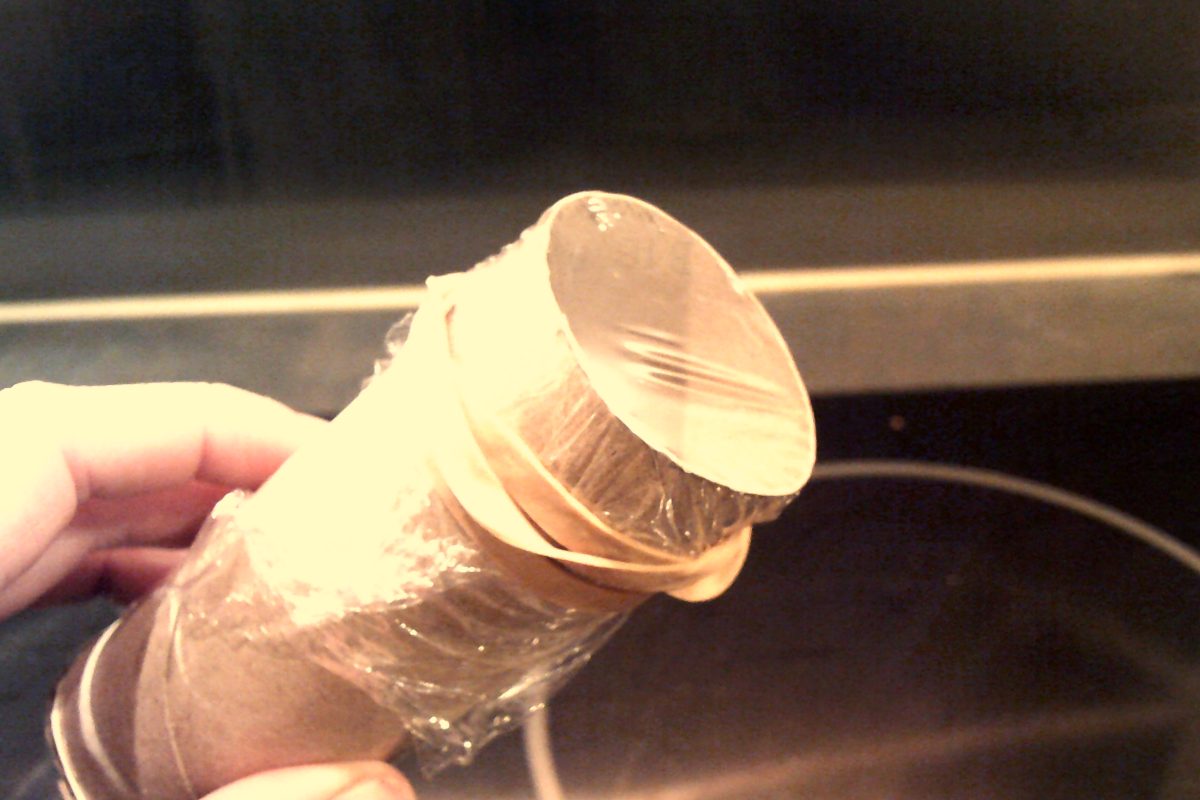
  5. Using the rubber band, fix a piece of plastic foil over the other end.
  6. Cut a thin paper strip, fold it and tape it to the top of the table.
  7. Point the end of the tube with the hole at the paper strip.
  8. If you tap the plastic the strip shakes.

Background

Sound waves are caused by vibrations and detected by our ears. The vibrations of loud sounds can even make things move which is shown by this experiment. Tapping the sound gun makes the paper strip shake.

Sound can even cause avalanches where snow and ice crash down a mountain. Sound waves from a loud noise disturb the snow and start it moving.

You can watch this experiment as a video here:

Godzilla Gummy Bears by Osmosis

You will need

  • 3 clear glasses or jars
  • 1 spoon
  • 2 cups of water
  • ½ cup of sugar
  • 1 package of gummy bears
  • 1 cup of juice
  • Post-it notes or pieces of paper and a pen for labelling

What to do

  1. Set three glasses or jars on the counter.
  2. Label one glass “water”, one “sugar water” and one “juice”
  3. Pour one cup of water into the glasses labelled “water” and “sugar water”.
  4. Pour one cup of juice into the last empty glass labelled “juice”.
  5. Add ½ cup of sugar to glass labelled “sugar water” and stir for 5 minutes.
  6. Put one gummy bear into each glass. Keep one gummy bear for comparison.
  7. Put the glasses in the fridge and leave the gummy bears to soak overnight.
  8. The next day use a spoon to take each gummy bear out of its glass.
  9. Compare the gummy bears to the one you left outside. What happened to them? You can even use a ruler to measure the gummy bears.
  10. All gummy bears are safe to eat. Compare how they feel when you eat them.

Background

Each liquid contained more water and less sugar than the gummy bears. The water went into the gummy bears to balance out the amount of water between the bears and the solution. This movement of water from a place with lots of water to a place with less water is called osmosis. For example, plant roots use osmosis to take up water from the soil.

The gummy bears swelled up because water moved into them through osmosis. The larger the bear, the more water moved into it. How was osmosis different for the three liquids used?

You can watch a short video of this experiment here:

Home Experiment: Colour Changing Celery

You will need

  • 2 tall, clear glasses or jars
  • Knife
  • Food colouring (you choose the colour)
  • 2 long celery sticks
  • Water

What to do

  1. Fill two tall, clear glasses with water.
  2. Put 3 – 4 drops of food colouring in each glass.
  3. Wash two long celery sticks.
  4. Use the knife to cut the bottom 3 cm and top 5 cm off each celery sticks.
  5. Place one celery stick into a glass of coloured water immediately. There should be at least 3 cm of celery sticking up above the water.
  6. Set the other celery stick on the counter to dry for 30 minutes.
  7. After 30 minutes, place the second celery stick into the second glass of coloured water. There should be at least 3 cm of celery sticking up above the water.
  8. Let both celery sticks soak overnight.
  9. Observe what happens over the next two days.

Background

Water is very important for plants. They use it for photosynthesis in their leaves to make their own food. The water that is used up in the leaves is taken from the soil and moves up through the plants – defying gravity! This movement of water in plants is called “transpiration”.

In this experiment, you can observe the water movement by tracking the coloured water in your celery. Do you think water movement in plants works better in dry or wet plants?

You can watch a short video with this experiment here:

Home Experiment: Underwater Volcano

You will need:

  • Small bottle
  • Large glass jar
  • Scissors
  • Hot and cold water
  • Red food colouring
  • String

What to do:

  1. Cut a long piece of string.
  2. Tie the string firmly around the neck of the bottle.
  3. Pour cold water into the large glass jar until it is about three quarters full.
  4. Fill the small bottle with hot water. Add food colouring to make the water bright red.
  5. Hold the small bottle by the loop of string. Lower it gently into the jar with cold water.
  6. The hot red water rises from the bottle like smoke from an erupting volcano.

Background:

Hot water is less dense than cold water and always rises to the surface. Cold water floats underneath. This is the reason why the hot red water rises to the surface, making your experiment look like an erupting volcano.

There are deep holes in the ocean floor. Water, heated by rocks deep in the Earth’s crust shoots out of these holes and rises to the surface of the sea. Divers have discovered strange sea creatures that live around these hot-water holes.

You can watch this experiment as a video here:

Home Experiment: Build a Jet

You will need:

  • Long string
  • Sticky tape
  • Balloon
  • Drinking straw
  • Scissors

What to do:

  1. Cut a very long piece of string.
  2. Feed the string through the straw. It must move easily.
  3. Stretch the string across a room and tie its ends to suitable places, for example a door handle or a chair.
  4. Stick two pieces of tape to the straw.
  5. Blow up the balloon. Hold the neck and attach the balloon to the straw. The air must not escape.
  6. Let go of the balloon. It rushes along the thread at high speed.

Background

The balloon produces a jet of air which drives the balloon forwards. It works the same way as jet engines on airplanes. These engines produce powerful jet of air that drives the airplane forwards.