M&M Diffusion Experiment

Background

Diffusion is the movement of particles from a place of high concentration to a place of low concentration. We can also say that particles move from where there are lots of particles to where there are less particles.

In this experiment we are going to look at the diffusion of colour particles. You will observe the colour moving away from the sweets where lots of colour particles are found to places with less colour particles in the middle of the plate.

You will need

  • M&Ms or Smarties
  • Plate
  • Water

What to do

  1. Once you start this experiment, you cannot move it. So, make sure you choose a good spot to start.
  2. Pour the bag of M&Ms or Smarties onto your plate.
  3. Remove the sweets that landed in the middle of your plate.
  4. Place the remaining sweets in a circle around the outside of your plate.
  5. Remove any remaining M&Ms or Smarties that do not fit in the circle.
  6. Slowly add water to your plate. It needs to reach the M&Ms, but they should not float. From now on you cannot move the experiment.
  7. Observe what happens to the colour of the sweets.

You can also watch this experiment on YouTube:

Static Electricity at Home

Background

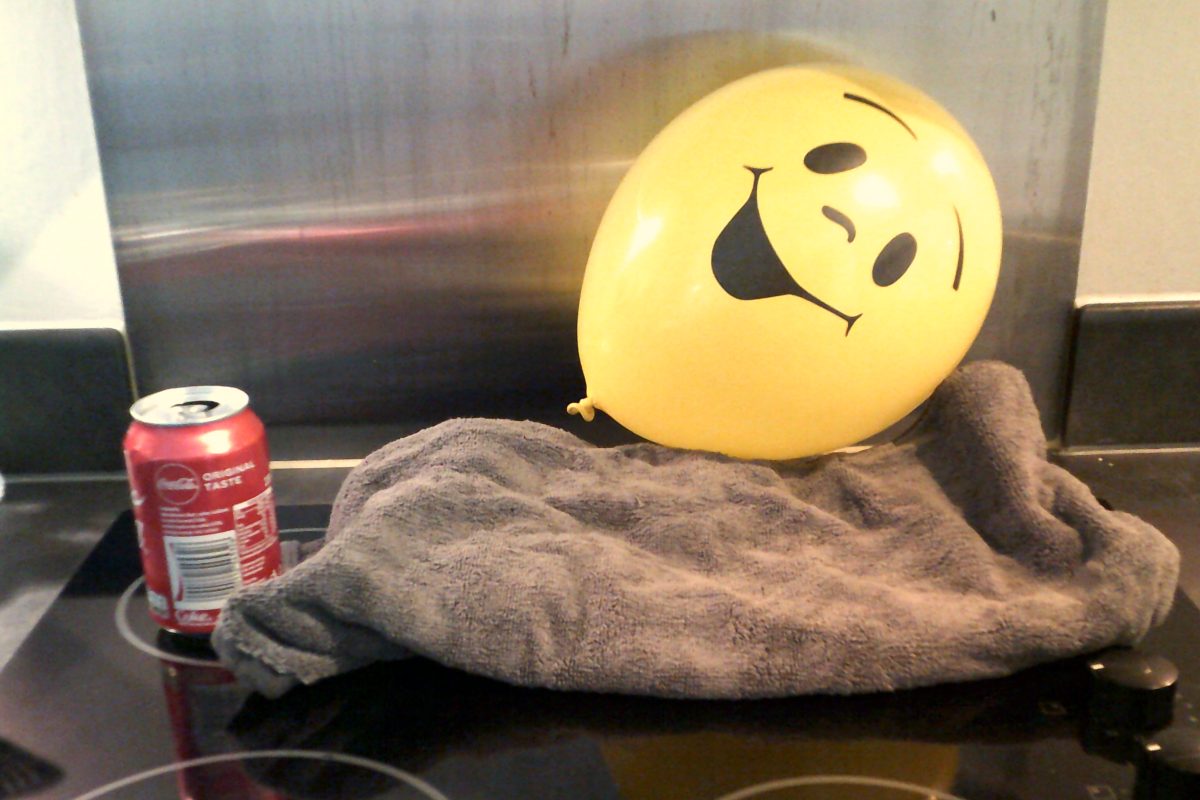
When a balloon is rubbed against hair, a towel or a jumper, it gains more electrons which have a negative charge. This gives the balloon an overall negative charge. Objects with a positive charge or no overall charge like a tin can will now be attracted (= be drawn) to the balloon. We call this “static electricity”.

You will need

  • Balloon
  • Towel, jumper or your hair
  • Empty soda can
  • Water tap
  • A smooth surface, e.g. a table

What to do

  1. Blow up the balloon.
  2. Put the empty soda can on its side on a smooth surface.
  3. Rub the balloon on a towel, jumper or your hair to create static electricity.
  4. Hold the balloon close to the side of the soda can, but do not let them touch.
  5. Slowly move the balloon away from the soda can along the surface.
  6. Observe what happens.
  7. Rub the balloon again on a towel, jumper or your hair.
  8. Open the water tap, so that only very little water is running. It should be almost dripping.
  9. Hold the balloon close to the water, but do not let the balloon touch the water.
  10. Observe what happens.

You can also watch this experiment here:

Rainbow in a Glass

Background

Density tells you how heavy a certain volume of a substance is. It decides which materials can float on water and which sink. For example, a rock will sink because its density is higher that the density of water. However, wood floats because its density is lower than that of water.

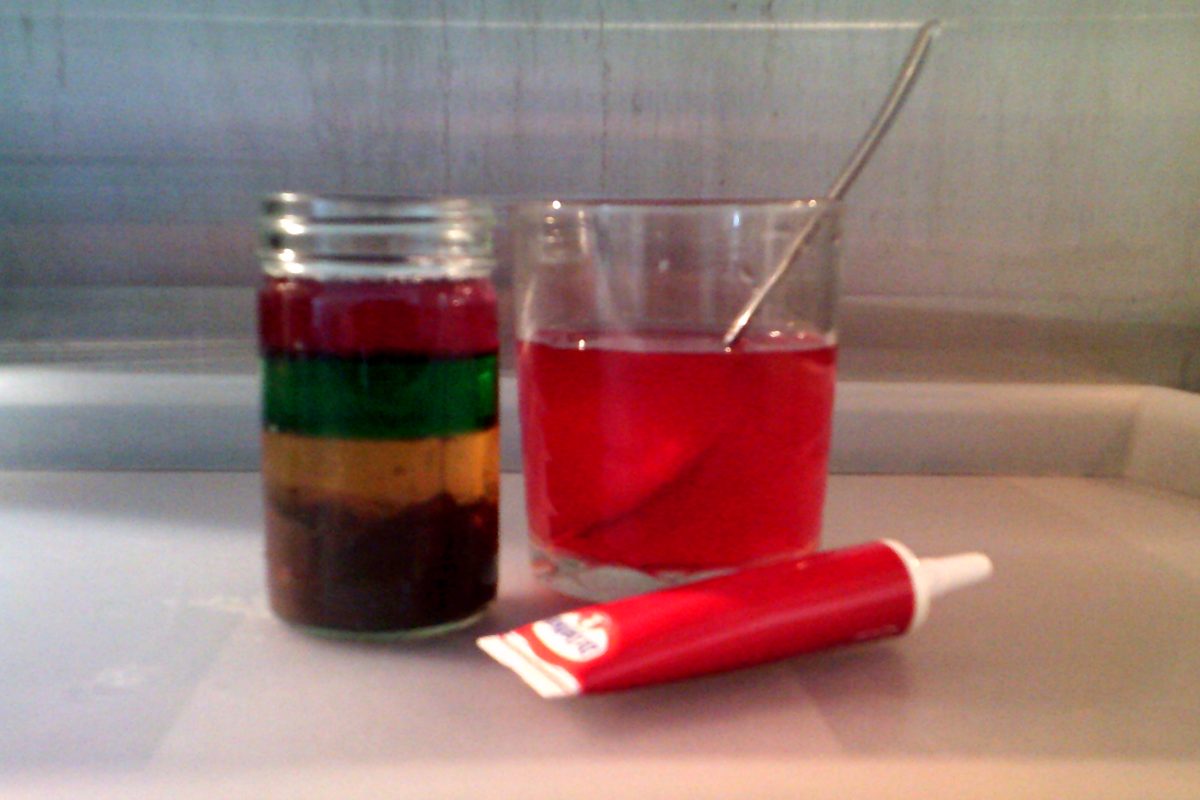
The same is true for liquids. Liquids with high densities sink, while liquids with lower densities float. We are going to use this to make a rainbow in a glass. Chocolate sauce has a highest density of the four liquids and will stay at the bottom. However, water has the lowest density and will, therefore, float on top.

You will need

  • 1 Glass
  • 1 Spoon
  • Chocolate sauce
  • Honey
  • Washing up liquid
  • Water
  • Red food colouring

What to do

  1. Start by pouring chocolate sauce into your glass until it is one quarter full.
  2. Use the spoon to carefully add the honey until your glass is half full. Do NOT stir!
  3. Now add the washing up liquid slowly and until your glass is three quarters full.
  4. In a separate glass mix water with red food colouring.
  5. Carefully add the water dropwise until your glass is full. Do NOT stir!

You can watch this experiment as a YouTube video:


Lemon Volcano

You will need

  • 1 plate or tray
  • 1 lemon
  • 1 cutting knife (to cut the lemon)
  • 1 butter knife
  • Baking soda
  • 1 table spoon
  • Food colouring (1 to 4 colours of your choice)

What to do

  1. Cut your lemon in half. Then cut of a bit at the bottom, so that the lemon can now stand up.
  2. Place the lemon on the plate or tray with the wide side facing up.
  3. Use the butter knife to poke holes in the flesh.
  4. Add 8 to 10 drops of food colouring spread out over the lemon.
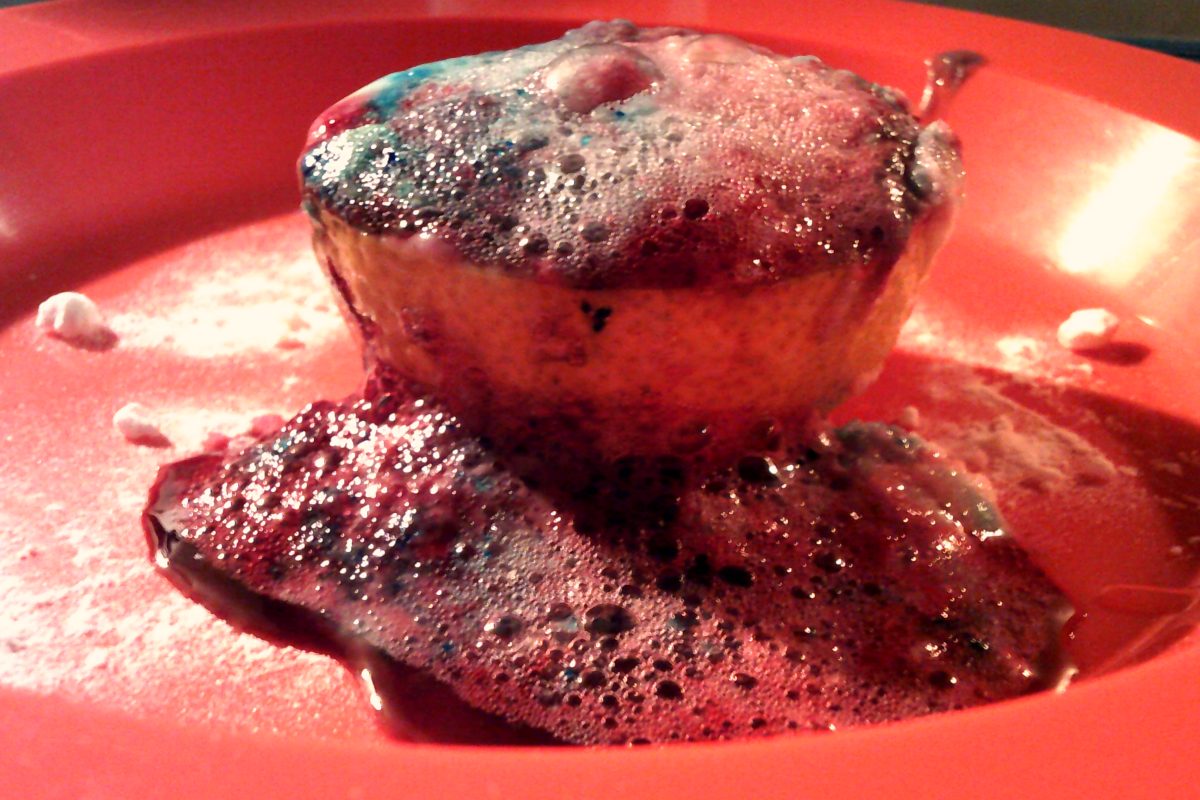
  5. Add 1 heaped table spoon of baking soda.
  6. Poke with the butter knife to mix the baking soda with the lemon juice.

The acid in the lemon reacts with the baking soda to form salt, water and carbon dioxide gas. The carbon dioxide gas will cause fizzing. We also call this effervescence.

You can watch this experiment on YouTube:

Coke and Mentos Fountain

Background

Catalysts are substances that speed up chemical reactions. However, they do not directly take part in the reaction and are not used up themselves.

Cars contain catalysts in catalytic converters that split toxic substances released by the car’s engine into less harmful ones.

The gas bubbles inside coke are the result of a chemical reaction where carbonic acid decomposes to water and carbon dioxide gas. The bubbles you feel when drinking coke are carbon dioxide. The word equation for this reaction is:

Carbonic acid → Water + Carbon dioxide

Carbonic acid is the reactant. Water and carbon dioxide are the products.

Mentos can act as a catalyst and increase the speed of carbon dioxide production. This causes the foaming you can see when adding Mentos to coke. The scientific word for bubbles, fizzing or foaming is effervescence.

You will need:

  • 1 bottle with coke or diet coke (Normal coke and diet coke both work, but diet coke is less sticky and easier to clean up afterwards.)
  • 1 pack of Mentos

What to do:

  1. Go outside to do this experiment.
  2. Put the coke bottle on the floor and remove the lid.
  3. Put about 5 pieces of Mentos inside at the same time.
  4. Step back and watch.
  5. You should see a lot of foaming due to the increased carbon dioxide production.

Questions

  1. What is meant by a “catalyst”?
  2. What is the catalyst in this reaction?
  3. Is the Mentos used up in this reaction or not? Why?
  4. What is meant by the “reactant” in a reaction? What is the reactant in this reaction?
  5. What is meant by the “product” in a reaction? What are the products in this reaction?
  6. Where are catalysts used in our everyday lives?
  7. What is meant by “effervescence”?

You can watch this experiment on YouTube:

Reacting Vinegar and Baking Soda

You will need:

  • Baking soda (= alkali)
  • Vinegar (= acid)
  • 1 empty, clean bottle
  • 1 spoon
  • 1 balloon

What to do:

  1. Fill the bottle about one third with vinegar (your acid).
  2. Use the spoon to fill the balloon with baking soda (your alkali). You might need another person to help you and hold the balloon open.
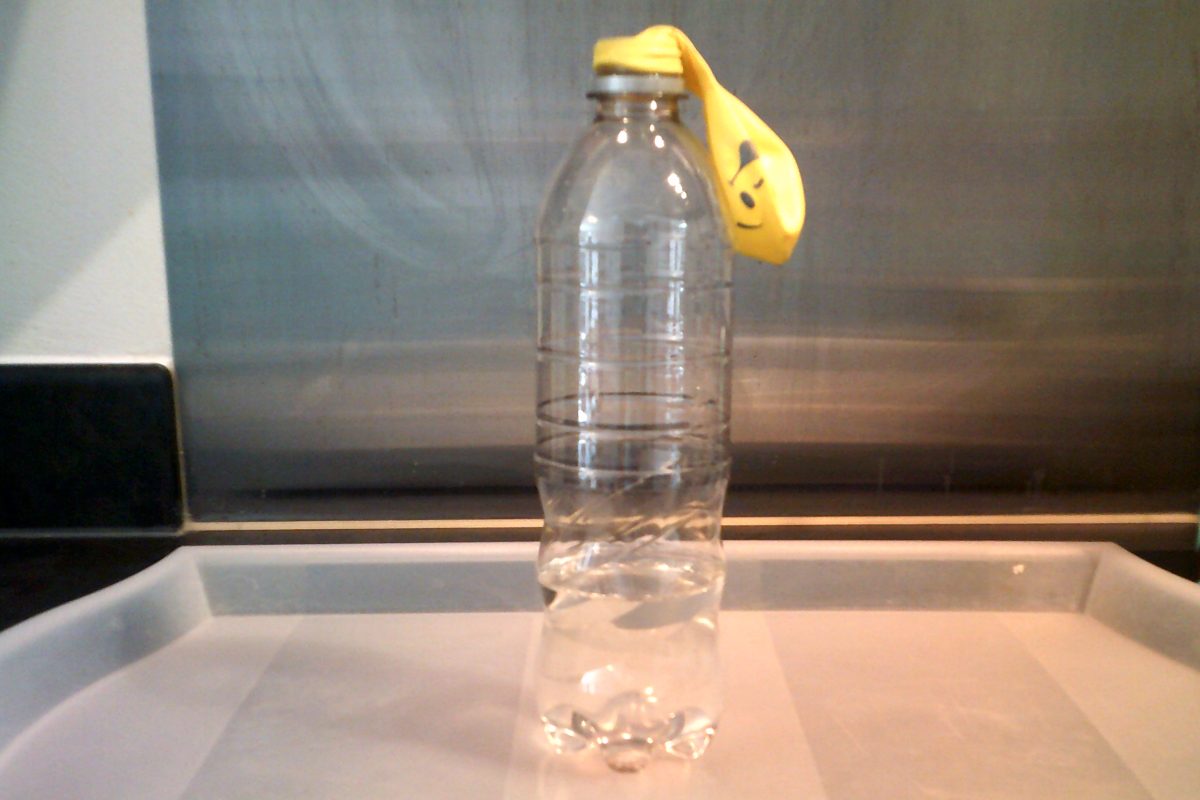
  3. Put the opening of the balloon over the opening of the bottle. (See image above.)
  4. Now tip the baking soda from the balloon into the bottle.
  5. A neutralization reaction will take place where the acid and alkali react to form the products salt, water and carbon dioxide. All three products are neutral substances. Observe what happens.

Questions

  1. Which signs do you see that tell you a chemical reaction is happening?
  2. What happens generally in a neutralization reaction?
  3. Which two products are formed in the neutralization reaction?
  4. Which colour would the following have when adding universal indicator?                   A) Vinegar          B) Baking soda       C) The products after the reaction

You can watch this experiment on YouTube:

Disappearing Egg Shell

Background

In this experiment you will use vinegar to dissolve the shell of a raw egg. Vinegar is an acid and egg shells are made from calcium carbonate. Acids react with metal carbonates like calcium carbonate to form salt, water and carbon dioxide gas. The metal carbonate is dissolved in the process. You can find the word equation below.

Acid + Metal carbonate → Salt + Water + Carbon dioxide

You will be able to observe gas bubbles because carbon dioxide gas is formed. We also call this “effervescence”. The egg shell will dissolve leaving behind the raw egg in its membrane.

You will need:

  • Vinegar (= acid)
  • 1 raw egg
  • 1 glass

What to do:

  1. Place the raw egg carefully in the glass.
  2. Fill the glass with vinegar until the egg floats.
  3. Observe what happens on the egg shell. You should see effervescence.
  4. Leave your experiment for three days in a cool, safe place.
  5. After three days remove the egg from the vinegar and carefully dry it with kitchen roll paper.
  6. Take the egg in your hand and squeeze it gently. What does it feel like?

You can watch this experiment on YouTube:

Colourful Milk Experiment

You will need:

  • 1 plate
  • milk
  • food colouring (2 to 4 colours)
  • washing-up liquid
  • 1 cotton bud

What to do:

  1. Pour the milk on the plate.
  2. Choose 2 to 4 colours of food colouring that you want to use.
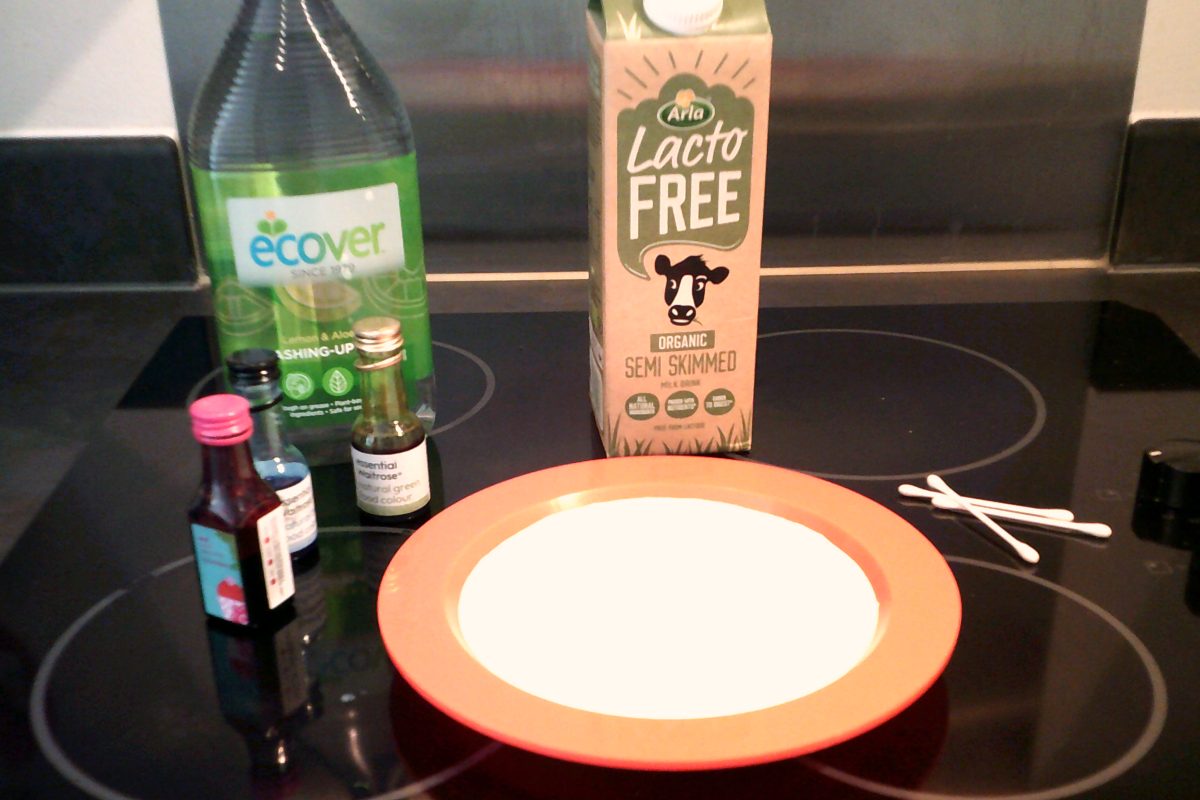
  3. Add 8 to 10 drops of each food colour to the milk in different spots. (See image above.) Do NOT stir or mix.
  4. Put one drop of washing-up liquid on the end of your cotton bud.
  5. Hold the end of the cotton bud into the middle of the milk with the food colouring.
  6. Observe what happens.
  7. You can move the cotton bud around the plate to different places and observe what happens.

How to build a hovercraft

You will need:

  • 1 balloon
  • 1 plastic pull-out bottle cap
  • All-purpose glue or hot-glue gun (if you don’t have this, tape will do)
  • 1 old CD

What to do:

  1. Glue the plastic pull-out bottle cap over the hole in the middle of the CD using all-purpose glue or tape. If you are using all-purpose glue, ask an adult to help you and let the glue dry off.
  2. Blow up a balloon.
  3. Make sure the pull-out cap is open.
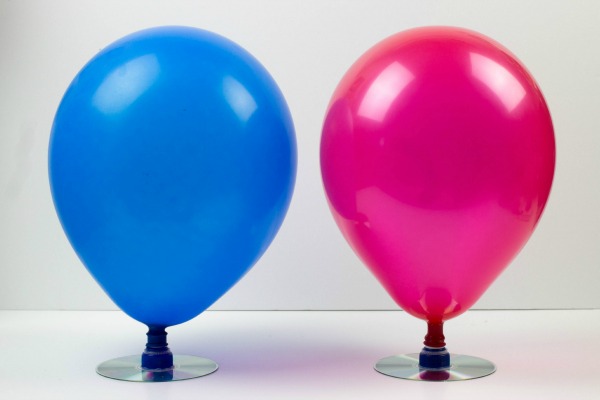
  4. Attach the balloon to the pull-out cap by stretching its opening over the cap. (See image above.)
  5. Put the craft on a table with the CD facing down and the balloon up.
  6. The air escaping from the balloon will produce an air cushion underneath the CD. This reduces the friction between the table and the CD and your hovercraft will move over the table very fast.
  7. Your hovercraft will speed along until it runs out of air and you have to blow the balloon up again.

Investigating Pressure with a Plastic Bottle – Experiment

Introduction

Air is made from gas particles. They constantly move around at a high speed. When speeding around like this, the particles often collide with the walls of their containers. For example, the air particles in a balloon move around and hit the balloon’s walls. These collisions cause the balloon to stay inflated. We call this gas pressure.

There are two ways to affect gas pressure. One is to change the number of air particles. When you blow up a party balloon, you add more air particles to it. More gas particles hit the walls more often and the balloon’s pressure increases.

The second method to increase pressure is by raising the temperature. When it is warmer, the gas particles have more energy and move faster. If the particles move faster, they hit with the walls more often and the pressure increases. When decreasing the temperature by cooling, the gas pressure will decrease.

In this experiment we are going to look at what happens to the pressure inside a plastic bottle when you cool down the temperature.

What you will need

  • 1 empty plastic bottle (a small bottle is enough, 500 ml or even smaller)
  • Freezer

What to do

  1. Remove the lid and put the empty plastic bottle in the sun or on the radiator to heat up a bit.
  2. Close the lid tightly, so nor more air can move in or out of the bottle.
  3. Put the bottle in the freezer and wait for one hour.
  4. Collect the bottle from the freezer. What has happened to it? Take notes.
  5. Now observe the bottle for a couple of minutes after taking it out of the freezer.

Questions

1. What happened to the bottle in the freezer?

2. Why did this happen? Look back at the introduction to find some clues.

3. What happened to the bottle after you took it out from the freezer?

4. Why did this happen? Look back at the introduction to find some clues.

5. Why was it important to close the lid tightly before putting the bottle into the freezer?

6. How could you improve this experiment?